
Visual Theology – Bible Prophecy Charts
The Visual Theology charts are designed to help you see the structure and movement of Scripture. They highlight patterns, contrasts, and developments that are often difficult to hold together when reading line by line.
These charts show the structure of the argument. The accompanying articles develop each part in full.
This approach follows a long tradition of visual teaching in the Church. The well-known charts of Clarence Larkin helped many grasp the broad outline of Scripture. In the same spirit, these charts aim to make visible what the Word of God is revealing.
Charts and teaching notes for the book of Bible Prophecy Charts. Select a chart below to view the image and article.
Click chart to view larger
From the teaching in: The Master Key: Daniel's 70th Week
The Dangers of Date-Setting
The Dangers of Date-Setting
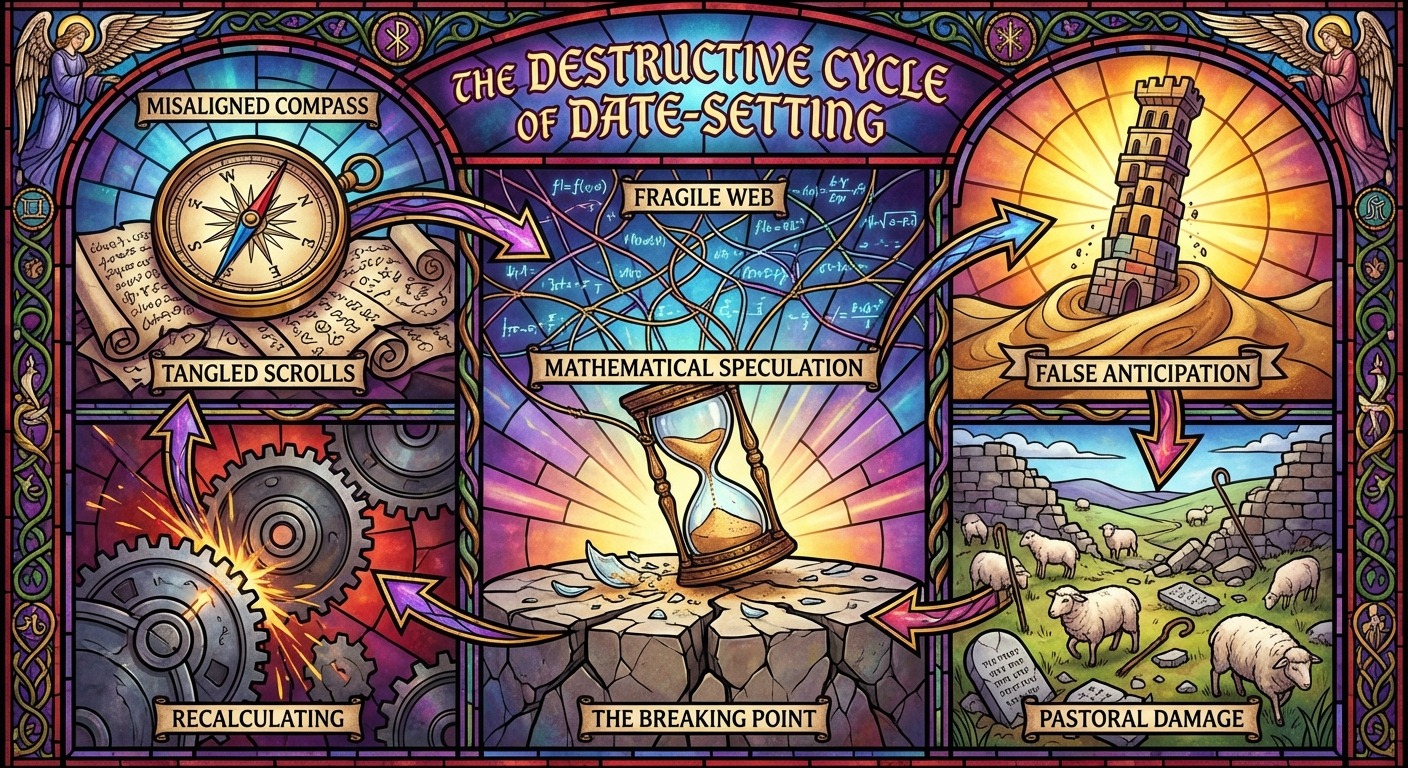
This chart shows the structure. What follows explains each part.
After mapping the signs of the approaching kingdom, the temptation is immediate and understandable: if we know the seasons, perhaps we can narrow the timing -- if not the day or the hour, then perhaps the year, the decade, the generation. That temptation has a long and consistently devastating track record in church history, and it is not a peripheral concern but a direct contradiction of something Jesus stated explicitly and unambiguously. This article does not approach date-setting as a minor methodological error; it approaches it as a spiritual hazard with real pastoral consequences -- communities destabilized, faith damaged, the gospel obscured -- and asks why, if the prohibition is this clear, it keeps reappearing.
After mapping the signs of the approaching kingdom, the temptation is immediate and understandable: if we know the seasons, perhaps we can narrow the timing -- if not the day or the hour, then perhaps the year, the decade, the generation. That temptation has a long and consistently devastating track record in church history, and it is not a peripheral concern but a direct contradiction of something Jesus stated explicitly and unambiguously. This article does not approach date-setting as a minor methodological error; it approaches it as a spiritual hazard with real pastoral consequences -- communities destabilized, faith damaged, the gospel obscured -- and asks why, if the prohibition is this clear, it keeps reappearing.
The Peril of Prophetic Date-Setting
Throughout church history, the temptation to assign specific dates to Christ’s return has ensnared many well-meaning believers. From the fervor of the Montanists in the early centuries to the disappointed followers of William Miller in the 1840s, and most recently Harold Camping’s failed predictions, the pattern remains unchanged: every attempt at prophetic date-setting has been proven wrong. This is not a mere historical curiosity—it is a recurring spiritual hazard that leaves real damage in its wake.
The Unchanging Prohibition
The consistent failure of these predictions is not surprising when we consider Jesus’ own words. In Matthew 24:36, He could not be more explicit: “But of that day and hour knoweth no man, no, not the angels of heaven, but my Father only.” Yet, despite this clear prohibition, each generation produces its own cycle of date-setters. What follows is often a mechanical progression—teachers identify a significant event, calculate a prophetic timeline using biblical numbers or patterns, and then build anticipation among their followers through books, conferences, or media. When the predicted date passes uneventfully, the cycle resets, leaving a trail of spiritual confusion and disappointment.
The Real-World Fallout
The fallout from such speculation is not limited to embarrassment. The spiritual and pastoral consequences are profound. When Miller’s prediction of Christ’s return in 1844 failed, thousands of his followers experienced what history calls “The Great Disappointment.” Many lost their faith entirely. In more recent times, followers of Harold Camping sold possessions, quit jobs, and upended their lives in anticipation of a rapture that never came. The aftermath was a wake of disillusionment and damaged testimonies, as believers grappled with the collapse of the prophetic frameworks in which they had invested so much hope.
This cycle of prophetic speculation—sometimes called “Rapture Bingo”—does more than disappoint. It undermines the credibility of Scripture itself, both in the eyes of believers and skeptics. When predictions repeatedly fail, immature believers may feel their faith shaken to the core, with some abandoning Christianity altogether. The world, observing these failed prognostications, finds further grounds to dismiss the message of the gospel. Most tragically, the beautiful hope of Christ’s return is recast as a matter of sensationalism rather than sound doctrine, robbing the Church of the comfort and motivation that biblical prophecy is meant to provide.
Personal stories bear witness to this damage. Some, after investing emotionally and spiritually in a specific prophetic timeline, describe feeling “spiritually adrift” when those predictions fail. Others find that their testimony before family and friends is permanently undermined, as their previous certainty about a rapture date becomes a source of ridicule and skepticism. These are not isolated incidents but represent a broader pastoral reality that flows from the error of date-setting.
The Biblical Call: Watchfulness, Not Speculation
The New Testament’s warnings are clear. Jesus’ command is not to speculate about the timing of His return, but to live in a state of watchfulness and eager anticipation. The hope of Christ’s appearing is meant to inspire purity and godliness, not anxiety or sensationalism. As Paul writes in Titus 2:13, we are to be “Looking for that blessed hope, and the glorious appearing of the great God and our Saviour Jesus Christ.” John echoes this in 1 John 3:2-3: “Beloved, now are we the sons of God, and it doth not yet appear what we shall be: but we know that, when he shall appear, we shall be like him; for we shall see him as he is. And every man that hath this hope in him purifieth himself, even as he is pure.” The anticipation of Christ’s return is not a license for speculative calculation, but a summons to holy living.
When the Church loses sight of this distinction—when watchfulness is replaced by date-setting—the result is not a stronger faith, but a weakened and confused body of believers. The credibility of the prophetic word is not enhanced by speculation, but by sober adherence to what God has actually revealed. As 2 Peter 3:14 exhorts, “Wherefore, beloved, seeing that ye look for such things, be diligent that ye may be found of him in peace, without spot, and blameless.”
A Pastoral Conclusion
In the end, the dangers of date-setting are not merely theoretical; they are deeply pastoral. The Church is called to wait expectantly, not anxiously, for her Lord. The hope of His return is a source of comfort and motivation for godly living. When that hope is distorted by speculative timelines and failed predictions, the damage is real, and the witness of the gospel is compromised. True biblical prophecy, rightly understood, leads not to sensationalism but to steadfast faith, patient endurance, and an unwavering hope in the One who has promised, “Surely I come quickly. Amen. Even so, come, Lord Jesus” (Revelation 22:20).
The danger of date-setting has been examined and its prohibition established -- not merely as a practical caution but as a command with theological weight: no one knows the day or the hour except the Father. That prohibition does not eliminate prophetic watchfulness; it defines it. And if we are not watching for dates, the question becomes: what exactly are we watching for, and how should that watchfulness shape the way we actually live? That is the territory of proper prophetic application, which is addressed next.
The danger of date-setting has been examined and its prohibition established -- not merely as a practical caution but as a command with theological weight: no one knows the day or the hour except the Father. That prohibition does not eliminate prophetic watchfulness; it defines it. And if we are not watching for dates, the question becomes: what exactly are we watching for, and how should that watchfulness shape the way we actually live? That is the territory of proper prophetic application, which is addressed next.
Every chart in this series is free to explore online.
 Get the full chart set (PDF – $8)
Members get all PDFs included → Why Membership
Log in with an active membership to download printable PDFs on this site. Purchased on the shop? Access downloads from your shop account.
If you would like to help fund this work:
These charts are based on the following book:

The Master Key: Daniel's 70th Week
The Bible's Framework for Understanding Prophecy - 230 Page Paperback Edition
View Related Book