
Visual Theology – Bible Prophecy Charts
The Visual Theology charts are designed to help you see the structure and movement of Scripture. They highlight patterns, contrasts, and developments that are often difficult to hold together when reading line by line.
These charts show the structure of the argument. The accompanying articles develop each part in full.
This approach follows a long tradition of visual teaching in the Church. The well-known charts of Clarence Larkin helped many grasp the broad outline of Scripture. In the same spirit, these charts aim to make visible what the Word of God is revealing.
Charts and teaching notes for the book of Bible Prophecy Charts. Select a chart below to view the image and article.
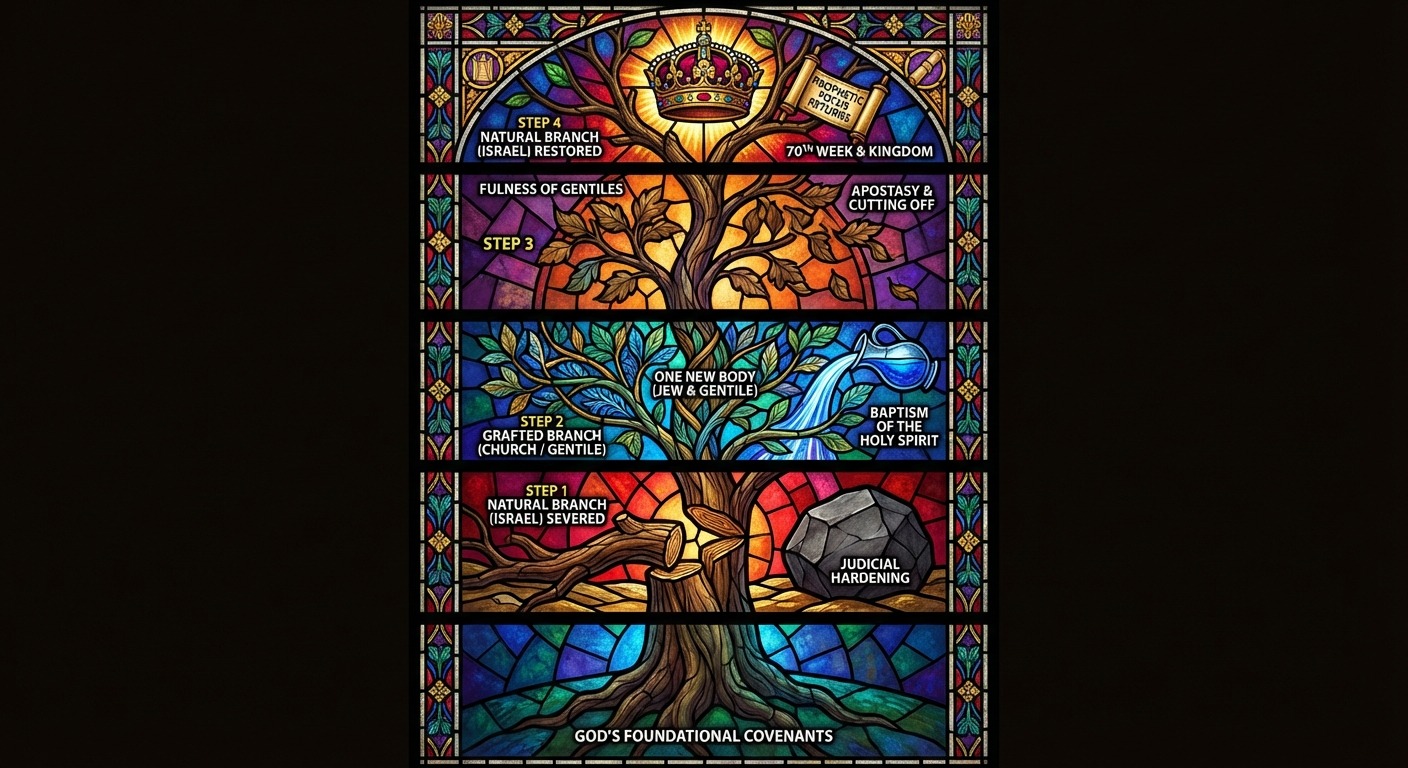
Click chart to view larger
From the teaching in: The Master Key: Daniel's 70th Week
The Pauline Revelation of the Mystery
The Pauline Revelation and the Gentile Branch
This chart shows the structure. What follows explains each part.
If Daniel was the instrument through whom God gave the chronological skeleton of His prophetic plan, Paul was the instrument through whom God explained what was living inside the skeleton -- specifically, what was living inside the gap. The mystery Paul describes in Ephesians 3 is not a minor addendum to the Old Testament program; it is a revelation that was explicitly hidden from the prophets, deliberately withheld, and then disclosed through Paul as the explanation for why the seventieth week did not follow the sixty-ninth. Understanding Paul's specific stewardship of this mystery -- and the particular shape of the entity he describes -- is essential for anyone who wants to read the rest of the prophetic argument without importing Israel's program into the Church's or the Church's into Israel's.
If Daniel was the instrument through whom God gave the chronological skeleton of His prophetic plan, Paul was the instrument through whom God explained what was living inside the skeleton -- specifically, what was living inside the gap. The mystery Paul describes in Ephesians 3 is not a minor addendum to the Old Testament program; it is a revelation that was explicitly hidden from the prophets, deliberately withheld, and then disclosed through Paul as the explanation for why the seventieth week did not follow the sixty-ninth. Understanding Paul's specific stewardship of this mystery -- and the particular shape of the entity he describes -- is essential for anyone who wants to read the rest of the prophetic argument without importing Israel's program into the Church's or the Church's into Israel's.
The Mystery of the Church
The apostle Paul was entrusted with a unique stewardship—a divine revelation that he described as "the mystery." This mystery, as Paul declares in Ephesians 3:6, is "That the Gentiles should be fellowheirs, and of the same body, and partakers of his promise in Christ by the gospel." What was once hidden through the ages was now made manifest: God was forming a new entity, the Church, in which both Jews and Gentiles would be united into one body, sharing equal standing before God. This was not a mere extension or improvement of Israel, nor was it a replacement. The Church is an entirely new creation, inaugurated at Pentecost with the baptism of the Holy Spirit.
Prior to Pentecost, nothing like the Church had ever existed. In 1 Corinthians 12:13, Paul writes, "For by one Spirit are we all baptized into one body, whether we be Jews or Gentiles, whether we be bond or free; and have been all made to drink into one Spirit." This spiritual baptism is the distinctive feature of the Church—it creates a body of believers in which previous distinctions, such as Jew and Gentile, no longer determine one's standing or relationship with God. The Church is not simply Israel with a new name; it is a new creation with a unique calling and destiny.
The Church as the Body of Christ
What sets the Church apart is its organic connection to Christ as His body. While Israel in the Old Testament was called God's chosen nation, His special people, and even His wife, it was never called His body. This new metaphor speaks to an intimacy and union with Christ that surpasses any prior relationship God had established with His people. Paul underscores this reality in Galatians 3:28: "There is neither Jew nor Greek, there is neither bond nor free, there is neither male nor female: for ye are all one in Christ Jesus." The distinctions that once defined identity and spiritual privilege—especially the division between Jew and Gentile—are no longer determinative in the Church age. This does not mean that these distinctions vanish in daily life; men remain men, women remain women, and Jews remain ethnically Jewish. Yet these differences no longer form the basis for spiritual hierarchy or access to the blessings of God in Christ.
Israel's Present Status and Future
Understanding the Church as a new creation is essential for grasping Paul's teaching on Israel's present status. The question naturally arises: Has God permanently rejected His chosen people? Paul answers unequivocally in Romans 11:1-2: "I say then, Hath God cast away his people? God forbid. For I also am an Israelite, of the seed of Abraham, of the tribe of Benjamin. God hath not cast away his people which he foreknew." Israel's current state is not one of final abandonment but of temporary hardening. Paul explains further in Romans 11:25: "For I would not, brethren, that ye should be ignorant of this mystery, lest ye should be wise in your own conceits; that blindness in part is happened to Israel, until the fulness of the Gentiles be come in." The key word is "until." Israel's hardening is temporary, lasting only for the duration of the Church age. Once this age concludes—when the Church is complete—God will resume His dealings with Israel and fulfill every promise He has made to them.
The Meaning of "The Fulness of the Gentiles"
But what is meant by "the fulness of the Gentiles"? While some have taught that this refers simply to the last Gentile being saved, the term encompasses something broader. The "fulness of the Gentiles" refers to the entire course of the Gentile branch—its grafting in through Israel's fall, its 2,000-year stewardship of the gospel, its progression toward apostasy, and its eventual cutting off. In Romans 11:22, Paul cautions, "Behold therefore the goodness and severity of God: on them which fell, severity; but toward thee, goodness, if thou continue in his goodness: otherwise thou also shalt be cut off." Here, Paul is not speaking to individual believers but to the Gentile branch as a whole—the Gentiles as God's current vessel for gospel testimony. Just as Israel was set aside when their apostasy reached its zenith and they became an obstacle to the truth, so the Gentile branch will be cut off when its apostasy is complete.
This pattern is visible in the present age. Paul, as the apostle to the Gentiles, saw the gospel advance primarily through Gentile nations and churches for two millennia. Yet, as with Israel, there is now a believing remnant that understands grace, while the majority of the visible Church drifts into works-righteousness and legalism. This signals that the age is nearing its close—the Gentile branch is approaching its cutting off, as Israel's did before. The "fulness of the Gentiles" thus includes not only the completion of Gentile salvation but also the course of apostasy and removal as God's primary instrument.
The Transition Back to Israel
When the fullness has "come in," that is, when the Gentile branch has run its course, God will graft Israel back in, and the prophetic clock will resume with the 70th week. This does not mean Gentiles will cease to be saved, but God's focus will shift back to Israel as His primary instrument on earth. The 144,000 sealed from Israel will preach the gospel of the kingdom during the tribulation, as God's program for Israel resumes.
Conclusion
In sum, the Pauline revelation of the mystery unveils a dispensational transition from Israel to the Church as God's prophetic instrument. The Church is not merely a new phase for Israel but a new creation, marked by spiritual baptism into one body and a unique relationship to Christ as His body. Israel's setting aside is temporary, and the Gentile branch's stewardship will end in apostasy and removal. When the "fulness of the Gentiles" is complete, God will turn again to Israel, fulfilling every covenant promise and bringing His redemptive plan to its appointed consummation.
The mystery has been defined: Jew and Gentile in one body, sharing equally in Christ, a heavenly entity that is neither an extension of Israel nor a replacement of it. That definition, if held firmly, reshapes the way every subsequent prophetic passage must be read -- because the question every passage raises from this point forward is: which program does this belong to? That question has a name in the history of theology, and the discipline that answers it most consistently is the subject of the next article.
The mystery has been defined: Jew and Gentile in one body, sharing equally in Christ, a heavenly entity that is neither an extension of Israel nor a replacement of it. That definition, if held firmly, reshapes the way every subsequent prophetic passage must be read -- because the question every passage raises from this point forward is: which program does this belong to? That question has a name in the history of theology, and the discipline that answers it most consistently is the subject of the next article.
Every chart in this series is free to explore online.
 Get the full chart set (PDF – $8)
Members get all PDFs included → Why Membership
Log in with an active membership to download printable PDFs on this site. Purchased on the shop? Access downloads from your shop account.
If you would like to help fund this work:
These charts are based on the following book:

The Master Key: Daniel's 70th Week
The Bible's Framework for Understanding Prophecy - 230 Page Paperback Edition
View Related Book