
Visual Theology – Bible Prophecy Charts
The Visual Theology charts are designed to help you see the structure and movement of Scripture. They highlight patterns, contrasts, and developments that are often difficult to hold together when reading line by line.
These charts show the structure of the argument. The accompanying articles develop each part in full.
This approach follows a long tradition of visual teaching in the Church. The well-known charts of Clarence Larkin helped many grasp the broad outline of Scripture. In the same spirit, these charts aim to make visible what the Word of God is revealing.
Charts and teaching notes for the book of Bible Prophecy Charts. Select a chart below to view the image and article.
Click chart to view larger
From the teaching in: The Master Key: Daniel's 70th Week
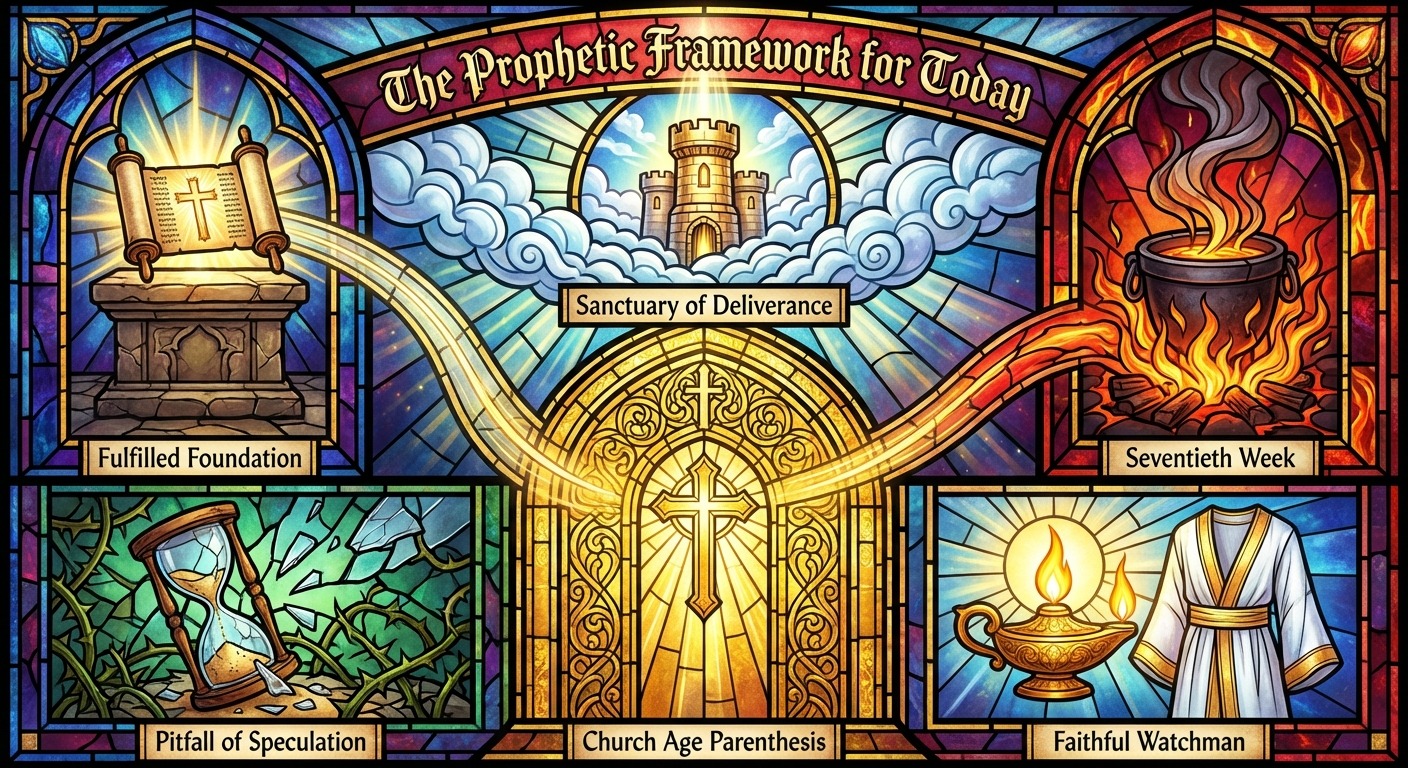
Conclusion: The Prophetic Framework for Today
The Prophetic Framework for Today
This chart shows the structure. What follows explains each part.
Daniel's framework is not only a map of what was and what will be -- it is also a means of locating where we are. The first sixty-nine weeks were fulfilled with documented, measurable precision; the seventieth week has not begun; and between them lies the Church Age, the interval of grace, the desolations. That is the landscape. But knowing the landscape and knowing how to read it are two different things, and this article presses on a specific distinction that is easy to blur when prophetic enthusiasm is running high: the difference between what God is doing with Israel and what He is doing with the Church, and why those two programs cannot be collapsed into one without distorting both.
Daniel's framework is not only a map of what was and what will be -- it is also a means of locating where we are. The first sixty-nine weeks were fulfilled with documented, measurable precision; the seventieth week has not begun; and between them lies the Church Age, the interval of grace, the desolations. That is the landscape. But knowing the landscape and knowing how to read it are two different things, and this article presses on a specific distinction that is easy to blur when prophetic enthusiasm is running high: the difference between what God is doing with Israel and what He is doing with the Church, and why those two programs cannot be collapsed into one without distorting both.
Daniel’s Prophetic Framework
Daniel’s seventy weeks prophecy stands as the essential chronological framework for understanding God’s prophetic program. The exact fulfillment of the first sixty-nine weeks, culminating in the coming of the Messiah, demonstrates the precision with which God orders history. This fulfillment is not merely a matter of historical interest; it is the foundation that assures us the seventieth week will be accomplished with the same certainty. Jesus Himself affirmed this framework, building His own eschatological teaching upon it and directing His followers to view future events through the lens of Daniel’s prophecy (Daniel 9:24-27).
A Crucial Distinction: Israel and the Church
A crucial principle that emerges from this prophetic structure is the distinction between God’s program for Israel and His program for the Church. The angel’s message to Daniel was clear: these things pertain to “thy people and thy holy city” (Daniel 9:24). The seventieth week, therefore, relates specifically to Israel. In contrast, the Church Age represents a parenthesis—a divinely appointed intercalation between the sixty-ninth and seventieth weeks—during which God is calling out a people for His name from among the Gentiles. This distinction is not a matter of speculation but is rooted in the very language and sequence of the prophecy itself.
Recognizing this distinction guards us against confusion that arises when these programs are mingled. As established earlier, the Church is not appointed to experience the wrath that characterizes Daniel’s seventieth week, but instead is destined to share in Christ’s inheritance and kingdom. This understanding preserves the integrity of God’s promises to both Israel and the Church, and upholds the reliability of His word.
Warning Against Speculation
At the same time, the prophetic framework warns against the persistent error of speculative date-setting. Jesus was explicit: “But of that day and hour knoweth no man, no, not the angels of heaven, but my Father only” (Matthew 24:36). Attempts to pinpoint the timing of end-times events have not only contradicted Scripture but have repeatedly led to disappointment and disillusionment. The proper response is not to indulge in fruitless speculation, but to heed the words of Christ and the apostles.
The Purpose of Prophecy: Watchfulness and Holiness
Instead, prophecy is designed to foster watchfulness and holy living. As Peter exhorts, “Seeing then that all these things shall be dissolved, what manner of persons ought ye to be in all holy conversation and godliness, Looking for and hasting unto the coming of the day of God” (2 Peter 3:11-12). The certainty of Christ’s return, grounded in the fulfillment of Daniel’s prophecy, ought to inspire believers to live in a manner worthy of their calling, marked by expectation and readiness.
Conclusion: Clarity and Confident Expectation
Thus, Christ’s use of Daniel’s prophetic framework provides us with the key to understanding biblical prophecy. By distinguishing between the beginning and end of the desolations, and between God’s program for Israel and His program for the Church, we gain clarity regarding God’s unfolding plan. This understanding does not lead to idle curiosity or speculative timetables, but to confident expectation, holy living, and eager anticipation of the day when Christ will return to establish His kingdom and fulfill all that the prophets have spoken.
The prophetic framework has been mapped from where we stand -- the desolations still ongoing, Israel's national program still future, the seventieth week still ahead. But that framework rests in large part on a revelation that was not given through Daniel or through Jesus's earthly ministry. It was given through Paul -- specifically through his disclosure of the mystery of the Church, which is the subject that demands attention next if the framework is to hold together.
The prophetic framework has been mapped from where we stand -- the desolations still ongoing, Israel's national program still future, the seventieth week still ahead. But that framework rests in large part on a revelation that was not given through Daniel or through Jesus's earthly ministry. It was given through Paul -- specifically through his disclosure of the mystery of the Church, which is the subject that demands attention next if the framework is to hold together.
Every chart in this series is free to explore online.
 Get the full chart set (PDF – $8)
Members get all PDFs included → Why Membership
Log in with an active membership to download printable PDFs on this site. Purchased on the shop? Access downloads from your shop account.
If you would like to help fund this work:
These charts are based on the following book:

The Master Key: Daniel's 70th Week
The Bible's Framework for Understanding Prophecy - 230 Page Paperback Edition
View Related Book