
Visual Theology – Bible Prophecy Charts
The Visual Theology charts are designed to help you see the structure and movement of Scripture. They highlight patterns, contrasts, and developments that are often difficult to hold together when reading line by line.
These charts show the structure of the argument. The accompanying articles develop each part in full.
This approach follows a long tradition of visual teaching in the Church. The well-known charts of Clarence Larkin helped many grasp the broad outline of Scripture. In the same spirit, these charts aim to make visible what the Word of God is revealing.
Charts and teaching notes for the book of Bible Prophecy Charts. Select a chart below to view the image and article.
Click chart to view larger
From the teaching in: The Master Key: Daniel's 70th Week
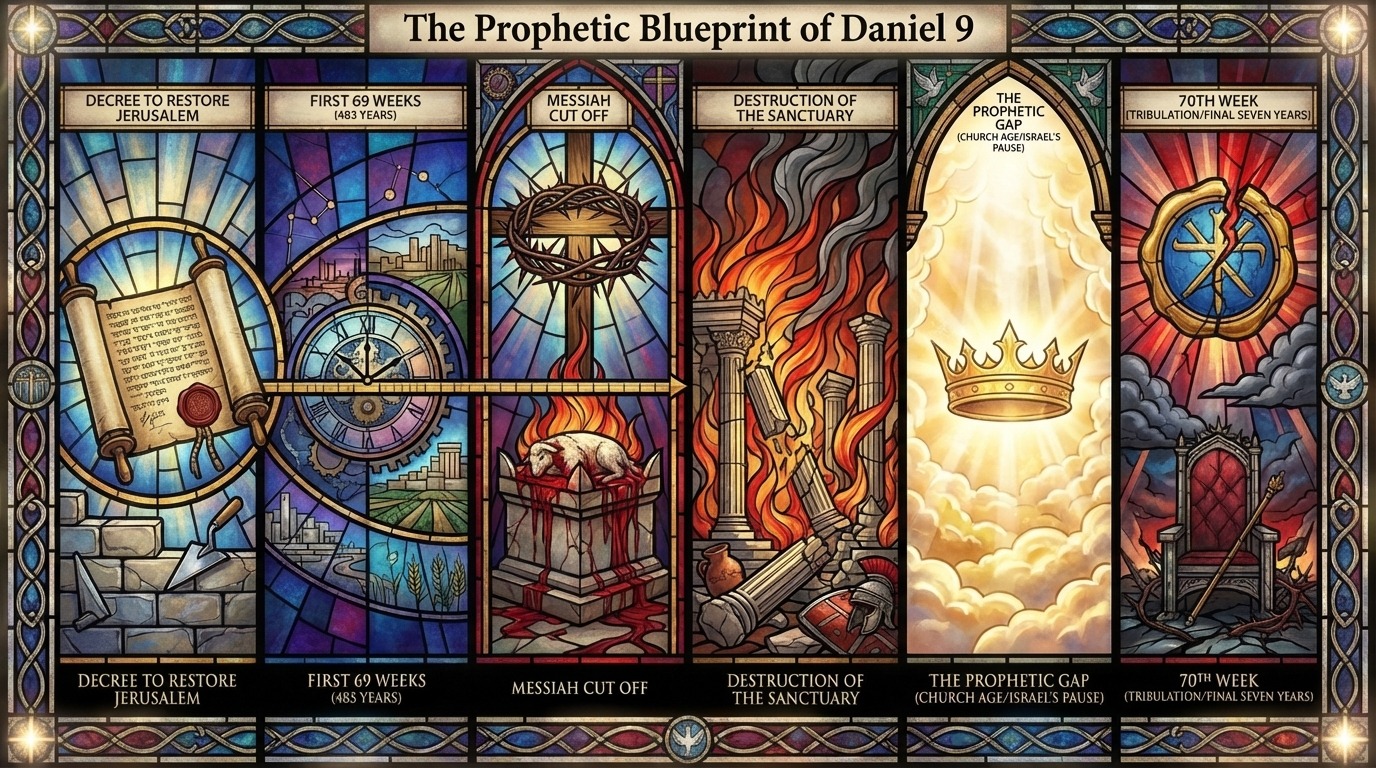
The Structural Blueprint of Daniel 9:24-27
The Structural Blueprint of Daniel 9:24-27
This chart shows the structure. What follows explains each part.
There are people who have studied Bible prophecy for decades and still, when pressed, cannot give a clear account of what Daniel 9:24-27 actually says -- not because the text is inaccessible but because it has been approached through layers of commentary and pre-formed conclusion rather than allowed to speak on its own terms. Before we can evaluate what the 70 weeks means for the present moment or for the future, we need to look carefully at what it says: how the years are counted, how the text divides the 490, and what the sequence of events actually requires. The chart that accompanies this article is designed to make that structure visible, but the structure itself needs to be examined in the text first.
There are people who have studied Bible prophecy for decades and still, when pressed, cannot give a clear account of what Daniel 9:24-27 actually says -- not because the text is inaccessible but because it has been approached through layers of commentary and pre-formed conclusion rather than allowed to speak on its own terms. Before we can evaluate what the 70 weeks means for the present moment or for the future, we need to look carefully at what it says: how the years are counted, how the text divides the 490, and what the sequence of events actually requires. The chart that accompanies this article is designed to make that structure visible, but the structure itself needs to be examined in the text first.
Daniel’s Prophecy of the 70 Weeks
Daniel’s prophecy of the 70 weeks, recorded in Daniel 9:24-27, stands as the most precise chronological framework in all of Scripture, outlining God’s program for Israel from the time of Persian rule until the establishment of the Messianic Kingdom. The angel Gabriel reveals to Daniel a timetable for “thy people and thy holy city,” establishing a 490-year framework divided into three distinct segments. The term “weeks” in this context refers to sets of seven years, aligning with the Sabbatical year system described in Leviticus 25:8 and confirmed by prophetic principles such as “each day for a year” in Numbers 14:34 and Ezekiel 4:6.
The Structure of the 70 Weeks
Gabriel declares, “Seventy weeks are determined upon thy people and upon thy holy city” (Daniel 9:24). These 70 weeks, or 490 years, are structured as 7 weeks (49 years), 62 weeks (434 years), and 1 week (7 years). The first segment of 49 years relates to the rebuilding of Jerusalem, followed by 434 years leading to the presentation of Messiah to Israel. Gabriel’s words are exact: “Know therefore and understand, that from the going forth of the commandment to restore and to build Jerusalem unto the Messiah the Prince shall be seven weeks, and threescore and two weeks” (Daniel 9:25).
The prophecy is not vague or figurative, but provides a measurable, literal timeline that can be historically verified. The starting point is “the going forth of the commandment to restore and to build Jerusalem” (Daniel 9:25). Among several decrees issued by Persian kings, the decree of Artaxerxes to Nehemiah in 445 BC (Nehemiah 2:1-8) most precisely matches the prophecy’s requirements, as it specifically authorized the rebuilding of Jerusalem’s walls and gates.
The Fulfillment of the 69 Weeks
From this decree, the prophecy marks out 483 years (7 + 62 weeks) until “Messiah the Prince.” Using the 360-day prophetic year common in Scripture, this period brings us to the time of Jesus’ triumphal entry into Jerusalem, when He openly presented Himself as Israel’s Messiah. This literal fulfillment demonstrates the supernatural precision of biblical prophecy. Jesus Himself held the Jewish people accountable for recognizing “this thy day,” saying, “If thou hadst known, even thou, at least in this thy day, the things which belong unto thy peace! but now they are hid from thine eyes…because thou knewest not the time of thy visitation” (Luke 19:42-44). The leadership’s failure to recognize the exact day Daniel had prophesied resulted in judgment, not ignorance, for the Pharisees had the means to calculate the time but neglected the prophetic word.
The poignancy of this prophetic moment is underscored in Mark 11:11: after the triumphal entry, Jesus entered the temple, looked around, and left, as no reception awaited Him. The day Daniel’s prophecy had pinpointed—the day that should have inaugurated the kingdom—passed in silence, with Israel’s leaders in blindness. Paul later explains, “Blindness in part is happened to Israel, until the fulness of the Gentiles be come in” (Romans 11:25). This was not accidental but a judicial hardening, which effectively paused the prophetic clock after the 69th week. Israel’s rejection of Messiah on the very day prophesied initiated a gap between the 69th and 70th weeks, a period called “desolations determined,” lasting until God’s purpose with the Gentiles is fulfilled.
The Messiah Cut Off and the City Destroyed
The prophecy then turns to the Messiah’s death: “And after threescore and two weeks shall Messiah be cut off, but not for himself” (Daniel 9:26). This explicitly foretells the Messiah’s sacrificial death, not for His own sins but for others, in perfect harmony with Isaiah’s words: “he was cut off out of the land of the living: for the transgression of my people was he stricken” (Isaiah 53:8). Christ’s crucifixion, occurring just after His presentation as King, fulfilled this element of the prophecy with exactness.
Following the Messiah’s being “cut off,” the prophecy foretells that “the people of the prince that shall come shall destroy the city and the sanctuary” (Daniel 9:26). This refers to the Roman armies who destroyed Jerusalem and the Temple in 70 AD. The text is deliberate: it was “the people of the prince,” not the prince himself, who carried out this destruction. The prince in view is not Christ, who was Jewish and whose people did not destroy their own city, but a future ruler linked with the revived Roman Empire, often identified as the Antichrist. The actions attributed to this prince in Daniel 9:27—confirming and breaking a covenant, and setting up the abomination of desolation—are wholly inconsistent with Christ’s person and work. Jesus Himself referenced the abomination of desolation as a future event that would trigger the Great Tribulation (Matthew 24:15-21), not something accomplished at His first coming.
The Gap and the Final Week
Attempts to identify the prince as Christ and to locate the fulfillment of the 70th week in His earthly ministry ignore the clear statements of the prophecy. The Messiah is “cut off” before the 70th week, and the destruction of the city and sanctuary follows, still before the 70th week. These facts reveal a necessary gap between the 69th and 70th weeks—a gap during which the Messiah is cut off and Jerusalem is destroyed. Daniel is told that 70 weeks of years are determined, but the sequence is interrupted, especially between the 69th and 70th.
The final week—the 70th week of seven years—remains separate from the previous 69 weeks, beginning only when “he shall confirm the covenant with many for one week” (Daniel 9:27). The events of this week, including the abomination of desolation, have not yet occurred in history, making this prophetic gap essential to understanding God’s program for both the Church Age and the future Tribulation.
The Reliability of God’s Word
The literal and historical fulfillment of the first 69 weeks (483 years) gives absolute confidence that the final week will also be fulfilled with the same precision. The gap between the 69th and 70th weeks, now nearly 2,000 years, is not an oversight but a deliberate feature of God’s redemptive blueprint, explained more fully in the New Testament. Daniel’s 70 weeks thus provide the structural framework for all prophecy, anchoring the sequence of God’s dealings with Israel and the coming of the Messiah, and demonstrating the unshakeable reliability of God’s word.
The 490-year framework is now in view: seven weeks, then sixty-two weeks, then a final week -- with clear markers at the end of week sixty-nine and at the beginning and midpoint of week seventy. What the text does not resolve explicitly is why the seventieth week does not appear to have followed the sixty-ninth in an unbroken sequence. That gap -- its existence, its evidence, and its implications -- is the subject that must be examined next, because everything that follows in the New Testament depends on whether it is real.
The 490-year framework is now in view: seven weeks, then sixty-two weeks, then a final week -- with clear markers at the end of week sixty-nine and at the beginning and midpoint of week seventy. What the text does not resolve explicitly is why the seventieth week does not appear to have followed the sixty-ninth in an unbroken sequence. That gap -- its existence, its evidence, and its implications -- is the subject that must be examined next, because everything that follows in the New Testament depends on whether it is real.
Every chart in this series is free to explore online.
 Get the full chart set (PDF – $8)
Members get all PDFs included → Why Membership
Log in with an active membership to download printable PDFs on this site. Purchased on the shop? Access downloads from your shop account.
If you would like to help fund this work:
These charts are based on the following book:

The Master Key: Daniel's 70th Week
The Bible's Framework for Understanding Prophecy - 230 Page Paperback Edition
View Related Book