
Visual Theology – Bible Prophecy Charts
The Visual Theology charts are designed to help you see the structure and movement of Scripture. They highlight patterns, contrasts, and developments that are often difficult to hold together when reading line by line.
These charts show the structure of the argument. The accompanying articles develop each part in full.
This approach follows a long tradition of visual teaching in the Church. The well-known charts of Clarence Larkin helped many grasp the broad outline of Scripture. In the same spirit, these charts aim to make visible what the Word of God is revealing.
Charts and teaching notes for the book of Bible Prophecy Charts. Select a chart below to view the image and article.
Click chart to view larger
From the teaching in: The Master Key: Daniel's 70th Week
Dispensational Distinctions in Eschatology
Dispensational Distinctions in Prophecy
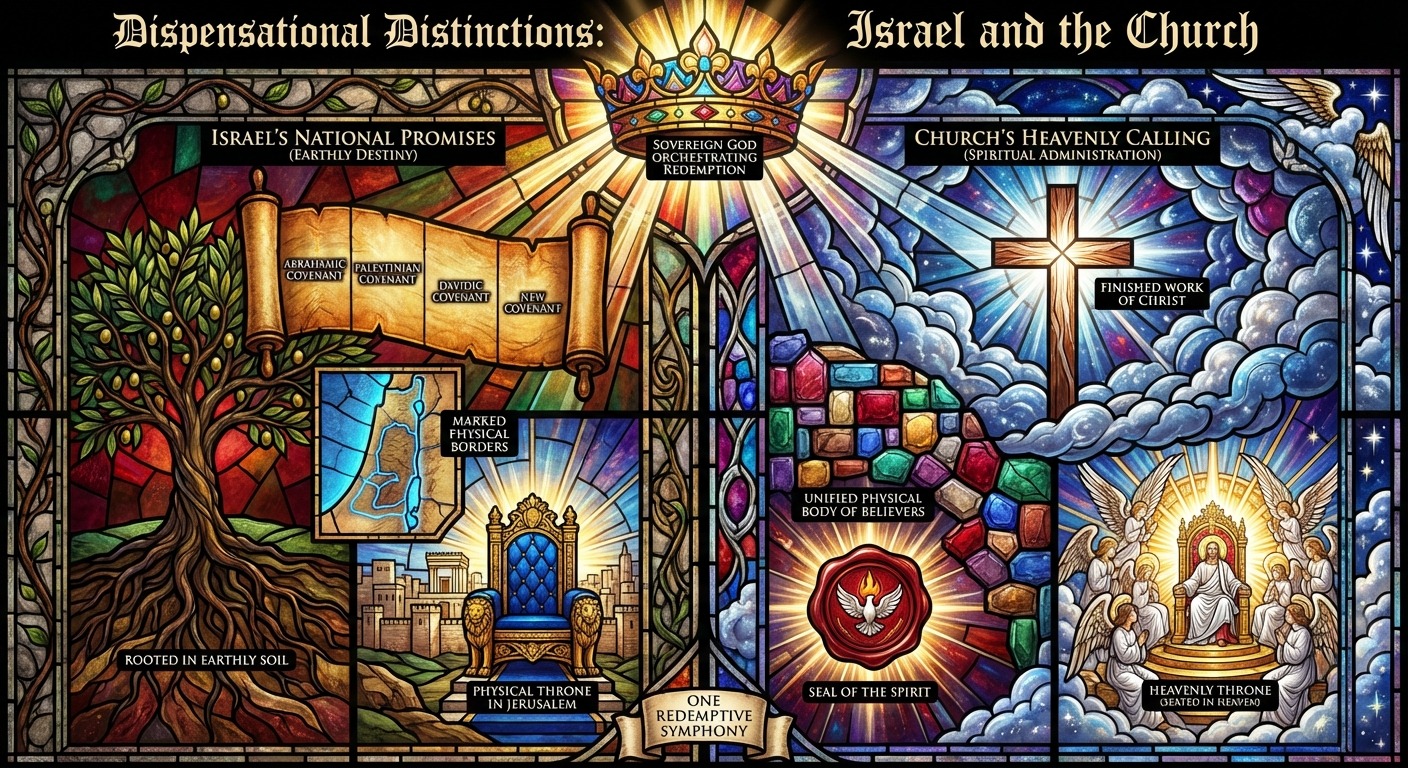
This chart shows the structure. What follows explains each part.
The word 'dispensationalism' has acquired a kind of theological toxicity in some circles -- associated in the popular mind with charts, predictions, and a certain brand of confident prophecy culture that has a poor track record. But the dispensational distinction at the heart of this study is not primarily about charts or sequences; it is about a hermeneutical commitment: that God's specific promises to specific people mean what they say, and that conflating those promises produces confusion not only in prophecy but in soteriology. This article makes the case for that distinction -- not as a system imposed on Scripture but as a pattern that emerges from reading Scripture on its own terms.
The word 'dispensationalism' has acquired a kind of theological toxicity in some circles -- associated in the popular mind with charts, predictions, and a certain brand of confident prophecy culture that has a poor track record. But the dispensational distinction at the heart of this study is not primarily about charts or sequences; it is about a hermeneutical commitment: that God's specific promises to specific people mean what they say, and that conflating those promises produces confusion not only in prophecy but in soteriology. This article makes the case for that distinction -- not as a system imposed on Scripture but as a pattern that emerges from reading Scripture on its own terms.
Understanding the Distinction Between Israel and the Church
Understanding the distinction between Israel and the Church is foundational for a right approach to biblical prophecy. The failure to maintain this distinction leads to confusion, as prophecies intended for Israel are misapplied to the Church, and vice versa, resulting in doctrinal misunderstandings and obscuring the clarity of God's plan.
Dispensationalism, as a theological framework, recognizes that God deals with different groups in distinct ways across the unfolding of redemptive history. This is not a matter of dividing Scripture into unrelated parts, but of acknowledging the progressive nature of God's revelation and the specific promises He has made to each group.
God's Specific Promises to Israel
God's promises to Israel are both specific and unconditional. Paul enumerates Israel's distinctive blessings in Romans 9:4-5: "Who are Israelites; to whom pertaineth the adoption, and the glory, and the covenants, and the giving of the law, and the service of God, and the promises; Whose are the fathers, and of whom as concerning the flesh Christ came, who is over all, God blessed for ever. Amen." These blessings are not generic spiritual principles, but concrete national promises.
- The Abrahamic Covenant (Genesis 12:1-3) pledged to Abraham a land, a seed, and a blessing.
- The land aspect was further detailed in the Palestinian Covenant (Deuteronomy 30:1-10), guaranteeing Israel's ultimate restoration to their land.
- The seed promise was developed in the Davidic Covenant (2 Samuel 7:12-16), which assured David of an eternal kingdom ruled by his descendant.
- The spiritual renewal of the nation was promised in the New Covenant (Jeremiah 31:31-34).
These covenants were made specifically with Israel and have never been transferred to the Church. God's faithfulness to His Word requires that they be fulfilled literally. Just as the prophecies concerning Christ's first coming were fulfilled in precise detail, so too will the promises regarding Israel's restoration and Messiah's return be fulfilled exactly as stated.
The Church's Heavenly Calling
In contrast, the Church's calling is not centered on earthly blessings, national prominence, or a kingdom with a throne in Jerusalem. Instead, the Church is marked by a heavenly calling. Paul declares in Ephesians 2:6 that God "hath raised us up together, and made us sit together in heavenly places in Christ Jesus." The Church's blessings and position are established in the heavenly realms, even though their full experience is yet to come.
This distinction does not exclude the possibility that the Church may enjoy earthly blessings or that Israel may share in heavenly ones. Rather, it is the primary focus and sphere of blessing for each group that differs, according to God's purpose.
One God, One Plan, Distinct Programs
It is crucial to understand that these distinctions do not imply different gods or separate religions. There is one God, orchestrating one unified redemptive plan, but He administers this plan through distinct programs for different peoples. The analogy of a symphony helps illustrate this truth: each movement has its own theme and tempo, yet all contribute to the same harmonious conclusion. God's dealings with Israel and the Church are like different movements in His grand symphony of redemption—each with unique features, yet all serving to magnify His glory and grace.
Both Israel and the Church are recipients of God's grace, but the administration of that grace differs according to His purpose in each dispensation. Israel's relationship with God was established through covenants that, although they included requirements for obedience, ultimately rested on God's gracious choice of them as His people. The Church, by contrast, stands entirely upon grace through faith in Christ's finished work. This does not mean that Israel was saved by works and the Church by grace; salvation has always been by grace through faith, as Paul demonstrates with Abraham in Romans 4. However, the expression and administration of grace are not identical in every age.
Conclusion: Clarity and Fulfillment
Recognizing these dispensational distinctions brings clarity to prophecy and preserves the integrity of God's promises. Israel's national covenants remain in force and await literal fulfillment. The Church enjoys a heavenly standing and calling, distinct from Israel's earthly destiny. God remains faithful to both programs, and each will reach its appointed fulfillment in His perfect timing, all to the praise of His glory.
The dispensational distinctions have been named and defended -- not as a system but as a necessary hermeneutic that follows from taking God's covenantal language seriously. What those distinctions clarify most sharply is the question of the seventieth week: to whom does it belong? Daniel said it was determined 'upon thy people and upon thy holy city' -- and if that language means anything at all, the answer requires examining it carefully, which is what comes next.
The dispensational distinctions have been named and defended -- not as a system but as a necessary hermeneutic that follows from taking God's covenantal language seriously. What those distinctions clarify most sharply is the question of the seventieth week: to whom does it belong? Daniel said it was determined 'upon thy people and upon thy holy city' -- and if that language means anything at all, the answer requires examining it carefully, which is what comes next.
Every chart in this series is free to explore online.
 Get the full chart set (PDF – $8)
Members get all PDFs included → Why Membership
Log in with an active membership to download printable PDFs on this site. Purchased on the shop? Access downloads from your shop account.
If you would like to help fund this work:
These charts are based on the following book:

The Master Key: Daniel's 70th Week
The Bible's Framework for Understanding Prophecy - 230 Page Paperback Edition
View Related Book