
Visual Theology – Bible Prophecy Charts
The Visual Theology charts are designed to help you see the structure and movement of Scripture. They highlight patterns, contrasts, and developments that are often difficult to hold together when reading line by line.
These charts show the structure of the argument. The accompanying articles develop each part in full.
This approach follows a long tradition of visual teaching in the Church. The well-known charts of Clarence Larkin helped many grasp the broad outline of Scripture. In the same spirit, these charts aim to make visible what the Word of God is revealing.
Charts and teaching notes for the book of Bible Prophecy Charts. Select a chart below to view the image and article.
Click chart to view larger
From the teaching in: The Master Key: Daniel's 70th Week
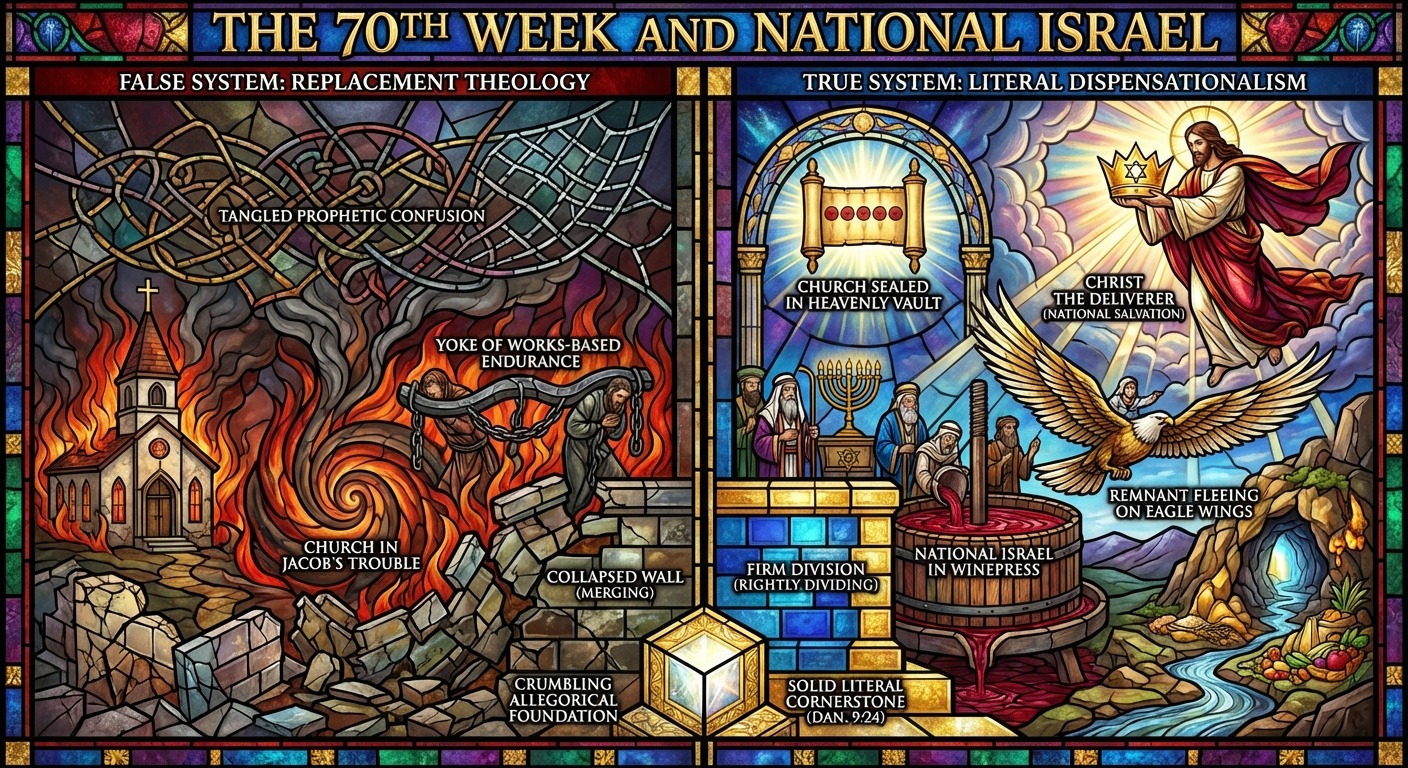
The 70th Week and National Israel
The 70th Week and National Israel
This chart shows the structure. What follows explains each part.
Daniel's prophecy opens with the most precise statement of scope in all prophetic literature: 'Seventy weeks are determined upon thy people and upon thy holy city.' The phrase is not ambiguous -- it names a people and a place, and neither of those referents is the Church. And yet a significant strand of prophetic interpretation has read the seventieth week as applying primarily or exclusively to the Church, producing eschatological positions that require the Church to go through, or partially through, or entirely within, the tribulation period. This article examines that question directly: whose is the seventieth week, and what does that ownership mean for the Church?
Daniel's prophecy opens with the most precise statement of scope in all prophetic literature: 'Seventy weeks are determined upon thy people and upon thy holy city.' The phrase is not ambiguous -- it names a people and a place, and neither of those referents is the Church. And yet a significant strand of prophetic interpretation has read the seventieth week as applying primarily or exclusively to the Church, producing eschatological positions that require the Church to go through, or partially through, or entirely within, the tribulation period. This article examines that question directly: whose is the seventieth week, and what does that ownership mean for the Church?
The Prophetic Foundation: Daniel’s Seventy Weeks
Daniel’s prophecy of the seventy weeks (Daniel 9:24-27) stands as the prophetic foundation for distinguishing between Israel and the Church in God’s redemptive program. The opening words of the prophecy make the scope unmistakable: “Seventy weeks are determined upon thy people and upon thy holy city” (Daniel 9:24). Here, God addresses Daniel directly, identifying “thy people” as Israel and “thy holy city” as Jerusalem. The sixfold purpose set forth—finishing transgression, ending sins, reconciling iniquity, bringing in everlasting righteousness, sealing vision and prophecy, and anointing the most Holy—concerns Israel’s national program, not the Church’s.
This distinction is not a matter of minor interpretation but is critical to the integrity of biblical prophecy. When the seventy weeks are allegorized or redirected toward the Church, the very foundation that maintains the distinction between Israel and the Church is dissolved. If “thy people and thy holy city” are spiritualized to mean “the Church and the heavenly Jerusalem,” then the entire prophetic program collapses into replacement theology, erasing the unique role of Israel and the meaning of kingdom prophecies. It is only by taking Daniel 9:24-27 literally, as concerning Israel specifically, that the distinction between Israel and the Church is preserved. This prophecy serves as the cornerstone upon which all prophetic distinctions rest. To collapse these distinctions is to blur the lines between law and grace and to lose the heavenly truths and destiny that belong uniquely to the Church.
The 70th Week and Israel’s Future
Central to Daniel’s 70th week is the future seven-year covenant that will be made between the Antichrist and Israel. This covenant, described in Daniel 9:27, has nothing to do with the Church. It is Israel’s future that is in view, and it forms the foundation for understanding the Tribulation period as described in Revelation 6-19. The Church is not present in these chapters because it is not on earth during this time. God’s focus returns to Israel as He completes His program with His chosen nation.
The prophecy’s scope is explicit: “Seventy weeks are determined upon thy people and upon thy holy city” (Daniel 9:24). Daniel’s people are Israel; the holy city is Jerusalem. The fulfillment of this prophecy will be for Israel during and at the conclusion of the 70th week. To apply this prophecy to the Church is to distort its meaning and to miss its significance for understanding God’s dealings with Israel.
This period is also known as “the time of Jacob’s trouble” (Jeremiah 30:7), a time of unprecedented tribulation specifically focused on Israel. Though it is a time of severe judgment, its ultimate purpose is Israel’s national salvation. Paul writes in Romans 11:26-27: “And so all Israel shall be saved: as it is written, There shall come out of Sion the Deliverer, and shall turn away ungodliness from Jacob: For this is my covenant unto them, when I shall take away their sins.” This national salvation will occur when Israel recognizes Jesus as Messiah at His second coming, leading to repentance and the fulfillment of God’s covenant promises to Israel.
Correctly Interpreting Key Passages
It is essential to recognize the thoroughly Jewish character of the 70th week and the passages that describe it. Prophetic sections such as Luke 21 and Matthew 24 are often misapplied to the Church, especially verses about “escaping” and “enduring to the end.” However, these passages do not describe the rapture or Christian perseverance but address the Jewish remnant during the time of Jacob’s trouble.
For example, Luke 21:36 says, “Watch ye therefore, and pray always, that ye may be accounted worthy to escape all these things that shall come to pass, and to stand before the Son of man.” Here, “escape” refers not to the rapture but to the physical deliverance of Jewish believers who heed the warning to flee Jerusalem, as Jesus instructs in Luke 21:20-21: “And when ye shall see Jerusalem compassed with armies, then know that the desolation thereof is nigh. Then let them which are in Judaea flee to the mountains.” Thus, to “escape” is to survive the coming tribulation by fleeing at the appointed time.
Similarly, the phrase “he that shall endure unto the end shall be saved” (Matthew 24:13) is not about perseverance in the Christian life or maintaining salvation through works. It means that those who survive the Great Tribulation—who physically endure to the end—will be saved, their lives preserved to enter the millennial kingdom. This is Jewish language about physical deliverance, not the Church’s eternal security.
The Remnant’s Refuge and Deliverance
The Jewish remnant’s flight is further described in Revelation 12:6, which says, “the woman fled into the wilderness, where she hath a place prepared of God, that they should feed her there a thousand two hundred and threescore days.” This period of refuge, lasting 1,260 days (the second half of the 70th week), is likely in Edom, as Daniel 11:41 shows Edom escaping the Antichrist’s grasp. Isaiah 63:1 depicts Christ’s return from Edom, His garments stained with the blood of judgment, suggesting He will appear to the remnant in their wilderness refuge before returning to Jerusalem. Zechariah 12:10 affirms that they will see Him whom they have pierced, mourn, and be reconciled to Him in the wilderness.
Upholding the Distinction
These details demonstrate that the 70th week prophecies in Daniel 9:24-27, Luke 21, Matthew 24-25, and their fulfillments in Revelation concern Israel’s program, not the Church’s. The Church is not told to watch for armies around Jerusalem, or to flee to the mountains, or to endure to the end to be saved. Believers in the Church age are already saved, sealed by the Spirit, and appointed to obtain salvation, not wrath (1 Thessalonians 5:9). The confusion that arises from applying Israel’s instructions to the Church, or vice versa, underscores the necessity of maintaining the distinction between these divinely established programs.
In summary, Daniel’s 70th week is the prophetic bedrock for the distinction between Israel and the Church. To misapply this prophecy is to undermine the coherence of God’s redemptive plan, to blur the unique destinies of Israel and the Church, and to risk losing the precious truths entrusted to each. Only by recognizing the literal, national focus of Daniel 9:24-27 can we uphold the integrity of biblical prophecy and the faithfulness of God to His promises.
The seventieth week has been established as belonging to national Israel -- and that is not a minor administrative detail. It carries with it the full weight of every promise God has made to that nation: the removal of the heart of stone, the New Covenant, the ingathering, the kingdom. Those promises are not floating abstractions; they have been laid out in the Old Testament with extraordinary specificity, most comprehensively in the prophet Ezekiel -- whose vision is the necessary companion to Daniel's blueprint, and the subject that must be examined next.
The seventieth week has been established as belonging to national Israel -- and that is not a minor administrative detail. It carries with it the full weight of every promise God has made to that nation: the removal of the heart of stone, the New Covenant, the ingathering, the kingdom. Those promises are not floating abstractions; they have been laid out in the Old Testament with extraordinary specificity, most comprehensively in the prophet Ezekiel -- whose vision is the necessary companion to Daniel's blueprint, and the subject that must be examined next.
Every chart in this series is free to explore online.
 Get the full chart set (PDF – $8)
Members get all PDFs included → Why Membership
Log in with an active membership to download printable PDFs on this site. Purchased on the shop? Access downloads from your shop account.
If you would like to help fund this work:
These charts are based on the following book:

The Master Key: Daniel's 70th Week
The Bible's Framework for Understanding Prophecy - 230 Page Paperback Edition
View Related Book