
Visual Theology – Bible Prophecy Charts
The Visual Theology charts are designed to help you see the structure and movement of Scripture. They highlight patterns, contrasts, and developments that are often difficult to hold together when reading line by line.
These charts show the structure of the argument. The accompanying articles develop each part in full.
This approach follows a long tradition of visual teaching in the Church. The well-known charts of Clarence Larkin helped many grasp the broad outline of Scripture. In the same spirit, these charts aim to make visible what the Word of God is revealing.
Charts and teaching notes for the book of Bible Prophecy Charts. Select a chart below to view the image and article.
Click chart to view larger
From the teaching in: The Master Key: Daniel's 70th Week
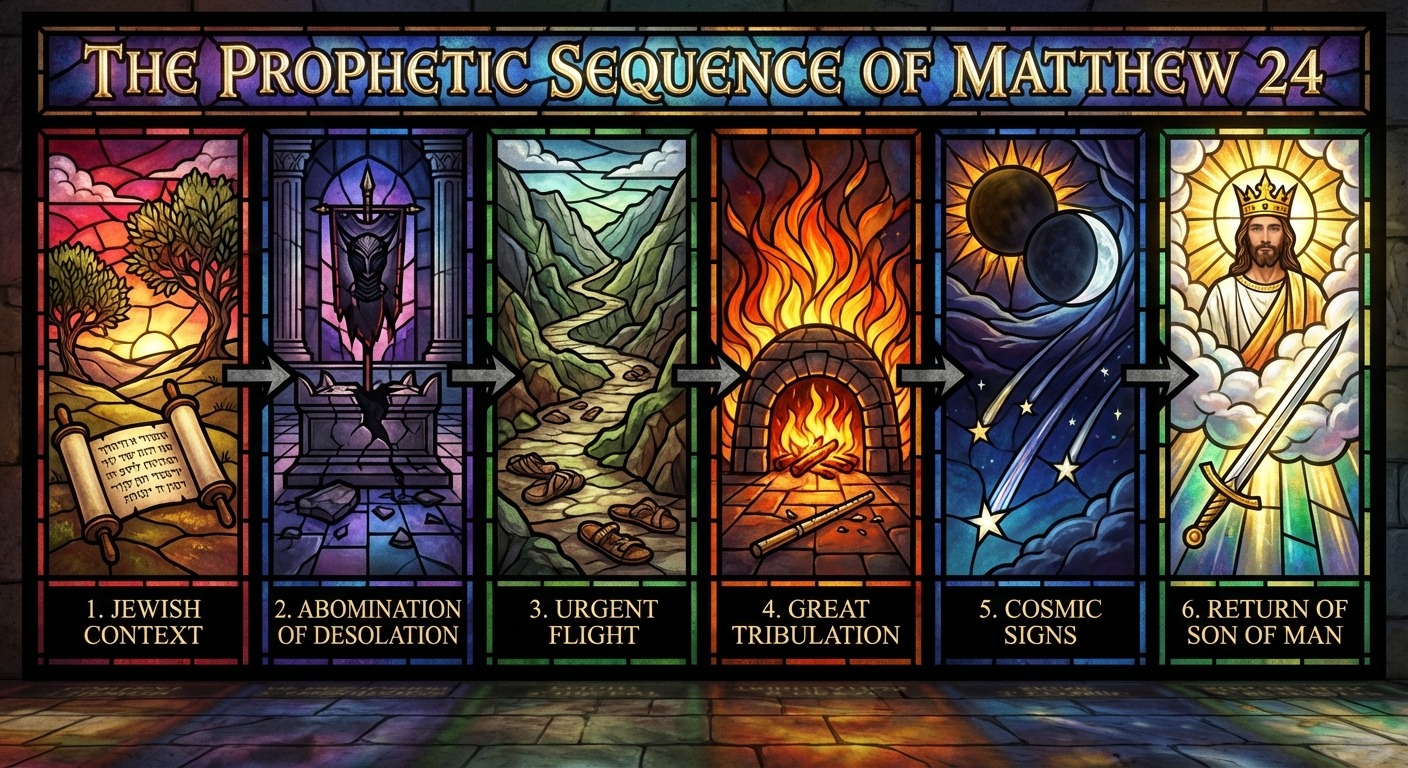
Matthew 24: The Desolations End and the 70th Week
Matthew 24: The Desolations End and the 70th Week
This chart shows the structure. What follows explains each part.
If Luke 21 describes the beginning of the desolations -- Jerusalem fallen, Israel scattered, the times of the Gentiles underway -- then Matthew 24 describes the other end: the closing of that interval, the sign that the seventieth week is about to begin, and the events that will characterize it. These are not the same conversation, though they are spoken by the same Lord in the same week. Matthew's account is addressed to the disciples privately, on the mountain, in response to a different question -- and that difference of setting and question produces a discourse that looks entirely different from Luke's once Daniel's framework is the lens through which it is read.
If Luke 21 describes the beginning of the desolations -- Jerusalem fallen, Israel scattered, the times of the Gentiles underway -- then Matthew 24 describes the other end: the closing of that interval, the sign that the seventieth week is about to begin, and the events that will characterize it. These are not the same conversation, though they are spoken by the same Lord in the same week. Matthew's account is addressed to the disciples privately, on the mountain, in response to a different question -- and that difference of setting and question produces a discourse that looks entirely different from Luke's once Daniel's framework is the lens through which it is read.
Matthew 24: The Prophetic Endpoint of Daniel's Seventy Weeks
Matthew 24 stands as the prophetic endpoint of the timeline established in Daniel's seventy weeks prophecy. Here, Jesus, speaking privately to His disciples on the Mount of Olives, addresses the question of the sign of His coming and of the end of the world (Matthew 24:3). Unlike the account in Luke 21, which centers on the beginning of the "desolations determined," Matthew's account directs our attention to their conclusion and the fulfillment of the final week foretold by Daniel.
A Jewish Context
The discourse is set firmly within a Jewish context. Jesus references those which be in Judaea (Matthew 24:16) and instructs, But pray ye that your flight be not in the winter, neither on the sabbath day (Matthew 24:20). Such details underscore that these prophetic events pertain specifically to Israel and to those living under the Mosaic Law, highlighting the national and territorial focus of the prophecy.
The Framework of the Seventieth Week
Central to Jesus’ teaching is the framework of Daniel’s seventieth week, as described in Daniel 9:27. This period consists of seven years, beginning with a covenant and marked by a pivotal event at its midpoint: the abomination of desolation. Jesus Himself identifies this marker, saying, When ye therefore shall see the abomination of desolation, spoken of by Daniel the prophet, stand in the holy place (Matthew 24:15). This abomination signals the moment for those in Judea to flee, for it inaugurates the most severe period of tribulation—the Great Tribulation, which is the latter half of the seven-year week.
The Unparalleled Great Tribulation
The severity of this time is without parallel in human history. Jesus declares, For then shall be great tribulation, such as was not since the beginning of the world to this time, no, nor ever shall be. And except those days should be shortened, there should no flesh be saved: but for the elect's sake those days shall be shortened (Matthew 24:21-22). This description resonates with Daniel 12:1, which foretells a time of trouble, such as never was since there was a nation even to that same time. Thus, the tribulation Jesus describes is not a mere repetition of past calamities but the climactic outpouring of judgment and trouble at the end of the age.
From Tribulation to Second Coming
Matthew’s account then presents a direct chronological progression from the tribulation to the Second Coming of Christ. Immediately after the tribulation of those days shall the sun be darkened, and the moon shall not give her light, and the stars shall fall from heaven, and the powers of the heavens shall be shaken: And then shall appear the sign of the Son of man in heaven (Matthew 24:29-30). These cosmic disturbances serve as unmistakable signs of the end, culminating in the visible and glorious return of Christ.
The return of Christ is described in terms that emphasize its undeniable, worldwide manifestation: And then shall appear the sign of the Son of man in heaven: and then shall all the tribes of the earth mourn, and they shall see the Son of man coming in the clouds of heaven with power and great glory (Matthew 24:30). This vision aligns with Zechariah 14:4, where the Messiah’s feet stand upon the Mount of Olives, and with Revelation 19:11-16, which depicts Christ returning as the conquering King.
Completing the Prophetic Sequence
What is especially significant in Matthew 24 is the way it completes the prophetic sequence begun in Luke 21. Whereas Luke addresses the beginning of the desolations—the destruction of Jerusalem and the onset of the "times of the Gentiles"—Matthew brings us to the conclusion of those times, the fulfillment of the seventieth week, and the establishment of the Messianic Kingdom. The gap between the sixty-ninth and seventieth weeks, marked by Israel's dispersion and Jerusalem's subjection to Gentile control, finds its divinely appointed climax in the events Jesus describes.
A Source of Assurance
For believers, this prophetic endpoint is a source of assurance. The God who fulfilled the first sixty-nine weeks of Daniel's prophecy with precision, and who permitted the desolations to begin in 70 AD, will just as certainly fulfill the seventieth week and bring those desolations to their appointed end. Thus, Matthew 24 not only provides the chronological sequence of end-times events but also affirms the reliability of God's Word and the certainty of His prophetic program for Israel.
Matthew 24 has filled in the far horizon of Daniel's timeline -- the seventieth week, the abomination, the great tribulation, and the sign of the Son of Man. Luke 21 filled in the near horizon -- the desolations that began in 70 AD. But we have not yet asked how Mark's account relates to these two, or how the three Synoptic accounts, taken together, function as a complete and complementary prophetic witness. That synthesis is the work of the next article.
Matthew 24 has filled in the far horizon of Daniel's timeline -- the seventieth week, the abomination, the great tribulation, and the sign of the Son of Man. Luke 21 filled in the near horizon -- the desolations that began in 70 AD. But we have not yet asked how Mark's account relates to these two, or how the three Synoptic accounts, taken together, function as a complete and complementary prophetic witness. That synthesis is the work of the next article.
Every chart in this series is free to explore online.
 Get the full chart set (PDF – $8)
Members get all PDFs included → Why Membership
Log in with an active membership to download printable PDFs on this site. Purchased on the shop? Access downloads from your shop account.
If you would like to help fund this work:
These charts are based on the following book:

The Master Key: Daniel's 70th Week
The Bible's Framework for Understanding Prophecy - 230 Page Paperback Edition
View Related Book