
Visual Theology – Bible Prophecy Charts
The Visual Theology charts are designed to help you see the structure and movement of Scripture. They highlight patterns, contrasts, and developments that are often difficult to hold together when reading line by line.
These charts show the structure of the argument. The accompanying articles develop each part in full.
This approach follows a long tradition of visual teaching in the Church. The well-known charts of Clarence Larkin helped many grasp the broad outline of Scripture. In the same spirit, these charts aim to make visible what the Word of God is revealing.
Charts and teaching notes for the book of Bible Prophecy Charts. Select a chart below to view the image and article.
Click chart to view larger
From the teaching in: The Master Key: Daniel's 70th Week
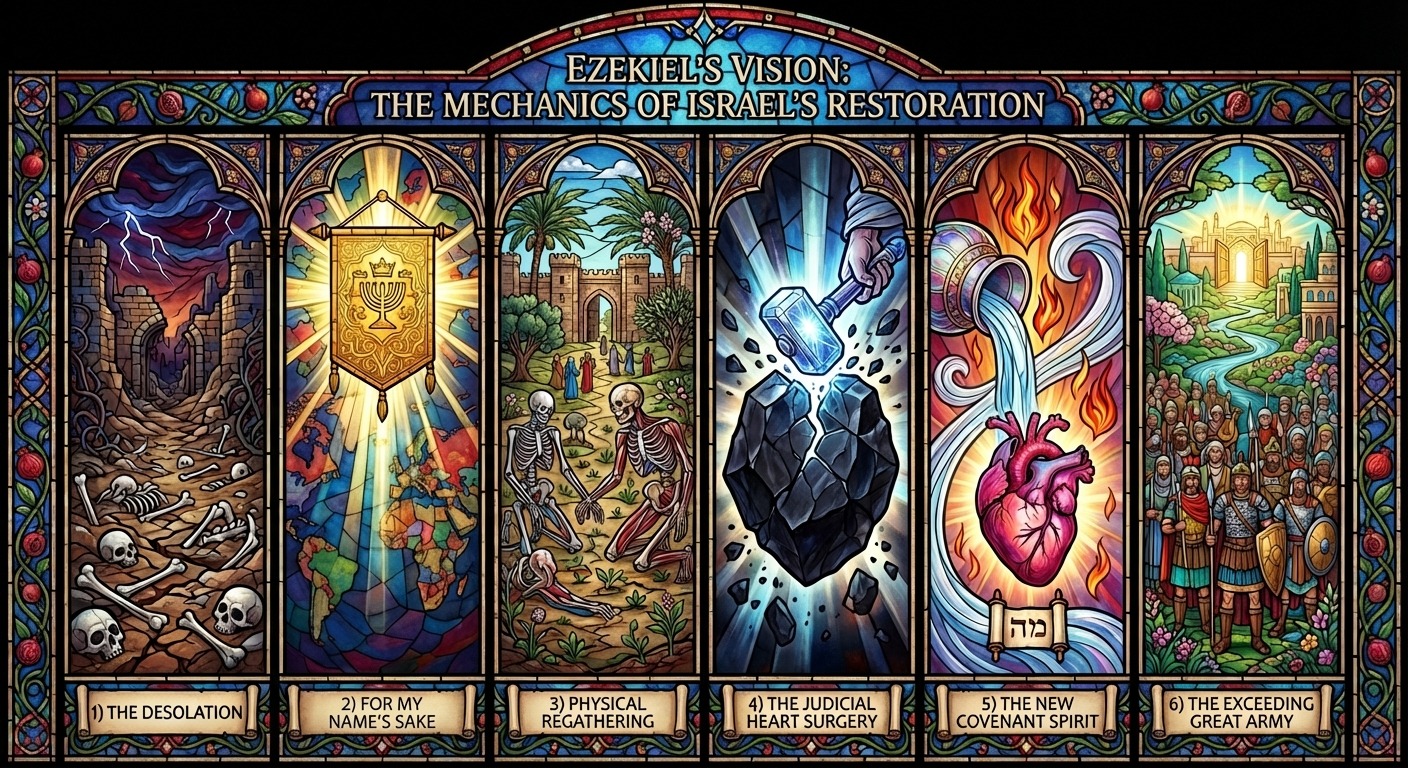
Ezekiel's Vision: The Desolations and the Restoration
Ezekiel's Vision of Restoration
This chart shows the structure. What follows explains each part.
Daniel's prophecy provides the timeline -- 490 years, a gap, a final week. But it does not describe in detail what Israel's national restoration will actually look like when the seventieth week reaches its conclusion and God's purposes for His people are fulfilled. For that, we go to Ezekiel, who received a vision so comprehensive and so physical that it cannot be spiritualized without doing violence to the language: a valley of dry bones that breathed again, a land that received its people back, a Spirit poured out on a nation, and a New Covenant -- not the Church's experience of the Spirit, but a specific promise to remove the heart of stone from Israel and give her a heart of flesh. This article reads that vision and asks what it tells us about what God is still committed to doing.
Daniel's prophecy provides the timeline -- 490 years, a gap, a final week. But it does not describe in detail what Israel's national restoration will actually look like when the seventieth week reaches its conclusion and God's purposes for His people are fulfilled. For that, we go to Ezekiel, who received a vision so comprehensive and so physical that it cannot be spiritualized without doing violence to the language: a valley of dry bones that breathed again, a land that received its people back, a Spirit poured out on a nation, and a New Covenant -- not the Church's experience of the Spirit, but a specific promise to remove the heart of stone from Israel and give her a heart of flesh. This article reads that vision and asks what it tells us about what God is still committed to doing.
Ezekiel 36-37: The Foundation for Israel's Restoration
Ezekiel 36-37 contains one of the most comprehensive revelations of God's program for Israel's restoration, providing crucial context for understanding the "desolations" mentioned in Daniel 9:26 and the nature of the New Covenant that will be established with Israel at the conclusion of the 70th week. The prophecy opens with a striking command: God instructs Ezekiel to prophesy not merely to the people, but to the land itself—to the mountains, hills, rivers, and valleys of Israel. Thus saith the Lord GOD; Behold, I have spoken in my jealousy and in my fury, because ye have borne the shame of the heathen (Ezekiel 36:6). This personification of the land underscores that God's covenant is not only with the people of Israel, but also with the specific territory promised to Abraham, Isaac, and Jacob.
The immediate context is one of desolation. When Israel was scattered among the nations, the land itself became ruined and desolate, provoking the nations to claim the ancient high places for themselves. Yet, God declares that while Israel would endure judgment and dispersion, the desolation of the land would be temporary—not permanent. The enemies of Israel would not ultimately possess the land. The shame and devastation, though real, would not be the final word.
The Ultimate Purpose: God's Holy Name
God then reveals the ultimate purpose behind Israel's restoration, and it is not primarily for Israel's benefit. Therefore say unto the house of Israel, Thus saith the Lord GOD; I do not this for your sakes, O house of Israel, but for mine holy name's sake, which ye have profaned among the heathen, whither ye went. And I will sanctify my great name, which was profaned among the heathen, which ye have profaned in the midst of them; and the heathen shall know that I am the LORD, saith the Lord GOD, when I shall be sanctified in you before their eyes (Ezekiel 36:22-23). When God's people are scattered and His promises appear unfulfilled, the nations conclude that either God was unfaithful or lacked the power to accomplish His word. This profanes God's character before the world. Therefore, the restoration of Israel is ultimately about the vindication of God's name and the demonstration of His faithfulness before all nations.
Physical and Spiritual Renewal
Ezekiel's prophecy describes both physical and spiritual renewal. Physically, God promises to regather Israel from the nations: For I will take you from among the heathen, and gather you out of all countries, and will bring you into your own land (Ezekiel 36:24). The land, once desolate, will be transformed: And the desolate land shall be tilled, whereas it lay desolate in the sight of all that passed by. And they shall say, This land that was desolate is become like the garden of Eden; and the waste and desolate and ruined cities are become fenced, and are inhabited (Ezekiel 36:34-35).
However, mere physical restoration is not sufficient. The deeper issue is spiritual—a hardened heart that led to Israel's rebellion and judgment. Here, the New Covenant comes into view. God promises, Then will I sprinkle clean water upon you, and ye shall be clean: from all your filthiness, and from all your idols, will I cleanse you. A new heart also will I give you, and a new spirit will I put within you: and I will take away the stony heart out of your flesh, and I will give you an heart of flesh. And I will put my spirit within you, and cause you to walk in my statutes, and ye shall keep my judgments, and do them (Ezekiel 36:25-27). This is the essence of the New Covenant promised to Israel—a divine act whereby God removes the "stony heart," a supernatural hardness described as the "adamant stone" in Zechariah 7:12 and as "blindness in part" in Romans 11:25. This judicial hardening, imposed because of persistent rejection of the prophets and the Messiah, is not mere unbelief but a divinely imposed condition that only God Himself can remove.
It is crucial to recognize that these promises are made explicitly to the house of Israel and the house of Judah (Jeremiah 31:31), not to the Church. The Church never possessed a "heart of adamant stone"—Gentiles were alienated from the life of God (Ephesians 4:18) through ignorance, not through judicial hardening. Furthermore, the promises of the New Covenant include dwelling in the land given to the fathers (Ezekiel 36:28), a literal, geographical promise that cannot be spiritualized as "heaven" without distorting the text.
The Vision of the Dry Bones
Ezekiel 37 continues with the vision of the valley of dry bones, a dramatic picture of Israel's national resurrection. God shows Ezekiel a valley filled with dry bones and asks, Son of man, can these bones live? (Ezekiel 37:3). As Ezekiel prophesies, the bones come together, flesh covers them, and breath enters them, so they stand as an exceeding great army (Ezekiel 37:10). God interprets the vision: Son of man, these bones are the whole house of Israel...Behold, O my people, I will open your graves, and cause you to come up out of your graves, and bring you into the land of Israel...And shall put my spirit in you, and ye shall live, and I shall place you in your own land (Ezekiel 37:11-12, 14).
While the modern return of Jewish people to the land after centuries of dispersion is a remarkable fulfillment of the physical aspect of this prophecy, the spiritual aspect—the removal of the heart of stone and the outpouring of the Spirit—awaits the time of Jacob's trouble. Only then, in the crucible of the 70th week, will Israel seek the Lord in their affliction (Hosea 5:15) and look upon me whom they have pierced, and...mourn for him (Zechariah 12:10).
Conclusion: The Complementary Revelation
Ezekiel's vision thus forms the Old Testament foundation for what Daniel 9:24-27 prophesies concerning Israel's future. The sixfold purpose of Daniel's seventy weeks—to finish transgression, make an end of sins, make reconciliation for iniquity, bring in everlasting righteousness, seal up vision and prophecy, and anoint the most holy—finds its detailed exposition in Ezekiel 36-37. These are not separate prophecies but complementary revelations of the same divine program. God will restore Israel not primarily for their own sake but for His own name's sake. He will remove the heart of stone, pour out His Spirit, cause them to walk in His ways, and establish them in their land under the New Covenant. This is Israel's future, secured by God's faithfulness to His word, awaiting its fulfillment in the 70th week and the establishment of the Messianic Kingdom.
Ezekiel's vision of Israel's restoration is not a symbol for the Church's experience of new birth -- it is a promise to a nation that has not yet been fulfilled, and it will be fulfilled exactly as described. What makes that claim controversial in much of contemporary theology is a specific interpretive move that has been with the Church for a very long time: the tendency to read 'Israel' as a metaphor for the people of God in general rather than as a reference to the specific nation God named in His covenants. That move, and the theological damage it does, is what the next article confronts head-on.
Ezekiel's vision of Israel's restoration is not a symbol for the Church's experience of new birth -- it is a promise to a nation that has not yet been fulfilled, and it will be fulfilled exactly as described. What makes that claim controversial in much of contemporary theology is a specific interpretive move that has been with the Church for a very long time: the tendency to read 'Israel' as a metaphor for the people of God in general rather than as a reference to the specific nation God named in His covenants. That move, and the theological damage it does, is what the next article confronts head-on.
Every chart in this series is free to explore online.
 Get the full chart set (PDF – $8)
Members get all PDFs included → Why Membership
Log in with an active membership to download printable PDFs on this site. Purchased on the shop? Access downloads from your shop account.
If you would like to help fund this work:
These charts are based on the following book:

The Master Key: Daniel's 70th Week
The Bible's Framework for Understanding Prophecy - 230 Page Paperback Edition
View Related Book