
Visual Theology – Bible Prophecy Charts
The Visual Theology charts are designed to help you see the structure and movement of Scripture. They highlight patterns, contrasts, and developments that are often difficult to hold together when reading line by line.
These charts show the structure of the argument. The accompanying articles develop each part in full.
This approach follows a long tradition of visual teaching in the Church. The well-known charts of Clarence Larkin helped many grasp the broad outline of Scripture. In the same spirit, these charts aim to make visible what the Word of God is revealing.
Charts and teaching notes for the book of Bible Prophecy Charts. Select a chart below to view the image and article.
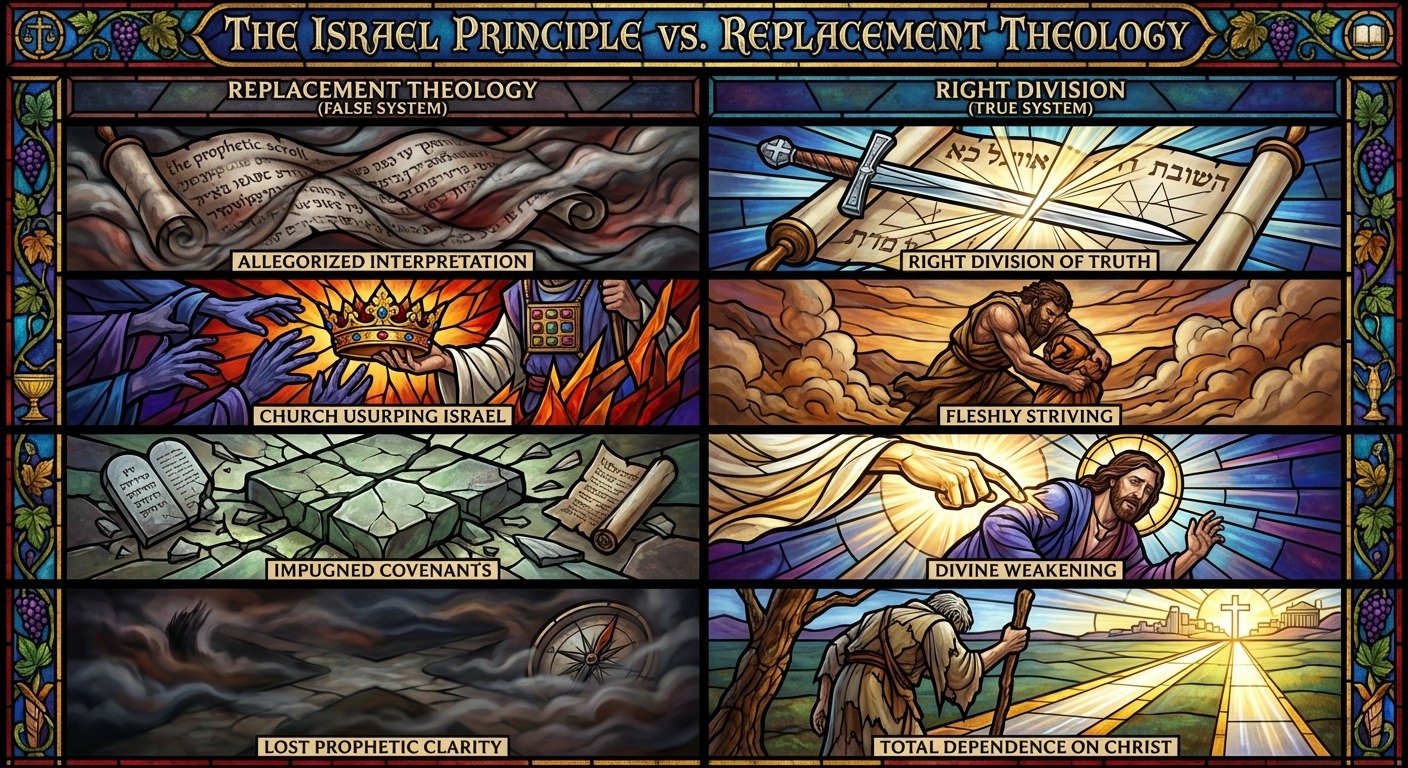
Click chart to view larger
From the teaching in: The Master Key: Daniel's 70th Week
Avoiding Interpretive Confusion
Rightly Dividing the Israel of God
This chart shows the structure. What follows explains each part.
There is a reading of Galatians 6:16 that has done enormous theological work over the centuries -- a reading in which 'the Israel of God' refers to the Church, which is then understood to have inherited the full prophetic identity of national Israel. From that reading, enormous conclusions follow: that Israel's land promises are spiritualized, that Israel's national future is absorbed into the Church's story, and that God's covenantal faithfulness to Abraham and his descendants has been fulfilled in a way that leaves nothing specifically awaiting the Jewish nation. This article examines that reading directly -- whether it holds up under exegetical scrutiny, and what is at stake if it does not.
There is a reading of Galatians 6:16 that has done enormous theological work over the centuries -- a reading in which 'the Israel of God' refers to the Church, which is then understood to have inherited the full prophetic identity of national Israel. From that reading, enormous conclusions follow: that Israel's land promises are spiritualized, that Israel's national future is absorbed into the Church's story, and that God's covenantal faithfulness to Abraham and his descendants has been fulfilled in a way that leaves nothing specifically awaiting the Jewish nation. This article examines that reading directly -- whether it holds up under exegetical scrutiny, and what is at stake if it does not.
The Danger of Blurring Israel and the Church
Interpretive confusion in prophecy and doctrine often arises when the God-given distinction between Israel and the Church is neglected or blurred. This confusion affects not only our understanding of prophecy but also our application of Scripture and even our perception of God's own character. One of the most significant theological errors stemming from this confusion is Replacement Theology—the view that the Church has permanently taken the place of Israel in God's program. Such a view stands in direct contradiction to Paul's clear teaching in Romans 11, where he asks, I say then, Hath God cast away his people? God forbid (Romans 11:1). God's faithfulness to His unconditional promises—both to Israel and to the Church—is a fundamental aspect of His character, and to deny this is to call His faithfulness into question.
The Principle of Right Division
A foundational principle for avoiding this interpretive confusion is to maintain a consistent, literal interpretation of Scripture, especially in the realm of prophecy. This does not mean ignoring figures of speech or symbolic language, but it does require us to interpret Scripture according to its normal, historical-grammatical sense unless the context demands otherwise. When we apply this approach, the distinction between Israel and the Church emerges clearly. Promises made to Israel as a nation are to be understood as pertaining to Israel, not spiritualized and applied to the Church.
Paul's instruction to Timothy underscores the importance of this approach: Study to shew thyself approved unto God, a workman that needeth not to be ashamed, rightly dividing the word of truth (2 Timothy 2:15). Right division includes recognizing the distinctions God Himself has established in His Word. When we fail to do so, we risk misapplying passages and doctrines in ways that obscure God's plan and purpose.
Understanding "The Israel of God" (Galatians 6:16)
A key passage that is frequently misunderstood in this regard is Galatians 6:16: And as many as walk according to this rule, peace be on them, and mercy, and upon the Israel of God. Some have used this verse to claim that the Church is now "the Israel of God," effectively spiritualizing ethnic Israel out of existence. However, Paul is not redefining Israel. Instead, he is drawing on the pattern from Jacob's life—a pattern of transformation through weakness.
Jacob, who sought to secure God's promises through his own schemes, was finally brought to a place of dependence when God touched his thigh, leaving him unable to rely on his own strength. From that moment, Jacob walked with a limp, leaning on a staff, and God changed his name to Israel, meaning "prince with God"—one who prevails not through human strength but through dependence on God.
This transformation is what Paul calls "the true circumcision" in Philippians 3:3: For we are the circumcision, which worship God in the spirit, and rejoice in Christ Jesus, and have no confidence in the flesh. The "Israel of God" in Galatians 6:16 refers to those—whether Jew or Gentile—who have experienced this transformation from fleshly striving to spiritual dependence. They have ceased to trust in their own works or abilities, having been brought to the end of themselves, and now depend entirely on Christ. They worship in the Spirit, rejoice in Christ Jesus, and have no confidence in the flesh.
A Distinction Preserved
It is important to note that Paul is not teaching that the Church has become ethnic Israel. Throughout his epistles, whenever Paul refers to "Israel," he consistently means national, ethnic Israel (see Romans 9:6; 10:19; 11:2, 7, 25, 26). In Galatians 6:16, he is not redefining Israel as the Church. Rather, he is pronouncing peace and mercy upon those who walk according to the new creation principle—those who, like Jacob, have been transformed through weakness and dependence on God. This is the "Israel principle" at work in believers, not a replacement of Israel as a nation in God's prophetic program.
Maintaining this understanding is vital. It allows us to avoid the error of Replacement Theology while recognizing the spiritual reality that God transforms His people through weakness, bringing them to the end of fleshly confidence so they might truly depend on Christ. The Jacob-to-Israel pattern is set forth for our learning, not for redefining who Israel is in God's redemptive plan.
The Result: Clarity and Confidence
When we interpret Scripture in this way—recognizing and maintaining the distinctions God has established—God's plan becomes clear and coherent. The book of Revelation, often considered difficult, becomes much clearer when we see its focus on the completion of God's program with Israel during the 70th week of Daniel. The events of Revelation 6-19 correspond to this seven-year period and are centered on Israel and the nations, not the Church.
This clarity gives us confidence in God's sovereign control over history and the assurance that He will fulfill all His promises exactly as He has stated—both to Israel and to the Church. Rightly dividing the word of truth preserves the integrity of God's character and the coherence of His redemptive plan, allowing us to rejoice in His faithfulness and wisdom.
What has been established here is that the Israel of God in Galatians 6:16 does not refer to the Church, and that replacement theology -- the broader claim that the Church has supplanted Israel in God's program -- is not a defensible reading of Paul or of the prophets. The implications of that conclusion run through the rest of the series, but before moving forward, this section closes with what is genuinely a convergence -- not of the two programs into one, but of two distinct programs both reaching their appointed conclusions under the same sovereign God. That convergence is the subject of the next article.
What has been established here is that the Israel of God in Galatians 6:16 does not refer to the Church, and that replacement theology -- the broader claim that the Church has supplanted Israel in God's program -- is not a defensible reading of Paul or of the prophets. The implications of that conclusion run through the rest of the series, but before moving forward, this section closes with what is genuinely a convergence -- not of the two programs into one, but of two distinct programs both reaching their appointed conclusions under the same sovereign God. That convergence is the subject of the next article.
Every chart in this series is free to explore online.
 Get the full chart set (PDF – $8)
Members get all PDFs included → Why Membership
Log in with an active membership to download printable PDFs on this site. Purchased on the shop? Access downloads from your shop account.
If you would like to help fund this work:
These charts are based on the following book:

The Master Key: Daniel's 70th Week
The Bible's Framework for Understanding Prophecy - 230 Page Paperback Edition
View Related Book