
Visual Theology – Bible Prophecy Charts
The Visual Theology charts are designed to help you see the structure and movement of Scripture. They highlight patterns, contrasts, and developments that are often difficult to hold together when reading line by line.
These charts show the structure of the argument. The accompanying articles develop each part in full.
This approach follows a long tradition of visual teaching in the Church. The well-known charts of Clarence Larkin helped many grasp the broad outline of Scripture. In the same spirit, these charts aim to make visible what the Word of God is revealing.
Charts and teaching notes for the book of Bible Prophecy Charts. Select a chart below to view the image and article.
Click chart to view larger
From the teaching in: The Master Key: Daniel's 70th Week
Historical Context: Daniel's Prayer and God's Response
Historical Context: Daniel's Prayer and God's Response
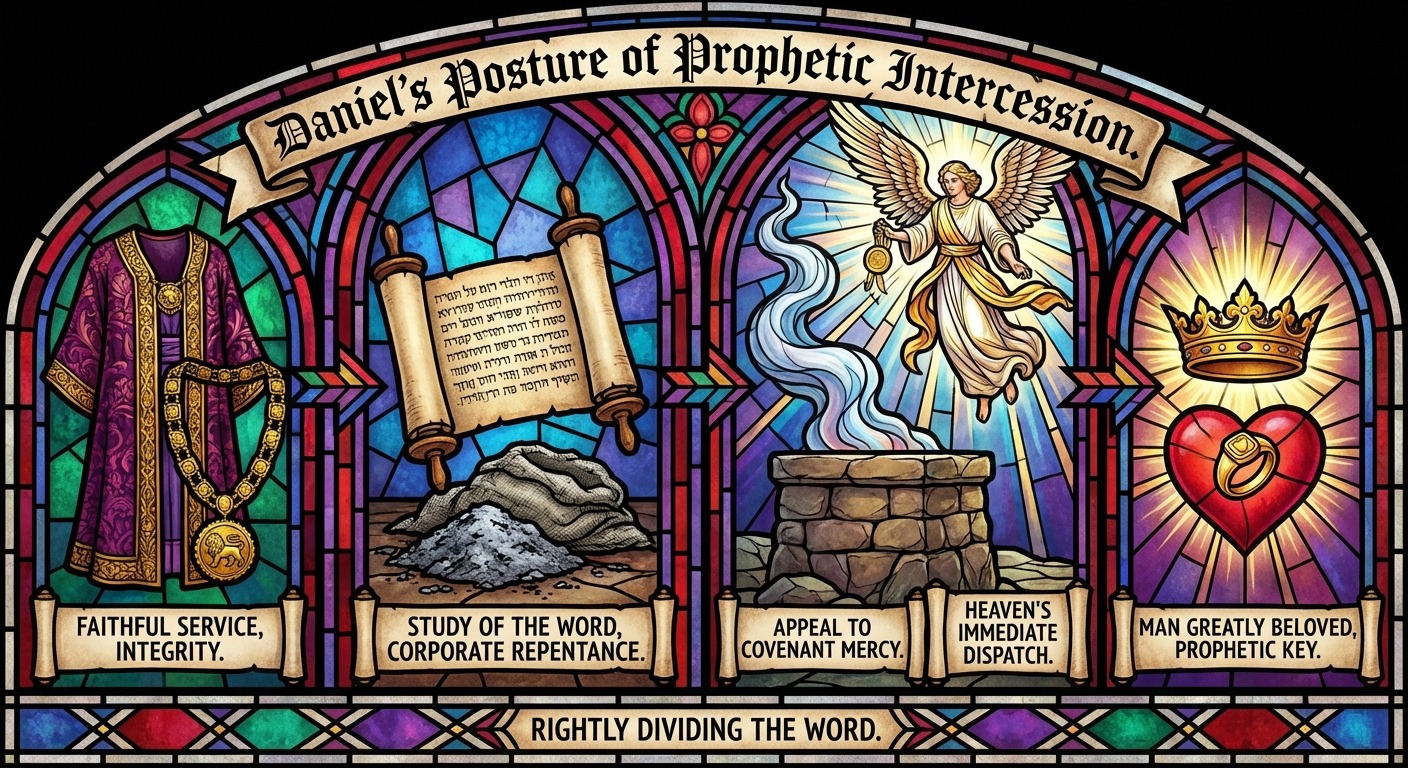
This chart shows the structure. What follows explains each part.
We tend to receive prophetic revelation as a text to be analyzed, but it came first as an answer to a prayer -- and the character of the one praying is inseparable from the weight of what he received. Before Gabriel arrived with the 70 weeks vision, there was a man in Babylon who had spent a lifetime of faithfulness under conditions designed to erode it, a man whose enemies could find nothing against him except the direction he faced when he prayed. The question this article presses on is not simply what Daniel prayed but who he was -- because God's choice of Daniel as the vessel of the most precise eschatological revelation in the Old Testament was not arbitrary, and understanding it guards against the kind of spiritual pride that treats prophetic knowledge as a status symbol rather than a stewardship.
We tend to receive prophetic revelation as a text to be analyzed, but it came first as an answer to a prayer -- and the character of the one praying is inseparable from the weight of what he received. Before Gabriel arrived with the 70 weeks vision, there was a man in Babylon who had spent a lifetime of faithfulness under conditions designed to erode it, a man whose enemies could find nothing against him except the direction he faced when he prayed. The question this article presses on is not simply what Daniel prayed but who he was -- because God's choice of Daniel as the vessel of the most precise eschatological revelation in the Old Testament was not arbitrary, and understanding it guards against the kind of spiritual pride that treats prophetic knowledge as a status symbol rather than a stewardship.
The Context of Daniel's Prophecy
To understand the weight and authority of Daniel's prophecy, we must first consider the extraordinary historical and spiritual context in which it was received. Daniel's revelation came during the Babylonian captivity, a period marked by national despair as Jerusalem lay in ruins and the Temple had been destroyed. The Jewish people, exiled and chastened, wondered if God had abandoned His covenant promises. It was in this setting that Daniel, moved by the fulfillment of Jeremiah's words, sought the Lord with prayer and supplication, fasting, sackcloth, and ashes (Daniel 9:2-3). His intercession was not born of mere ritual, but of a deep identification with his people's guilt and a profound understanding of God's faithfulness.
A Man with an Excellent Spirit
Daniel stands apart in the biblical record, not as an ordinary prophet, but as one distinguished by what Scripture calls an excellent spirit (Daniel 5:12; 6:3). This was not a common measure of virtue, but the most excellent spirit found in any biblical figure. Even pagan kings, steeped in the wisdom and mysteries of Babylon, recognized that the wisdom of God operated through Daniel in a manner unparalleled in their experience. Daniel's life echoes the pattern of Joseph—faithfulness in a foreign land, elevation in the face of opposition, and divine favor that brought blessing to his captors. Yet Daniel surpasses even Joseph, for to him was entrusted the revelation and interpretation of the end of the age, the eschatological framework with its precise calculations and prophetic signs. In terms of scope and precision, Daniel is the Revelation of the Old Testament.
The Integrity of Daniel's Character
The integrity of Daniel's character is central to the theology of his prayer. He served faithfully under Nebuchadnezzar, Belshazzar, and Darius, maintaining devotion to God amid Babylon's corruptions and idolatries. His enemies, unable to find any fault in his administration, confessed, "We shall not find any occasion against this Daniel, except we find it against him concerning the law of his God" (Daniel 6:5). Daniel's obedience was so consistent that his faithfulness was the only ground for accusation. In the trial of the lions' den, Daniel's innocence was vindicated not only before men but before God: "My God hath sent his angel, and hath shut the lions' mouths, that they have not hurt me: forasmuch as before him innocency was found in me" (Daniel 6:22). Such testimony appears nowhere else in the Old Testament. The result was not merely Daniel's deliverance, but the conversion of a pagan king, who decreed that all should fear before the God of Daniel, "for he is the living God, and stedfast for ever, and his kingdom that which shall not be destroyed, and his dominion shall be even unto the end" (Daniel 6:26).
God's choice of Daniel as the recipient of the 70 weeks prophecy is thus no accident. The weight of biblical testimony concerning Daniel's character serves to validate the revelation he received. God entrusted the chronological blueprint for redemptive history to one whose life, wisdom, and spirit were above reproach—Daniel, the man greatly beloved (Daniel 9:23). This unique designation, spoken by Gabriel, appears nowhere else in the Old Testament and underscores the supreme importance of the message that follows.
Faithful Service in a Foreign Land
Daniel's service in Babylon further rebukes the confusion of spiritual faithfulness with cultural resistance or political activism. Daniel 2:48 records that Nebuchadnezzar made him ruler over the whole province of Babylon and chief of the governors over all the wise men of Babylon. Daniel, therefore, was placed in authority over the very practitioners of Babylonian mystery religion—the Chaldeans, astrologers, soothsayers, and magicians. He daily walked among those steeped in occult symbols and pagan wisdom, likely bearing the regalia of office associated with such authority. Yet Daniel maintained perfect integrity, never defiling himself, nor confusing his faithful service with compromise. He did not resist Babylon's authority, nor stage protests against ungodly decrees. His resistance was private prayer, not public rebellion; his testimony was excellent service, not cultural grievance. This pattern stands in contrast to the spirit of modern "prophecy watchers," who often mistake activism for spiritual fidelity.
The Occasion and Nature of Daniel's Prayer
The occasion of Daniel's prayer was his study of Jeremiah's prophecy, by which he discerned that the seventy years of captivity were accomplished (Daniel 9:2). Daniel was a student of Scripture, not a passive recipient of visions. His prayer, recorded in Daniel 9:4-19, is marked by corporate confession—"we have sinned"—despite his own personal righteousness. He appeals not to Israel's merit, but to God's great mercies and to the honor of His name, recognizing that Jerusalem and the people are called by God's name, and that their condition reflects on God's reputation before the nations.
The Divine Response: Gabriel's Arrival
The response to Daniel's intercession is immediate and emphatic. Gabriel is dispatched "at the beginning of thy supplications" (Daniel 9:23), suggesting a divine urgency. Gabriel addresses Daniel as "greatly beloved" and announces that he has come to give "skill and understanding." The appearance of Gabriel in this context is profoundly significant, for in all of Scripture, Gabriel appears only here and in connection with the advent of Christ—to Zechariah (Luke 1:11-19) and to Mary (Luke 1:26-38). These three announcements—the prophecy of the 70 weeks, the forerunner's birth, and the Messiah's incarnation—stand as the most significant angelic messages in redemptive history. By sending Gabriel to Daniel, God places this revelation at the very heart of His unfolding plan.
Conclusion: The Source of True Prophetic Insight
In sum, the historical context of Daniel's prayer reveals a man whose life embodied the highest standard of faithfulness, humility, and wisdom. His intercession for his people was grounded in Scripture, marked by corporate repentance, and answered with a revelation of unparalleled significance. Daniel's example teaches that true prophetic insight arises not from cultural resistance or spiritual pride, but from humble devotion, integrity, and a heart aligned with God's purposes. The prophecy that follows is validated not only by its content, but by the character of the one who received it—a man greatly beloved, chosen to unveil the architecture of God's redemptive plan.
What Daniel's life establishes is this: that he was personally justified by faith, walking with God in a foreign land, while simultaneously carrying the burden of his nation's covenantal failure. This is not incidental -- it is structurally important. The prayer that received the 70 weeks vision was a prayer that held both realities at once, and that dual holding is what the next article examines directly: what it means that Daniel occupied two positions before God at the same time.
What Daniel's life establishes is this: that he was personally justified by faith, walking with God in a foreign land, while simultaneously carrying the burden of his nation's covenantal failure. This is not incidental -- it is structurally important. The prayer that received the 70 weeks vision was a prayer that held both realities at once, and that dual holding is what the next article examines directly: what it means that Daniel occupied two positions before God at the same time.
Every chart in this series is free to explore online.
 Get the full chart set (PDF – $8)
Members get all PDFs included → Why Membership
Log in with an active membership to download printable PDFs on this site. Purchased on the shop? Access downloads from your shop account.
If you would like to help fund this work:
These charts are based on the following book:

The Master Key: Daniel's 70th Week
The Bible's Framework for Understanding Prophecy - 230 Page Paperback Edition
View Related Book