
Visual Theology – Bible Prophecy Charts
The Visual Theology charts are designed to help you see the structure and movement of Scripture. They highlight patterns, contrasts, and developments that are often difficult to hold together when reading line by line.
These charts show the structure of the argument. The accompanying articles develop each part in full.
This approach follows a long tradition of visual teaching in the Church. The well-known charts of Clarence Larkin helped many grasp the broad outline of Scripture. In the same spirit, these charts aim to make visible what the Word of God is revealing.
Charts and teaching notes for the book of Bible Prophecy Charts. Select a chart below to view the image and article.
Click chart to view larger
From the teaching in: The Master Key: Daniel's 70th Week
Luke 21: The Desolations Begin and the Times of the Gentiles
Luke 21 and the Times of the Gentiles
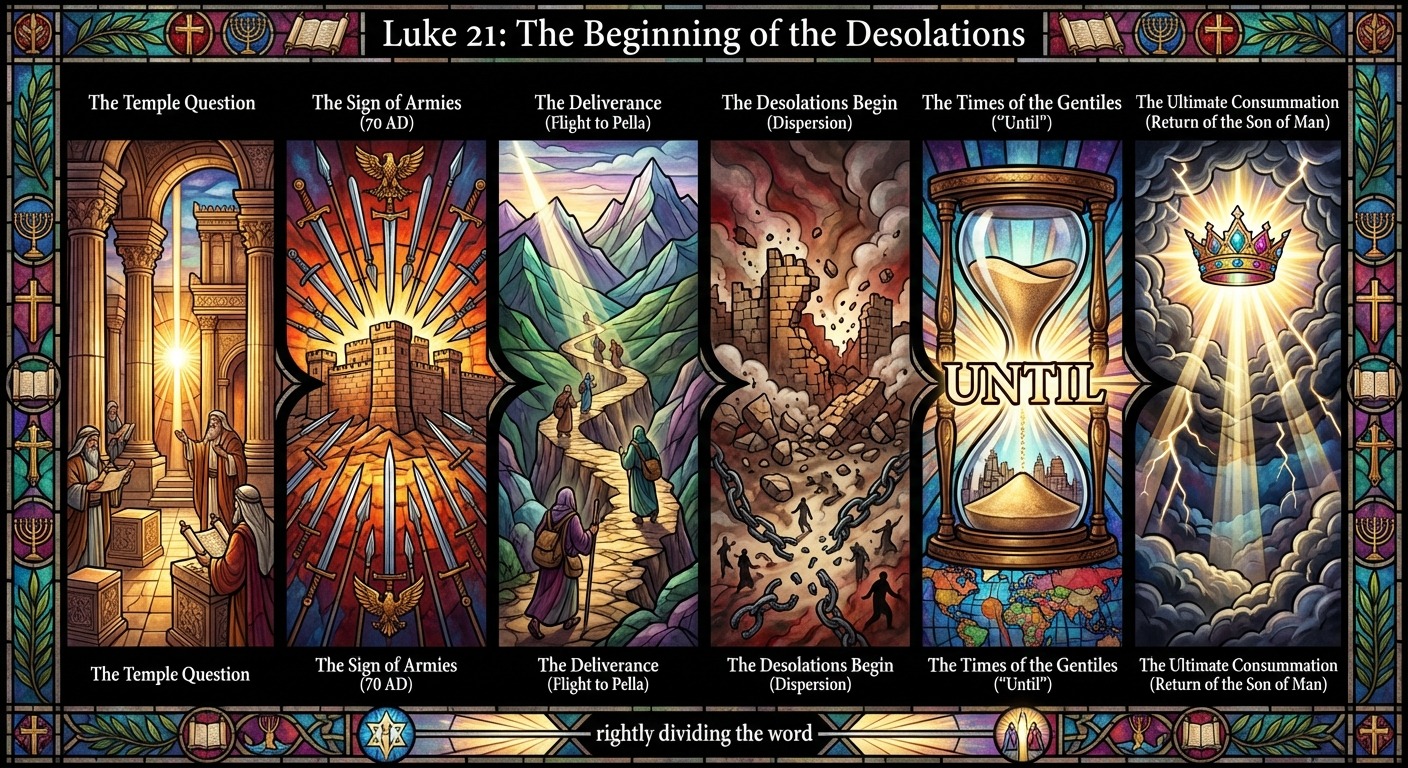
This chart shows the structure. What follows explains each part.
It is possible to read Luke 21 and Matthew 24 side by side and assume they are telling the same story -- two versions of one discourse, slightly different in emphasis. Most readers have done exactly that, and the resulting confusion has shaped centuries of interpretation. But the two accounts are not parallel versions of the same speech; they are records of two distinct prophetic answers to two distinct questions, covering two different segments of Daniel's timeline. Luke 21 is the account that concerns the near horizon -- Jerusalem's destruction, the dispersion, and the long period that Jesus names 'the times of the Gentiles' -- and this article examines what that period is, how it connects to Daniel's desolations, and why it still has not ended.
It is possible to read Luke 21 and Matthew 24 side by side and assume they are telling the same story -- two versions of one discourse, slightly different in emphasis. Most readers have done exactly that, and the resulting confusion has shaped centuries of interpretation. But the two accounts are not parallel versions of the same speech; they are records of two distinct prophetic answers to two distinct questions, covering two different segments of Daniel's timeline. Luke 21 is the account that concerns the near horizon -- Jerusalem's destruction, the dispersion, and the long period that Jesus names 'the times of the Gentiles' -- and this article examines what that period is, how it connects to Daniel's desolations, and why it still has not ended.
The Prophetic Framework of Luke 21
In Luke 21, Jesus provides a prophetic answer to a question posed by His disciples regarding the timing and sign of the temple's destruction. Unlike Matthew's account, which addresses the sign of Christ's coming and the end of the age, Luke records a distinct question: Master, but when shall these things be? and what sign will there be when these things shall come to pass? (Luke 21:7). This focus on the immediate future of Jerusalem leads Jesus to root His response in the prophetic framework established by Daniel, specifically the "desolations determined" described in Daniel 9:26.
The Sign and the Desolation
Jesus declares, And when ye shall see Jerusalem compassed with armies, then know that the desolation thereof is nigh (Luke 21:20). This statement directly connects to Daniel 9:26, where the prophet foretold: the people of the prince that shall come shall destroy the city and the sanctuary; and the end thereof shall be with a flood, and unto the end of the war desolations are determined. Jesus is not merely predicting a historical calamity but is identifying the destruction of Jerusalem as the beginning of a divinely determined period—the desolations that would follow Israel's rejection of her Messiah.
The subsequent warning—Then let them which are in Judaea flee to the mountains; and let them which are in the midst of it depart out; and let not them that are in the countries enter thereinto. For these be the days of vengeance, that all things which are written may be fulfilled (Luke 21:21-22)—invokes the language of Old Testament judgment. The "days of vengeance" are the outworking of prophetic warnings issued through the former prophets, culminating in the Roman destruction of Jerusalem in 70 AD.
The "Times of the Gentiles"
Yet, as Jesus continues, it becomes clear that this event inaugurates a much longer epoch: And they shall fall by the edge of the sword, and shall be led away captive into all nations: and Jerusalem shall be trodden down of the Gentiles, until the times of the Gentiles be fulfilled (Luke 21:24).
This verse is pivotal for understanding the theological significance of Luke 21. The fall of Jerusalem and the subsequent dispersion of the Jewish people among the nations mark the commencement of the "desolations determined"—a period during which Jerusalem remains under Gentile control and Israel is scattered. The phrase "times of the Gentiles" is not a mere historical observation but a prophetic designation for the gap between Daniel's sixty-ninth and seventieth weeks. This era, now spanning nearly two millennia, was foreseen in the Old Testament though not fully explained. It is echoed in Paul's teaching: blindness in part is happened to Israel, until the fulness of the Gentiles be come in (Romans 11:25).
The Temporary Nature of Judgment
The use of "until" in Luke 21:24 is crucial. It signals that the desolation and Gentile domination are temporary, not permanent. This aligns with the pattern found elsewhere in Scripture, where God sets clear temporal boundaries on Israel's judgment. Zechariah describes the aftermath of Israel's hardness of heart: I scattered them with a whirlwind among all the nations whom they knew not. Thus the land was desolate after them...for they laid the pleasant land desolate (Zechariah 7:14). Ezekiel likewise foretells a future restoration: And the desolate land shall be tilled, whereas it lay desolate in the sight of all that passed by...Then the heathen that are left round about you shall know that I the LORD build the ruined places (Ezekiel 36:34, 36). The prophetic vocabulary of "desolation" thus directly links Israel's scattering and Jerusalem's subjugation to God's determined plan, with restoration assured at the appointed time.
Historical Fulfillment and Future Hope
Historical fulfillment confirms the accuracy of Jesus' words. When the Roman armies first surrounded Jerusalem in 66 AD and then withdrew, believers who heeded Christ's warning escaped to safety. The destruction that followed in 70 AD was catastrophic, yet it was only the beginning of a prolonged period of dispersion and Gentile dominance. This historical episode serves not only as fulfillment but as a pattern—a foreshadowing of the greater deliverance that awaits the believing remnant of Israel at the end of the age.
Luke's account does not stop at the beginning of the desolations. It points forward to their conclusion: And there shall be signs in the sun, and in the moon, and in the stars; and upon the earth distress of nations...And then shall they see the Son of man coming in a cloud with power and great glory (Luke 21:25-27). These events transcend the destruction of 70 AD and anticipate the consummation of God's prophetic program when Christ returns and the desolations end.
Theological Import for the Believer
For the believer, the theological import of Luke 21 is profound. Jesus' prophetic teaching is not an isolated prediction but is anchored in Daniel's framework (Daniel 9:24-27), explaining how the destruction of the city and sanctuary fits within God's overarching plan. The "times of the Gentiles" represent a divinely appointed interval during which Israel is set aside nationally and Jerusalem is under Gentile control. Yet this period will end, as assured by the repeated "until" statements throughout Scripture. The God who fulfilled His word in 70 AD will fulfill His promises regarding Israel's restoration and the completion of Daniel's seventieth week. This confidence in God's faithfulness undergirds the believer's hope and expectation as history moves toward its appointed consummation.
Luke 21 has located us in the desolations -- the period of Israel's dispersion, Jerusalem under Gentile dominion, the timeline suspended between Daniel's sixty-ninth and seventieth weeks. What Matthew 24 addresses is the other end of that period: the sign of the end, the abomination of desolation, and the events that close the gap and initiate the final week. The two accounts are not competing witnesses; they are complementary ones, and bringing them together in the right order is what the next article does.
Luke 21 has located us in the desolations -- the period of Israel's dispersion, Jerusalem under Gentile dominion, the timeline suspended between Daniel's sixty-ninth and seventieth weeks. What Matthew 24 addresses is the other end of that period: the sign of the end, the abomination of desolation, and the events that close the gap and initiate the final week. The two accounts are not competing witnesses; they are complementary ones, and bringing them together in the right order is what the next article does.
Every chart in this series is free to explore online.
 Get the full chart set (PDF – $8)
Members get all PDFs included → Why Membership
Log in with an active membership to download printable PDFs on this site. Purchased on the shop? Access downloads from your shop account.
If you would like to help fund this work:
These charts are based on the following book:

The Master Key: Daniel's 70th Week
The Bible's Framework for Understanding Prophecy - 230 Page Paperback Edition
View Related Book