
Visual Theology – Bible Prophecy Charts
The Visual Theology charts are designed to help you see the structure and movement of Scripture. They highlight patterns, contrasts, and developments that are often difficult to hold together when reading line by line.
These charts show the structure of the argument. The accompanying articles develop each part in full.
This approach follows a long tradition of visual teaching in the Church. The well-known charts of Clarence Larkin helped many grasp the broad outline of Scripture. In the same spirit, these charts aim to make visible what the Word of God is revealing.
Charts and teaching notes for the book of Bible Prophecy Charts. Select a chart below to view the image and article.
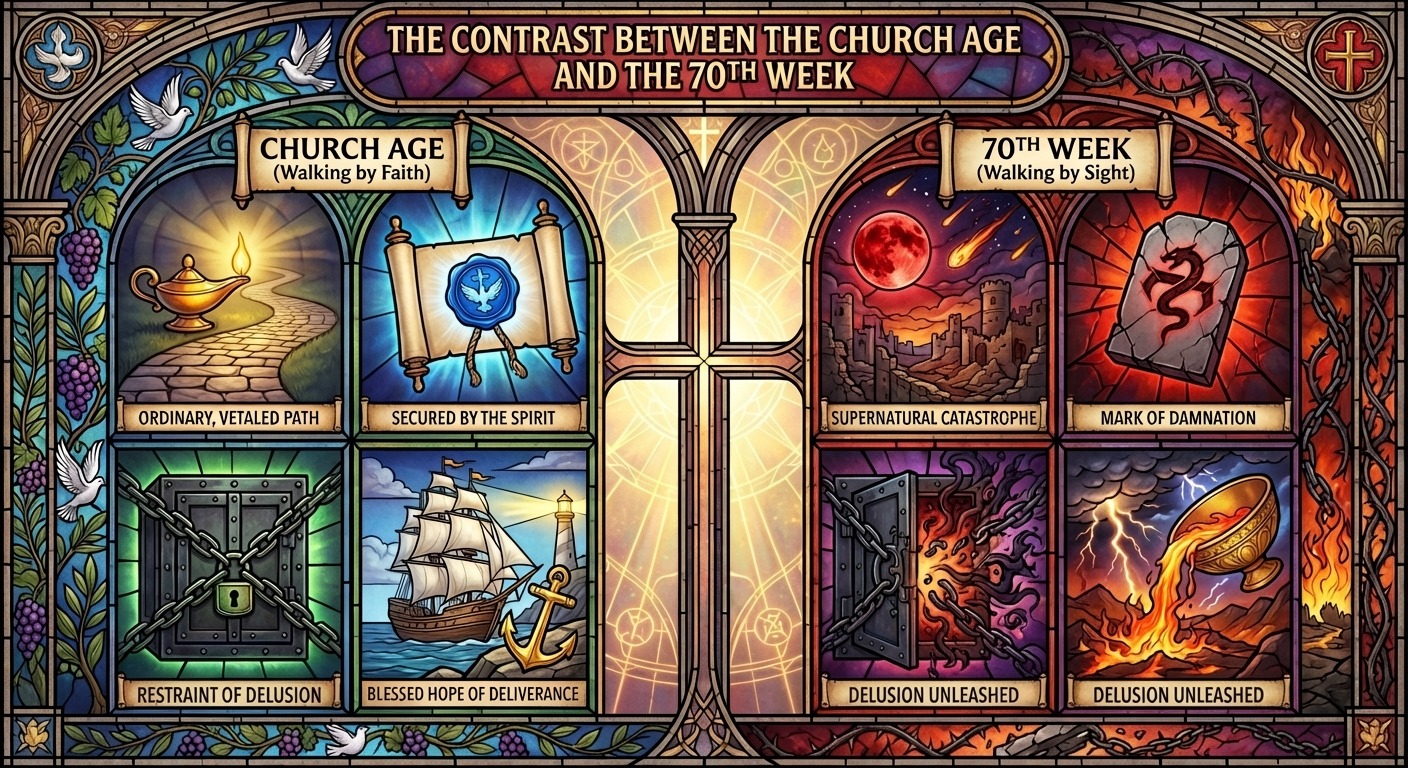
Click chart to view larger
From the teaching in: The Master Key: Daniel's 70th Week
The Comfort of Revelation's Message
The Comfort of Revelation's Message
This chart shows the structure. What follows explains each part.
For a book named after unveiling, Revelation has produced an extraordinary amount of dread -- which suggests that many readers have not actually received what it was sent to deliver. The book was addressed to seven churches in a time of persecution, and its dominant tone -- beneath the thundering judgments and the cosmic upheavals -- is reassurance: that God is on the throne, that the Lamb has already conquered, and that His people are not appointed to the wrath that falls on a world that rejected Him. Receiving that reassurance requires knowing where the Church stands in the timeline Daniel established, and this article makes that location clear.
For a book named after unveiling, Revelation has produced an extraordinary amount of dread -- which suggests that many readers have not actually received what it was sent to deliver. The book was addressed to seven churches in a time of persecution, and its dominant tone -- beneath the thundering judgments and the cosmic upheavals -- is reassurance: that God is on the throne, that the Lamb has already conquered, and that His people are not appointed to the wrath that falls on a world that rejected Him. Receiving that reassurance requires knowing where the Church stands in the timeline Daniel established, and this article makes that location clear.
The Comfort of Revelation
It may seem paradoxical to describe the book of Revelation—replete with vivid judgments, plagues, and cosmic upheavals—as a source of comfort. Yet for those who understand its message through the lens of Daniel’s prophecy, Revelation is not given to frighten the Church but to comfort it. The key to this reassurance lies in recognizing that the tribulation period, Daniel’s 70th week, is a future epoch fundamentally distinct from the present Church Age. This distinction is not minor, but essential for rightly dividing prophecy and discerning the believer’s present experience.
The Unparalleled Nature of the 70th Week
The 70th week will be a time of unprecedented, supernatural upheaval. Jesus Himself declared, “For then shall be great tribulation, such as was not since the beginning of the world to this time, no, nor ever shall be” (Matthew 24:21). Daniel described it as “a time of trouble, such as never was since there was a nation” (Daniel 12:1). These are not exaggerations, but sober statements underscoring the unparalleled character of that period.
The events of the 70th week will include cosmic signs and supernatural occurrences without parallel in human history: the sun darkened, the moon turned to blood, stars falling from heaven, waters transformed to blood, demonic armies unleashed from the abyss, an image of the beast that speaks and kills, the false prophet calling fire from heaven, and plagues of unprecedented severity (cf. Revelation 13:14-18). Reality itself will be torn open as God intervenes directly, in ways not seen since the days of Egypt.
During this time, 144,000 sealed servants—Jewish believers transformed by the New Covenant, described as having “no guile in their mouth” and being “without fault before God” (Revelation 14:5)—will proclaim the gospel of the kingdom worldwide. Two witnesses will be granted supernatural power to prophesy, call down plagues, and withhold rain (Revelation 11:3-6). The restrainer will have been removed, allowing the full force of Satan’s deception to operate through the beast and false prophet. The mark of the beast will be required for commerce, and those who accept it will be sealed unto damnation (Revelation 13:16-18; 14:10). The entire order of creation will be upended as judgment falls.
A Stark Contrast with the Church Age
This period bears almost nothing in common with the Church Age except for two constants: the gospel, which will still save those who believe, and the faith of the saints, which will sustain those who endure. Otherwise, the 70th week is marked by a complete rupture from the present order.
- In the Church Age, we “walk by faith, not by sight” (2 Corinthians 5:7), but in the 70th week, supernatural manifestations will be visible to all.
- We are sealed by the Holy Spirit unto the day of redemption (Ephesians 4:30), but in the 70th week, those who take the mark are sealed unto damnation.
- Today, the mystery of iniquity is restrained (2 Thessalonians 2:7), but then, that restraint will be removed and lawlessness will reach its zenith.
- Now, we are “appointed to obtain salvation, not wrath” (1 Thessalonians 5:9), but in that future period, “the wrath of God will be poured out without mixture upon those who worship the beast” (Revelation 14:10).
The difference between the Church Age and the 70th week is as stark as day and night, as distinct as walking by faith in a veiled world and living through open supernatural catastrophe. Attempts to place the Church in the tribulation or to claim we are experiencing Revelation’s events now fundamentally misunderstand the nature of that coming period. The 70th week is not a mere intensification of present conditions—it is a complete break with the current order, so unique that Scripture devotes more attention to those seven years than to any other period in history.
The Church’s Blessed Hope
This is why the Church’s exemption from the coming wrath is described as our “blessed hope.” We are not appointed to experience this wrath, but to obtain salvation. Revelation’s portrayal of tribulation is not intended to terrify believers, but rather to underscore the urgency of salvation and to motivate us to share the gospel with renewed passion and clarity. The prophetic warnings are given to inspire faithfulness now and gratitude for our exemption.
As John records, Jesus says, “Surely I come quickly,” to which John responds, “Amen. Even so, come, Lord Jesus” (Revelation 22:20). This is the proper response—not fear that we will endure these judgments, but eager longing for Christ to come and remove us before they begin.
In this light, the message of Revelation is profoundly comforting. It assures the Church that the coming tribulation is not our portion, and it calls us to live in anticipation of Christ’s return, motivated by the certainty of deliverance and the urgency of the gospel.
The comfort of Revelation has been grounded: the Church is not appointed to wrath, and the distinction between the Church Age and Daniel's seventieth week is what makes that comfort coherent rather than wishful. But comfort rests on a framework, and that framework requires an understanding of exactly what Paul taught about the sequence of events at the end of the age -- the restrainer, the removal, the revelation of the man of sin, the Day of the Lord -- because Paul's eschatological architecture is the load-bearing structure underneath the comfort Revelation offers.
The comfort of Revelation has been grounded: the Church is not appointed to wrath, and the distinction between the Church Age and Daniel's seventieth week is what makes that comfort coherent rather than wishful. But comfort rests on a framework, and that framework requires an understanding of exactly what Paul taught about the sequence of events at the end of the age -- the restrainer, the removal, the revelation of the man of sin, the Day of the Lord -- because Paul's eschatological architecture is the load-bearing structure underneath the comfort Revelation offers.
Every chart in this series is free to explore online.
 Get the full chart set (PDF – $8)
Members get all PDFs included → Why Membership
Log in with an active membership to download printable PDFs on this site. Purchased on the shop? Access downloads from your shop account.
If you would like to help fund this work:
These charts are based on the following book:

The Master Key: Daniel's 70th Week
The Bible's Framework for Understanding Prophecy - 230 Page Paperback Edition
View Related Book