
Visual Theology – Bible Prophecy Charts
The Visual Theology charts are designed to help you see the structure and movement of Scripture. They highlight patterns, contrasts, and developments that are often difficult to hold together when reading line by line.
These charts show the structure of the argument. The accompanying articles develop each part in full.
This approach follows a long tradition of visual teaching in the Church. The well-known charts of Clarence Larkin helped many grasp the broad outline of Scripture. In the same spirit, these charts aim to make visible what the Word of God is revealing.
Charts and teaching notes for the book of Bible Prophecy Charts. Select a chart below to view the image and article.
Click chart to view larger
From the teaching in: The Master Key: Daniel's 70th Week
Conclusion: The Key to All Prophecy
Conclusion: The Key to All Prophecy
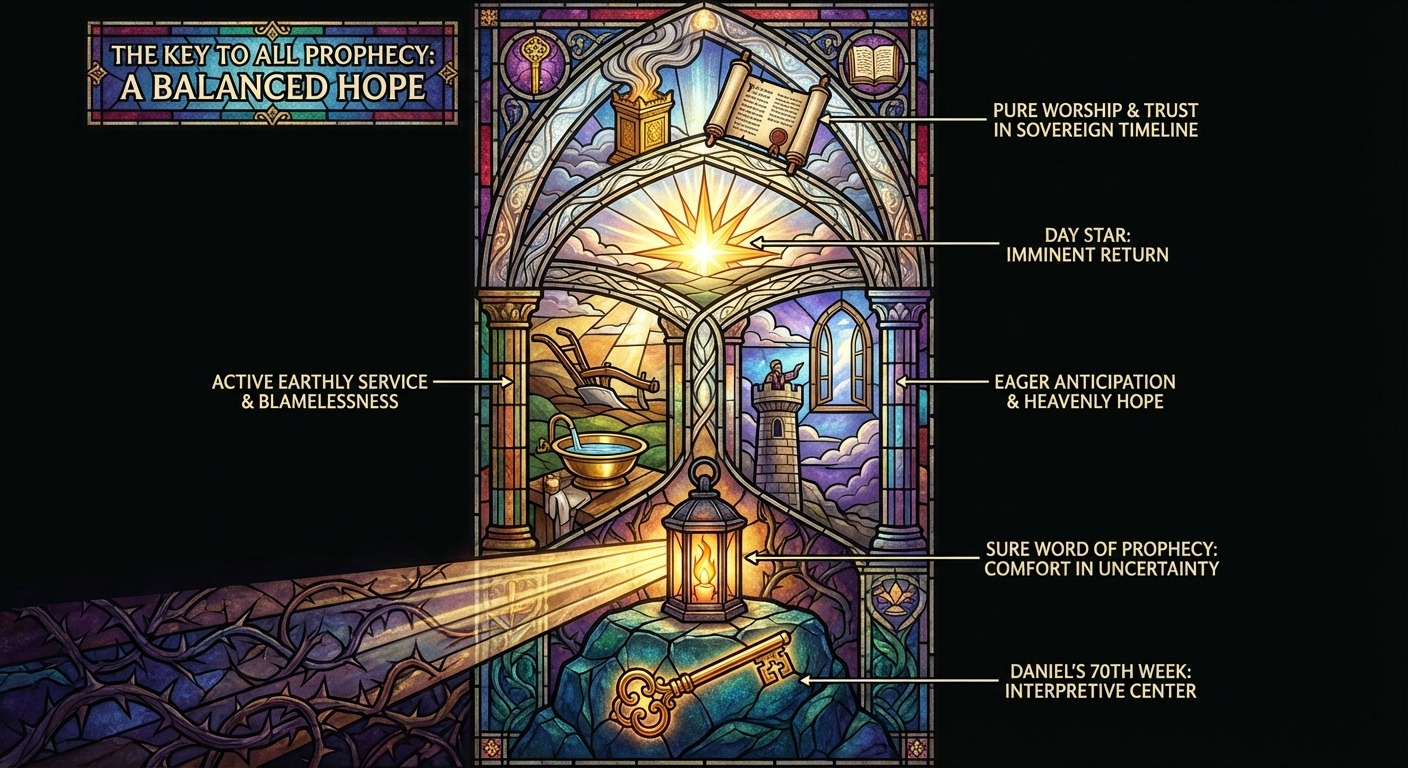
This chart shows the structure. What follows explains each part.
Every major argument this series has made has led here: to the question of what it means to hold a key. Daniel's 70 weeks has been called the master key to prophecy, and that language is precise -- a key is not an answer to every question, but it is the instrument that opens the room in which the answers are found. Having traced the prophecy from its historical context through its structural analysis through its New Testament development through its present and future implications, the final question is: what does a person who has received this key actually do with it, and what kind of life does it orient toward?
Every major argument this series has made has led here: to the question of what it means to hold a key. Daniel's 70 weeks has been called the master key to prophecy, and that language is precise -- a key is not an answer to every question, but it is the instrument that opens the room in which the answers are found. Having traced the prophecy from its historical context through its structural analysis through its New Testament development through its present and future implications, the final question is: what does a person who has received this key actually do with it, and what kind of life does it orient toward?
The Balanced Study of Prophecy
The study of prophecy is often met with extremes: some are drawn into endless speculation and anxiety, while others dismiss it as irrelevant or too complex for practical faith. Yet the testimony of Scripture calls for a balanced approach, one that neither obsesses over prophetic minutiae nor ignores the profound hope and direction prophecy provides. At the heart of biblical eschatology lies Daniel's 70th Week (Daniel 9:24-27), which serves as the interpretive center for understanding the unfolding of God's plan. Recognizing this central framework brings coherence and clarity to the prophetic word, allowing believers to see how the various passages of Scripture align and point toward their appointed fulfillment.
A Source of Comfort and Clarity
This consistency in prophetic revelation is not merely a matter of intellectual satisfaction; it is a source of deep comfort in an age of uncertainty. The Word of God assures us that, despite the darkness and confusion that may surround us, His purposes are advancing with unerring precision. As Peter writes, "We have also a more sure word of prophecy; whereunto ye do well that ye take heed, as unto a light that shineth in a dark place, until the day dawn, and the day star arise in your hearts" (2 Peter 1:19). The prophetic Scriptures function as a lantern, casting beams of hope and guidance across the thorny path of our present journey, enabling us to walk with confidence toward the day of Christ.
Active Anticipation
Living in light of this prophetic hope does not mean disengaging from the world or becoming preoccupied with calculating dates. Rather, it means maintaining an eager anticipation of Christ's return while laboring faithfully in the present. Paul describes this balance in his letter to the Corinthians: "So that ye come behind in no gift; waiting for the coming of our Lord Jesus Christ: Who shall also confirm you unto the end, that ye may be blameless in the day of our Lord Jesus Christ" (1 Corinthians 1:7-8). The expectation of the Lord's appearing is not a passive waiting but an active, Spirit-empowered service that is rooted in the certainty of God's promises.
The Proper Posture of Hope
The final words of Scripture capture the proper posture of the believer: "He which testifieth these things saith, Surely I come quickly. Amen. Even so, come, Lord Jesus" (Revelation 22:20). This is the hopeful anticipation that should characterize our response—not a restless searching for hidden clues, but a steadfast longing for the One who is faithful to His word. The balanced perspective avoids both distraction and neglect, enabling prophecy to fulfill its intended role: providing hope, motivation, and direction as we navigate the present age and look forward to the glorious future God has prepared.
From Study to Worship
Ultimately, the study of prophecy should lead to worship. As we marvel at God's wisdom in orchestrating history toward its appointed end, our trust in His faithfulness deepens. We recognize that every prophetic promise will be fulfilled with the same precision as those already accomplished. Our longing for Christ's return intensifies, and our hearts are anchored in the hope that, when faith gives way to sight, we shall see Him face to face.
Until that day, the exhortation remains: "Wherefore, beloved, seeing that ye look for such things, be diligent that ye may be found of him in peace, without spot, and blameless" (2 Peter 3:14). To truly live in light of prophecy is to walk in this hope—faithful, watchful, and confident in the sure word that shines until the day dawns and the day star arises in our hearts.
The key to all prophecy is not finally a chronological framework -- it is a Person, the one to whom every timeline points, in whom every promise is yes and amen, and by whose return every prophetic word will be fulfilled with the same precision that has marked every fulfillment before it. The study of Daniel's 70 weeks is not meant to produce prophetic experts; it is meant to produce people whose confidence in God's word is so complete that they can live without anxiety about the future, love without conditions in the present, and look without fear toward the day when the Heir of all things enters His inheritance -- and brings us with Him.
The key to all prophecy is not finally a chronological framework -- it is a Person, the one to whom every timeline points, in whom every promise is yes and amen, and by whose return every prophetic word will be fulfilled with the same precision that has marked every fulfillment before it. The study of Daniel's 70 weeks is not meant to produce prophetic experts; it is meant to produce people whose confidence in God's word is so complete that they can live without anxiety about the future, love without conditions in the present, and look without fear toward the day when the Heir of all things enters His inheritance -- and brings us with Him.
Every chart in this series is free to explore online.
 Get the full chart set (PDF – $8)
Members get all PDFs included → Why Membership
Log in with an active membership to download printable PDFs on this site. Purchased on the shop? Access downloads from your shop account.
If you would like to help fund this work:
These charts are based on the following book:

The Master Key: Daniel's 70th Week
The Bible's Framework for Understanding Prophecy - 230 Page Paperback Edition
View Related Book