Visual Theology – Bible Prophecy Charts
The Visual Theology charts are designed to help you see the structure and movement of Scripture. They highlight patterns, contrasts, and developments that are often difficult to hold together when reading line by line.
These charts show the structure of the argument. The accompanying articles develop each part in full.
This approach follows a long tradition of visual teaching in the Church. The well-known charts of Clarence Larkin helped many grasp the broad outline of Scripture. In the same spirit, these charts aim to make visible what the Word of God is revealing.
Charts and teaching notes for the book of Bible Prophecy Charts. Select a chart below to view the image and article.
Click chart to view larger
From the teaching in: The Master Key: Daniel's 70th Week
Why This Matters: The Three Judgments and the Gospel
Why Confusion About Judgments Matters
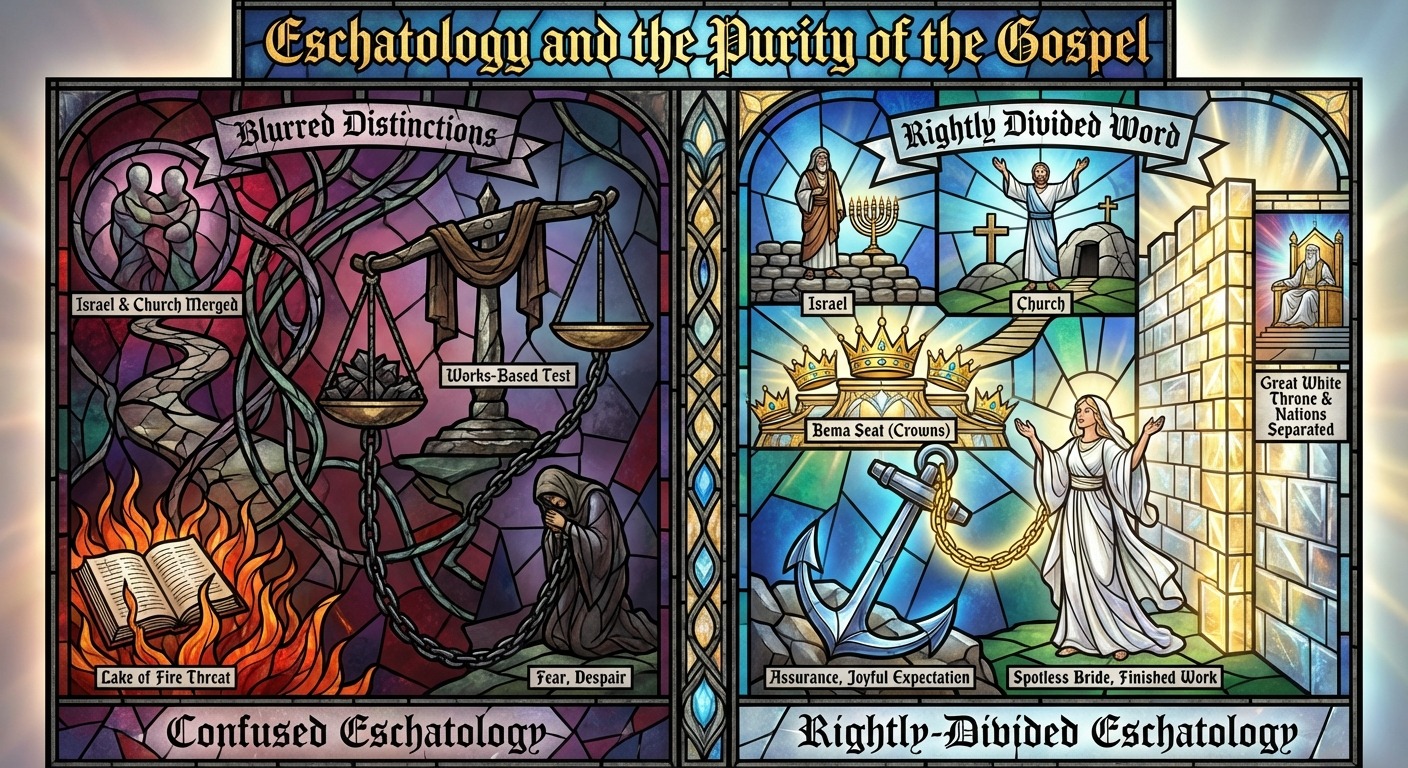
This chart shows the structure. What follows explains each part.
Here is a question worth sitting with before reading the article: have you ever heard a sermon on the Bema Seat that produced anxiety rather than hope? Have you ever read about the Great White Throne and wondered -- not as an academic matter but as a genuine personal uncertainty -- whether you might be among those standing there? Have you ever heard Matthew 25's Sheep and Goat judgment described as the evaluation Christians will face for their works? If any of those descriptions landed with real weight rather than being immediately recognized as a category error, this article is specifically for you -- because the confusion of these three judgments is not a minor interpretive question; it is a direct assault on the gospel's assurance.
Here is a question worth sitting with before reading the article: have you ever heard a sermon on the Bema Seat that produced anxiety rather than hope? Have you ever read about the Great White Throne and wondered -- not as an academic matter but as a genuine personal uncertainty -- whether you might be among those standing there? Have you ever heard Matthew 25's Sheep and Goat judgment described as the evaluation Christians will face for their works? If any of those descriptions landed with real weight rather than being immediately recognized as a category error, this article is specifically for you -- because the confusion of these three judgments is not a minor interpretive question; it is a direct assault on the gospel's assurance.
The Gospel Stakes of Prophetic Distinctions
Many believers assume that prophecy and eschatology are secondary matters, subjects best left to enthusiasts or scholars. Yet the question of how we distinguish between the three great biblical judgments is not an academic curiosity—it strikes at the very heart of the gospel and the believer’s assurance. When we blur the Israel-Church distinction and misunderstand Daniel’s 70th week, the result is not merely confusion about future events; it is real pastoral damage and a fundamental distortion of grace.
The Tragic Misapplication of Matthew 25
Confusion most often arises when teachers fail to recognize that Matthew 24–25 addresses the Tribulation period and not the Church Age. When the judgment of the sheep and goat nations in Matthew 25 is misapplied to the Church, believers are told they will be judged based on whether they fed the hungry, clothed the naked, or visited the imprisoned. I have personally witnessed the devastating effects of this teaching: young people despairing, even becoming suicidal, as they contemplate standing before Christ, fearing condemnation for not having done enough. They are told, “Yes, you’re saved by grace, but you’ll be judged by works—and if you didn’t do enough, you’re going to the lake of fire.” This is not grace; this is Galatian heresy—a works-based test that destroys the assurance of salvation.
This tragic confusion arises because teachers overlook that the body of Christ was still a mystery when Jesus spoke these words—a mystery hidden in God until after His resurrection. The sheep and goat nations judgment is not for the Church. We have been saved out of the nations; we are not of this world. We are members of the body of Christ—neither Jew nor Greek, but a new entity in which Christ is all and in all.
Confusing the Bema Seat and the Great White Throne
A similar error occurs when the Great White Throne judgment of Revelation 20:11-15 is conflated with the Bema Seat judgment described in 2 Corinthians 5:10. Some assert that every sin the believer has ever committed will be brought into account, every secret exposed, every idle word examined. But this contradicts the clear promise of Scripture: “shall not come into condemnation, but are passed from death unto life” (John 5:24), and “there is therefore now no condemnation to them which are in Christ Jesus” (Romans 8:1).
The Bema Seat is not the Great White Throne. Believers do not face the judgment that unbelievers face. The Great White Throne is reserved for those who rejected God’s righteousness through faith and trusted in their own works. Their conscience will bear perfect record of every thought and word, but we have nothing to do with that judgment—Christ is our righteousness, His blood speaks for us, and our Judge is our Advocate.
Why These Distinctions Matter Deeply
Why does this matter so deeply? Because when we fail to maintain the biblical distinctions between these three judgments, we inevitably corrupt the gospel. Bad eschatology produces bad soteriology. Allegorizing prophecy leads to allegorizing the gospel. Confusion about when leads to confusion about how—how we are saved, how we are sanctified, how we are judged. Those who treat eschatology as a secondary issue fail to see that their prophetic errors generate Galatian errors in practice. They may affirm justification by faith alone in their doctrinal statements, but in practice they teach a works-based approach to sanctification and reward—a direct result of their confused eschatology.
It is no coincidence that those who allegorize Israel’s promises, claim the Church is under the New Covenant, and deny the literal fulfillment of Daniel’s 70th week also tend to hold to some form of works-based sanctification or conditional security. When we lose the clarity that dispensational distinctions provide, we lose the clarity of grace itself.
Safeguarding the Gospel of Grace
This is why Daniel’s 70th week matters. This is why we must maintain the distinction between Israel and the Church. This is why prophecy cannot be treated as speculation for enthusiasts. The purity of the gospel itself is at stake. Understanding God’s program for Israel and His separate program for the Church protects us from the subtle works-righteousness that creeps in when these lines are blurred. It ensures that we maintain the blessed hope of the rapture—not merely as an escape from trouble, but as the joyful expectation of being presented to Christ as His glorious bride, without spot or wrinkle, based entirely on His work and not our own.
In the end, the distinctions between the Bema Seat, the judgment of the sheep and goat nations, and the Great White Throne are not mere technicalities. They are safeguards for the gospel of grace. To lose these distinctions is to lose assurance, to lose the liberty of the believer, and to obscure the finished work of Christ. Only by rightly dividing the prophetic word do we preserve the gospel from the yoke of bondage and keep the believer’s hope anchored in Christ alone.
What has been established here is that the three judgments -- the Bema Seat, the Sheep and Goat judgment, and the Great White Throne -- are distinct in their time, their subjects, and their basis, and that confusing them either imports fear where there should be confidence or confidence where there should be accountability. The Bema Seat, as the first judgment in God's prophetic sequence and the one that concerns the Church directly, deserves to be examined on its own terms -- which is what comes next.
What has been established here is that the three judgments -- the Bema Seat, the Sheep and Goat judgment, and the Great White Throne -- are distinct in their time, their subjects, and their basis, and that confusing them either imports fear where there should be confidence or confidence where there should be accountability. The Bema Seat, as the first judgment in God's prophetic sequence and the one that concerns the Church directly, deserves to be examined on its own terms -- which is what comes next.
Every chart in this series is free to explore online.
 Get the full chart set (PDF – $8)
Members get all PDFs included → Why Membership
Log in with an active membership to download printable PDFs on this site. Purchased on the shop? Access downloads from your shop account.
If you would like to help fund this work:
These charts are based on the following book:

The Master Key: Daniel's 70th Week
The Bible's Framework for Understanding Prophecy - 230 Page Paperback Edition
View Related Book