
Visual Theology – Bible Prophecy Charts
The Visual Theology charts are designed to help you see the structure and movement of Scripture. They highlight patterns, contrasts, and developments that are often difficult to hold together when reading line by line.
These charts show the structure of the argument. The accompanying articles develop each part in full.
This approach follows a long tradition of visual teaching in the Church. The well-known charts of Clarence Larkin helped many grasp the broad outline of Scripture. In the same spirit, these charts aim to make visible what the Word of God is revealing.
Charts and teaching notes for the book of Bible Prophecy Charts. Select a chart below to view the image and article.
Click chart to view larger
From the teaching in: The Master Key: Daniel's 70th Week
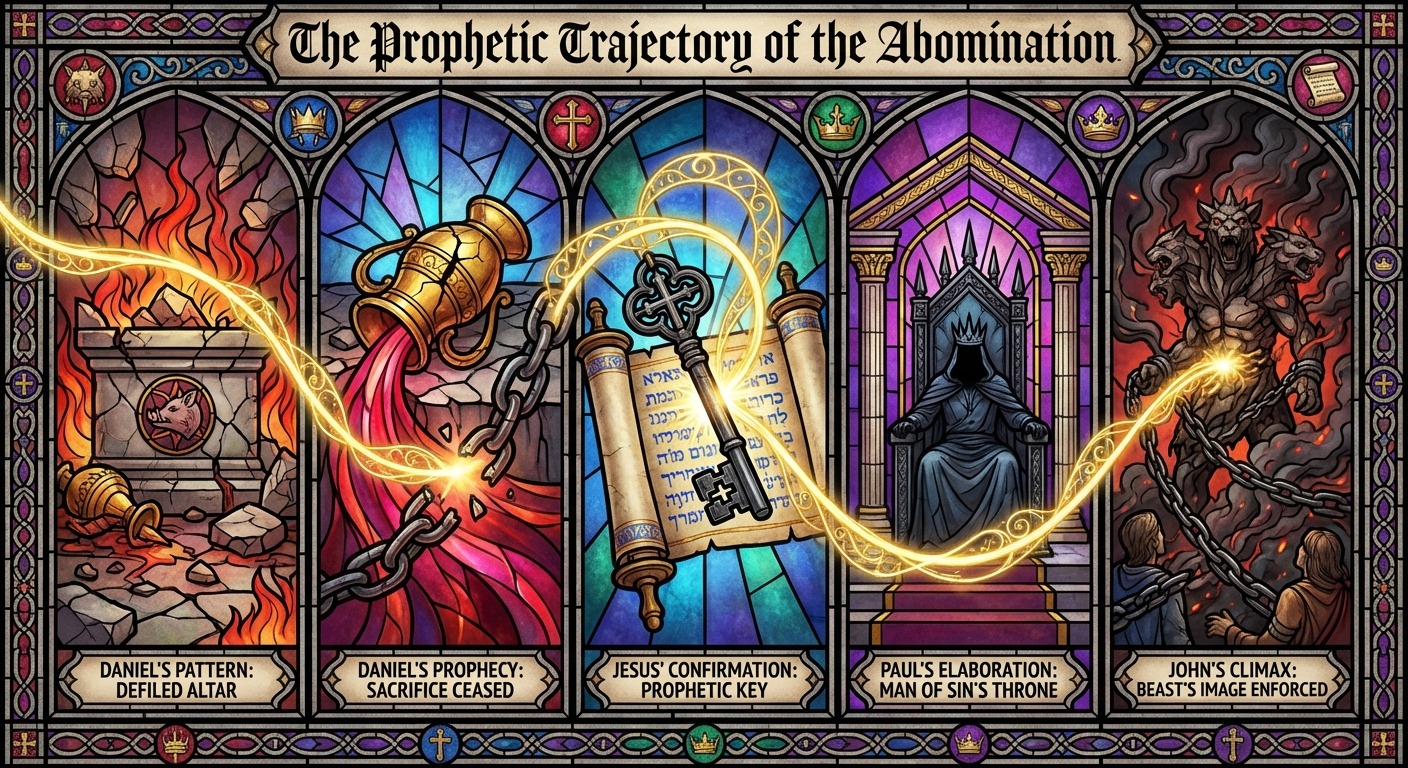
The Prophetic Trajectory of the Abomination
The Prophetic Trajectory of the Abomination
This chart shows the structure. What follows explains each part.
There is a prophetic phrase -- 'the abomination of desolation' -- that appears in Daniel, is quoted by Jesus, echoed by Paul, and developed at length in Revelation. It is one of the clearest indicators in Scripture that these four witnesses are all speaking about the same event from different points on the timeline, and that the event they are pointing to has not yet occurred. But this phrase is also one of the most frequently misread markers in prophetic study, partly because it has a historical type in Antiochus Epiphanes and partly because preterist interpreters have assigned its fulfillment to 70 AD. This article traces the abomination from its first appearance in Daniel through its final fulfillment, showing how the trajectory of the phrase itself argues against both the historical and the preterist readings.
There is a prophetic phrase -- 'the abomination of desolation' -- that appears in Daniel, is quoted by Jesus, echoed by Paul, and developed at length in Revelation. It is one of the clearest indicators in Scripture that these four witnesses are all speaking about the same event from different points on the timeline, and that the event they are pointing to has not yet occurred. But this phrase is also one of the most frequently misread markers in prophetic study, partly because it has a historical type in Antiochus Epiphanes and partly because preterist interpreters have assigned its fulfillment to 70 AD. This article traces the abomination from its first appearance in Daniel through its final fulfillment, showing how the trajectory of the phrase itself argues against both the historical and the preterist readings.
The Prophetic Thread of the Abomination of Desolation
The prophetic concept of the "abomination of desolation" serves as a golden thread running through the fabric of Scripture, weaving together the visions of Daniel, the teachings of Jesus, the apostolic witness of Paul, and the apocalyptic revelation given to John. This is not a disconnected set of prophecies but a single prophetic theme that develops progressively, becoming clearer as history advances toward its divinely appointed conclusion.
The Foundation in Daniel
Daniel is the prophet who first introduces this concept, anchoring it in specific historical events even as he points forward to its ultimate fulfillment. In Daniel 11:31, he prophesies concerning Antiochus Epiphanes, the Seleucid ruler who would desecrate the Jewish temple: "And arms shall stand on his part, and they shall pollute the sanctuary of strength, and shall take away the daily sacrifice, and they shall place the abomination that maketh desolate." This prophecy was literally fulfilled in 167 BC, when Antiochus erected an altar to Zeus in the temple and offered a pig upon it—a deliberate act of blasphemy that provoked the Maccabean revolt. Yet, this event did not exhaust the meaning of Daniel’s words; it served as a prophetic pattern, a foreshadowing of a far greater desecration yet to come.
The prophetic trajectory continues in Daniel 9:27, where the prophet speaks not merely of a past tyrant but of a future prince: "And he shall confirm the covenant with many for one week: and in the midst of the week he shall cause the sacrifice and the oblation to cease, and for the overspreading of abominations he shall make it desolate." Here, Daniel describes the ultimate abomination of desolation—a future act that will occur in the midst of the 70th week, perpetrated by the Antichrist, not by Antiochus. The historical event thus becomes a type, a shadow pointing forward to the final, climactic fulfillment.
The Affirmation by Jesus
Jesus Himself takes up this prophetic thread, affirming both the historical pattern and its future realization. In Matthew 24:15, He warns His disciples, "When ye therefore shall see the abomination of desolation, spoken of by Daniel the prophet, stand in the holy place, (whoso readeth, let him understand:)." With these words, Jesus explicitly identifies Daniel’s prophecy as awaiting a future fulfillment in the end times. He instructs His followers to look for the abomination of desolation—not as a past event, but as a sign that will mark the midpoint of the 70th week and signal the onset of unparalleled tribulation.
The Development by Paul
The Apostle Paul, writing to the Thessalonians, further develops this prophetic narrative. Addressing concerns about the Day of the Lord, he describes the emergence of the Antichrist as the central figure in the coming desecration: "Let no man deceive you by any means: for that day shall not come, except there come a falling away first, and that man of sin be revealed, the son of perdition; Who opposeth and exalteth himself above all that is called God, or that is worshipped; so that he as God sitteth in the temple of God, shewing himself that he is God" (2 Thessalonians 2:3-4). Paul thus confirms that the abomination of desolation is not merely an act, but the personal self-deification of the Antichrist in the temple—blasphemy of the highest order, fulfilling Daniel’s vision in its most literal and ultimate sense.
The Climax in Revelation
This prophetic trajectory reaches its climax in the book of Revelation. John is shown the final manifestation of the abomination in the actions of the False Prophet: "And deceiveth them that dwell on the earth by the means of those miracles which he had power to do in the sight of the beast; saying to them that dwell on the earth, that they should make an image to the beast, which had the wound by a sword, and did live. And he had power to give life unto the image of the beast, that the image of the beast should both speak, and cause that as many as would not worship the image of the beast should be killed" (Revelation 13:14-15). Here, the abomination of desolation finds its final form—an image of the Antichrist set up in the sanctuary, animated by demonic power, and demanding universal worship on pain of death.
A Unified Prophetic Revelation
Throughout this progression, we see how biblical prophecy operates—not as a collection of isolated predictions, but as a unified revelation that builds upon itself through successive generations. God revealed the pattern through Daniel, Christ affirmed its future fulfillment, Paul described its personal character, and John unveiled its ultimate form. The abomination of desolation thus stands as a testament to the coherence and certainty of God’s prophetic word, drawing together the testimony of the Law, the Prophets, and the Apostles into a single, unfolding narrative that will reach its appointed end in the day of the Lord.
The abomination of desolation has been traced along its full prophetic trajectory -- from Daniel's foundation, through Antiochus as type, through Jesus's instruction, through Paul's description of the man of sin, toward its final literal fulfillment. That trajectory reaches its most detailed expression in the book of Revelation, which returns again and again to the framework Daniel established. Understanding how Revelation depends on Daniel -- and what that dependence means for interpretation -- is the necessary next step.
The abomination of desolation has been traced along its full prophetic trajectory -- from Daniel's foundation, through Antiochus as type, through Jesus's instruction, through Paul's description of the man of sin, toward its final literal fulfillment. That trajectory reaches its most detailed expression in the book of Revelation, which returns again and again to the framework Daniel established. Understanding how Revelation depends on Daniel -- and what that dependence means for interpretation -- is the necessary next step.
Every chart in this series is free to explore online.
 Get the full chart set (PDF – $8)
Members get all PDFs included → Why Membership
Log in with an active membership to download printable PDFs on this site. Purchased on the shop? Access downloads from your shop account.
If you would like to help fund this work:
These charts are based on the following book:

The Master Key: Daniel's 70th Week
The Bible's Framework for Understanding Prophecy - 230 Page Paperback Edition
View Related Book