
Visual Theology – Bible Prophecy Charts
The Visual Theology charts are designed to help you see the structure and movement of Scripture. They highlight patterns, contrasts, and developments that are often difficult to hold together when reading line by line.
These charts show the structure of the argument. The accompanying articles develop each part in full.
This approach follows a long tradition of visual teaching in the Church. The well-known charts of Clarence Larkin helped many grasp the broad outline of Scripture. In the same spirit, these charts aim to make visible what the Word of God is revealing.
Charts and teaching notes for the book of Bible Prophecy Charts. Select a chart below to view the image and article.
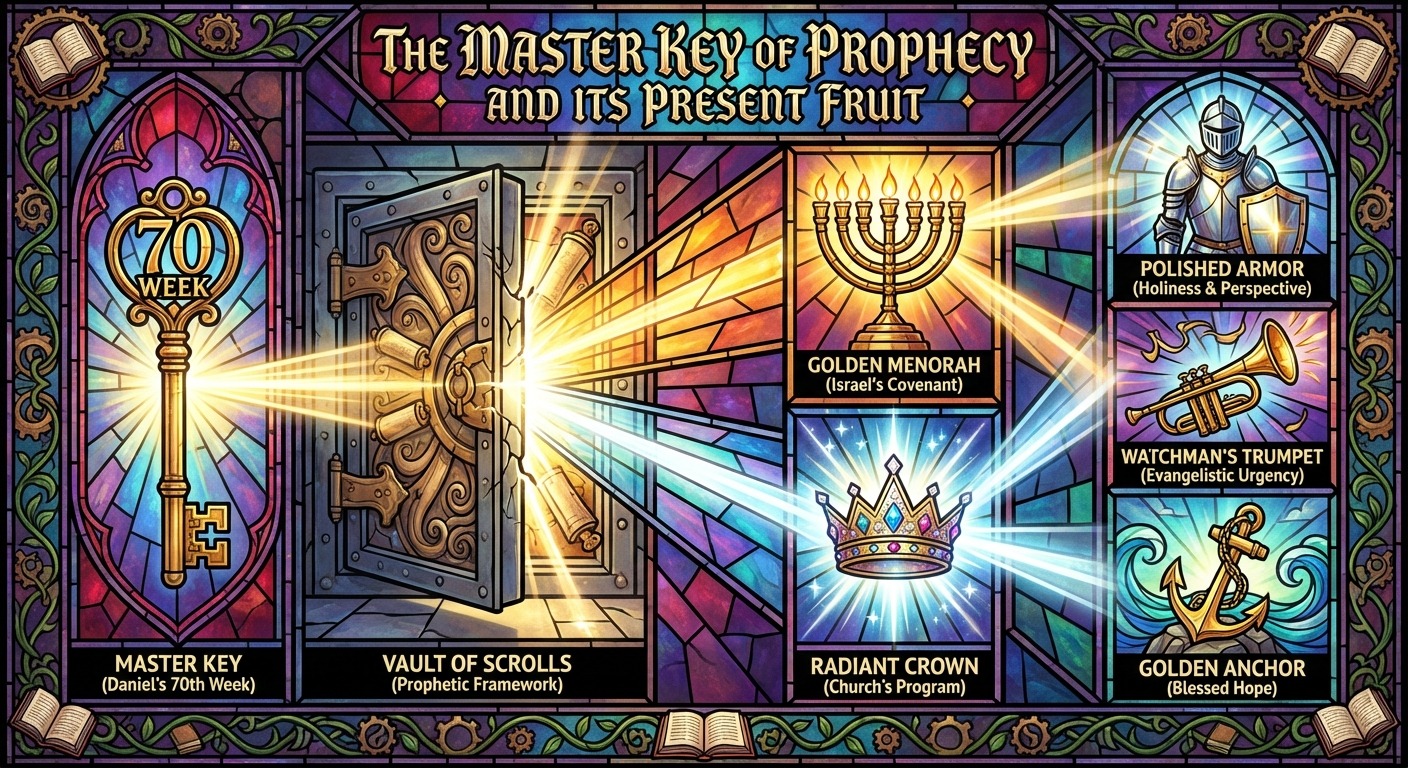
Click chart to view larger
From the teaching in: The Master Key: Daniel's 70th Week
Conclusion
The Purpose and Fruit of Prophecy
This chart shows the structure. What follows explains each part.
We have now moved through the full architectural argument of Daniel's 70 weeks -- its foundation in Abraham's covenant, its structure in Daniel's text, its gap explained by the mystery of the Church, its two endpoints mapped through the Synoptic Gospels, its national scope confirmed through Israel's promises, its development completed in Revelation, its framework articulated by Paul. The question that the remaining articles press on is not structural but applicational: what does a person do with all of this? What fruit should prophetic understanding actually produce -- in character, in affection, in watchfulness, in hope?
We have now moved through the full architectural argument of Daniel's 70 weeks -- its foundation in Abraham's covenant, its structure in Daniel's text, its gap explained by the mystery of the Church, its two endpoints mapped through the Synoptic Gospels, its national scope confirmed through Israel's promises, its development completed in Revelation, its framework articulated by Paul. The question that the remaining articles press on is not structural but applicational: what does a person do with all of this? What fruit should prophetic understanding actually produce -- in character, in affection, in watchfulness, in hope?
The Purpose and Framework of Prophecy
Prophecy, as revealed in the Scriptures, is not given to satisfy mere curiosity about the future or to provide fodder for speculative calculation and date-setting. Its purpose is far deeper and more transformative. The prophetic word, and in particular the revelation of Daniel's 70th week (Daniel 9:24-27), stands as the master key that unlocks the framework of all biblical prophecy. This framework is not a product of human imagination but is established by God Himself, providing the organizing principle by which we understand the teachings of Jesus, the apostolic witness of Paul, and the apocalyptic vision of John.
A Crucial Distinction: Israel and the Church
Central to a right understanding of prophecy is the recognition of the distinction between God's program for Israel and His program for the Church. Daniel's 70th week primarily concerns Israel; it is the period through which the sixfold purpose declared by Gabriel in Daniel 9:24 will be accomplished—culminating in the finishing of transgression, making an end of sins, and the anointing of the most Holy. The Church, by contrast, occupies a prophetic parenthesis, awaiting the blessed hope of Christ's return (1 Thessalonians 4:13-18). Maintaining this distinction is not an academic exercise but a safeguard against confusion and misapplication of prophetic truth.
The Fruit of Prophecy: Comfort and Hope
When prophecy is properly understood in this light, it does not produce anxiety or dread in the heart of the believer. Instead, it brings profound comfort and hope. The vivid descriptions of judgment and upheaval in books such as Revelation are not meant to terrify the Church but to reassure her of exemption from the coming wrath and to underscore the urgency of the present age. The knowledge that the Church is not appointed to wrath but to obtain salvation (1 Thessalonians 5:9) transforms Revelation from a book of terror to a book of triumph, as we anticipate the fulfillment of God's promises in Christ.
Prophecy as a Source of Clarity
Moreover, prophecy is not intended to be a source of confusion. Daniel's 70th week provides a coherent timeline and a unified prophetic framework that brings clarity to the otherwise complex tapestry of biblical revelation. The teachings of Jesus concerning the abomination of desolation (Matthew 24:15), Paul's eschatological instructions regarding the rapture and the Day of the Lord (1 Thessalonians 4:13-18; 1 Corinthians 15:51-52), and John's apocalyptic vision all fit together within this divinely appointed structure. The believer is thus equipped to avoid the pitfalls of private interpretation and speculative theology, instead receiving the prophetic word as a lamp that shineth in a dark place.
Practical Transformation in the Present
The fruit of prophecy, then, is not speculative excitement but practical transformation. The blessed hope of Christ's imminent return should motivate holiness, fuel evangelistic urgency, and produce in us a proper perspective on this world and its systems. Prophecy shapes our character and conduct today, calling us to live in anticipation of the completion of God's prophetic program. As we await the fulfillment of these promises, our response is not fear or confusion, but the eager anticipation expressed by John: Even so, come, Lord Jesus (Revelation 22:20).
In summary, Daniel's 70th week is the key that unlocks biblical prophecy, providing the framework within which all other prophetic revelation is understood. When received in faith, this understanding brings comfort, clarity, and hope, transforming how we live in the present and how we look forward to the future.
Prophecy's purpose has been grounded: not calculation, not status, not the management of anxiety, but the kind of hope that steadies the soul and fixes the eye on what is certain. That grounding, however, immediately raises the question of signs -- because if we are called to watch, we must be asking what we are watching for, and this is where the prophetic landscape of the present moment comes into view. What can actually be seen, from where we stand, that points toward the approach of the end?
Prophecy's purpose has been grounded: not calculation, not status, not the management of anxiety, but the kind of hope that steadies the soul and fixes the eye on what is certain. That grounding, however, immediately raises the question of signs -- because if we are called to watch, we must be asking what we are watching for, and this is where the prophetic landscape of the present moment comes into view. What can actually be seen, from where we stand, that points toward the approach of the end?
Every chart in this series is free to explore online.
 Get the full chart set (PDF – $8)
Members get all PDFs included → Why Membership
Log in with an active membership to download printable PDFs on this site. Purchased on the shop? Access downloads from your shop account.
If you would like to help fund this work:
These charts are based on the following book:

The Master Key: Daniel's 70th Week
The Bible's Framework for Understanding Prophecy - 230 Page Paperback Edition
View Related Book