
Visual Theology – Bible Prophecy Charts
The Visual Theology charts are designed to help you see the structure and movement of Scripture. They highlight patterns, contrasts, and developments that are often difficult to hold together when reading line by line.
These charts show the structure of the argument. The accompanying articles develop each part in full.
This approach follows a long tradition of visual teaching in the Church. The well-known charts of Clarence Larkin helped many grasp the broad outline of Scripture. In the same spirit, these charts aim to make visible what the Word of God is revealing.
Charts and teaching notes for the book of Bible Prophecy Charts. Select a chart below to view the image and article.
Click chart to view larger
From the teaching in: The Master Key: Daniel's 70th Week
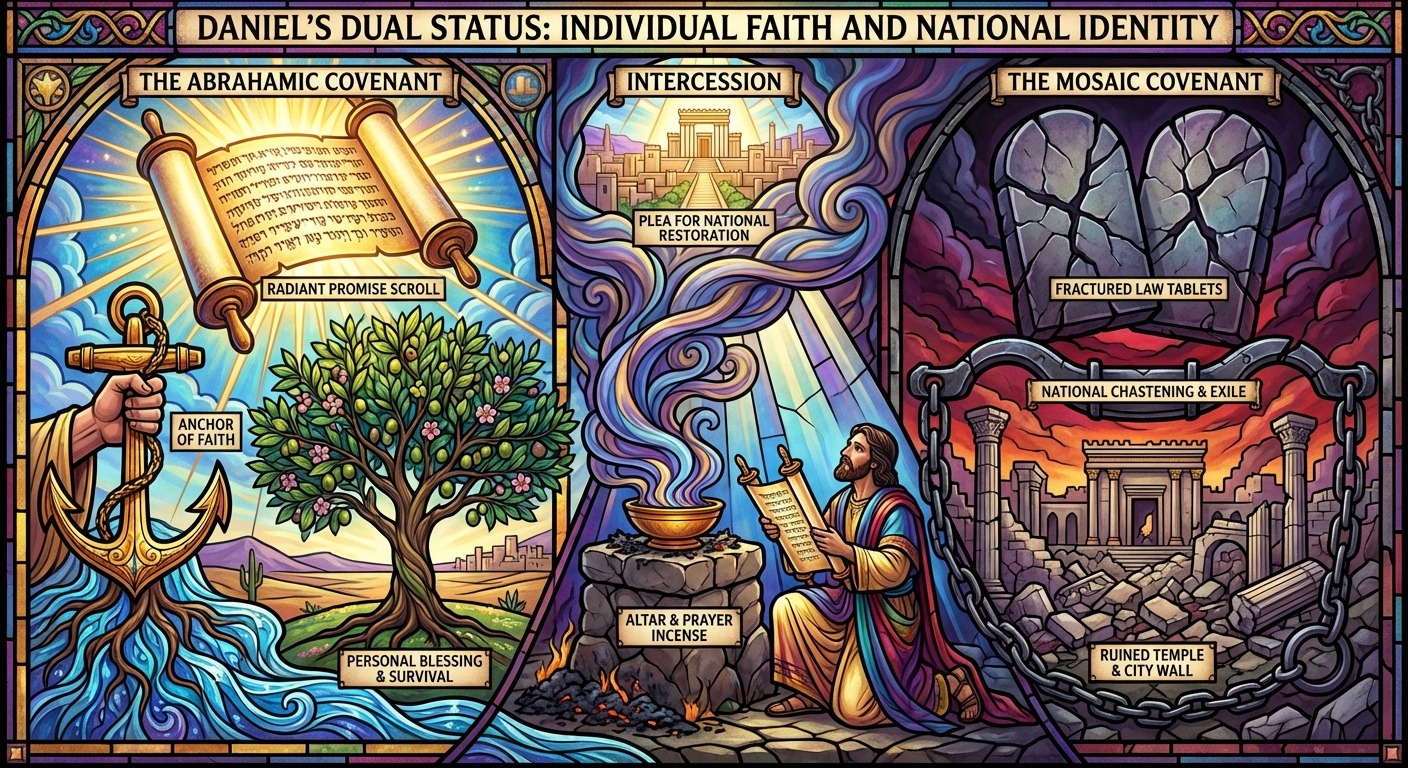
Daniel's Dual Status: Individual Faith and National Identity
Daniel's Dual Status
This chart shows the structure. What follows explains each part.
Daniel prayed as a guilty man -- confessing 'we have sinned,' using the language of corporate identification -- yet we have already seen that his personal integrity was beyond reproach, that his enemies could find no fault in him, that God Himself vindicated his innocence when the lions would not touch him. How do both things hold? There is a theological structure underneath that apparent tension, and it is not unique to Daniel; it is the pattern of every believing Israelite who ever lived under the Mosaic covenant, and it has profound implications for how we understand God's dealings with Israel as a nation versus His dealings with individuals who believe. This article names that structure and shows what it explains.
Daniel prayed as a guilty man -- confessing 'we have sinned,' using the language of corporate identification -- yet we have already seen that his personal integrity was beyond reproach, that his enemies could find no fault in him, that God Himself vindicated his innocence when the lions would not touch him. How do both things hold? There is a theological structure underneath that apparent tension, and it is not unique to Daniel; it is the pattern of every believing Israelite who ever lived under the Mosaic covenant, and it has profound implications for how we understand God's dealings with Israel as a nation versus His dealings with individuals who believe. This article names that structure and shows what it explains.
Understanding Daniel’s Dual Status
Understanding Daniel’s spiritual position during the Babylonian captivity requires us to recognize a crucial distinction: Daniel occupied what may be called a “dual status.” He was, on the one hand, justified by faith as an individual believer, yet on the other, he identified himself with the corporate fate of Israel under the Mosaic covenant. This dual status is not a minor detail, but the very key to comprehending both the nature of Daniel’s intercession and the broader pattern of God’s dealings with Israel.
The Error of Law-Based Justification
This distinction directly confronts a persistent error in biblical interpretation—the misconception that Old Testament saints were saved by keeping the law. Paul addresses this in Galatians 3, declaring that the gospel was preached to Abraham long before the law existed: “And the scripture, foreseeing that God would justify the heathen through faith, preached before the gospel unto Abraham, saying, In thee shall all nations be blessed. So then they which be of faith are blessed with faithful Abraham” (Galatians 3:8-9). The promise to Abraham predated the law by 430 years, and Paul insists that “the covenant, that was confirmed before of God in Christ, the law, which was four hundred and thirty years after, cannot disannul, that it should make the promise of none effect” (Galatians 3:17).
The law, Paul explains, was never given as a means of individual justification. Rather, it was added “because of transgressions, till the seed should come to whom the promise was made” (Galatians 3:19). The law functioned as a schoolmaster to bring Israel to Christ, exposing sin and demonstrating the need for a Savior. No individual could ever be justified by law-keeping, for “as many as are of the works of the law are under the curse: for it is written, Cursed is every one that continueth not in all things which are written in the book of the law to do them” (Galatians 3:10).
National Chastening vs. Individual Blessing
This distinction comes into sharp focus in the reason for Israel’s exile in Babylon. God’s law required that every seventh year, the land must rest—a sabbath year, a test of faith and a sign that Israel trusted God for provision (Leviticus 25:1-7). For 490 years, Israel had neglected these sabbath years, prioritizing profit and productivity over obedience and faith. As a result, God declared, “Then shall the land enjoy her sabbaths, as long as it lieth desolate...even then shall the land rest, and enjoy her sabbaths” (Leviticus 26:34). Israel owed God seventy sabbath years, and so the nation was sent into Babylon for seventy years to let the land rest.
This was not individual judgment but national chastening for collective disobedience. The temple was destroyed, the city burned, and the entire infrastructure that made law-keeping possible was removed. Yet, the individuals who believed the prophets’ warnings and obeyed God’s word by going to Babylon were not merely spared—they were blessed and multiplied in captivity. Through Jeremiah, God instructed them, “Build ye houses, and dwell in them; and plant gardens, and eat the fruit of them...And seek the peace of the city whither I have caused you to be carried away captives, and pray unto the LORD for it: for in the peace thereof shall ye have peace...For I know the thoughts that I think toward you, saith the LORD, thoughts of peace, and not of evil, to give you an expected end” (Jeremiah 29:5, 7, 11). Their blessing in Babylon did not come through keeping the law, which was impossible in exile, but through trusting God’s promise delivered by the prophets.
Daniel as the Exemplar
Daniel exemplifies this dual status during the captivity. As an individual, he was justified by faith through the Abrahamic covenant, just as Abraham was justified by believing God’s promise. Yet Daniel could not possibly have kept the Mosaic law in Babylon. There was no temple, no priesthood, no sacrifice, and no Holy of Holies. God had ordained Jerusalem as the sole place for sacrifice; the ceremonial law and the moral law were inseparably linked, especially through the Sabbath commandment, which required temple worship and sacrifices.
Those who clung to law-keeping for justification perished in Jerusalem when judgment came. Those who understood justification by faith—resting on God’s covenant promises, not their own works—heeded the prophetic word and survived in Babylon. This was the dividing line between true faith and false religion. The false prophets urged, “Stay in Jerusalem and keep the law!” The true prophets declared, “God will judge Jerusalem. Surrender to Babylon, and God will bless you there and eventually bring you back.” Faith in God’s faithfulness, not in human ability, marked out the true remnant.
The Heart of Intercession
Yet Daniel did not rest content in his individual blessing. When he discerned from Jeremiah’s prophecy that the seventy years were accomplished, he clothed himself in sackcloth and ashes, praying as though he himself were under the curse. He identified himself wholly with his nation’s transgression, confessing corporate sin even though he personally had walked uprightly before God. The book of Daniel highlights his blameless character precisely because, in his intercession, he stood in the place of the disobedient, considering himself under judgment for their sake.
Daniel’s heart was not satisfied with personal blessing alone. He longed for the restoration of Jerusalem, the rebuilding of the temple, and the fulfillment of God’s promises to Israel as a nation. His vision was fixed on the prophetic hope—the restoration described by Ezekiel, the coming of the New Covenant, and the ultimate establishment of the kingdom. This same pattern is seen in Moses, who “chose rather to suffer affliction with the people of God, than to enjoy the pleasures of sin for a season; Esteeming the reproach of Christ greater riches than the treasures in Egypt” (Hebrews 11:25-26), and in the patriarchs, who dwelt as strangers because “they looked for a city which hath foundations, whose builder and maker is God” (Hebrews 11:9-10).
The Apostle Paul also echoed this heart, writing, “I could wish that myself were accursed from Christ for my brethren, my kinsmen according to the flesh” (Romans 9:3). Both Daniel and Paul understood that God’s faithfulness to His covenant with Israel was inseparably bound to His own character and glory. The literal fulfillment of God’s promises vindicates His truthfulness before the nations.
The Purpose of Daniel’s Prayer
Thus, Daniel’s prayer was not the plea of a man seeking personal justification through confession of sin. It was the intercession of one already justified by faith, who understood that God’s purposes extended beyond individual salvation to the corporate, national restoration of Israel and the fulfillment of the kingdom. Daniel’s dual status—blessed individually, yet burdened for his nation—frames the context for the prophecy of the 70 weeks, which concerns not merely individual salvation but God’s program for “thy people and thy holy city.”
Guarding Against Error
This understanding protects us from two grave errors. First, it guards against the false teaching that Old Testament saints were ever saved by works—a doctrine that undermines the gospel by suggesting law-keeping could justify. Second, it preserves the crucial distinction between Israel and the Church, recognizing that God has always had both individual purposes (justification by faith for all who believe) and corporate purposes (His program for Israel as a nation and the Church as the body of Christ). Confusing these distinctions leads inevitably to the allegorization of prophecy and the mingling of law and grace that has confused so much of church history. Daniel’s dual status stands as a witness to the true nature of faith and the integrity of God’s redemptive plan.
The dual status has been established: Daniel justified individually by faith, yet identified corporately with Israel's national failure. That dual status is not a curiosity -- it is the lens through which the 70 weeks prophecy must be read, because Gabriel's word was given concerning a people and a city, not merely a collection of individuals. What comes next is the structure of that word itself: the precise, numbered framework that Gabriel laid before Daniel and that has organized prophetic interpretation ever since.
The dual status has been established: Daniel justified individually by faith, yet identified corporately with Israel's national failure. That dual status is not a curiosity -- it is the lens through which the 70 weeks prophecy must be read, because Gabriel's word was given concerning a people and a city, not merely a collection of individuals. What comes next is the structure of that word itself: the precise, numbered framework that Gabriel laid before Daniel and that has organized prophetic interpretation ever since.
Every chart in this series is free to explore online.
 Get the full chart set (PDF – $8)
Members get all PDFs included → Why Membership
Log in with an active membership to download printable PDFs on this site. Purchased on the shop? Access downloads from your shop account.
If you would like to help fund this work:
These charts are based on the following book:

The Master Key: Daniel's 70th Week
The Bible's Framework for Understanding Prophecy - 230 Page Paperback Edition
View Related Book