
Visual Theology – Bible Prophecy Charts
The Visual Theology charts are designed to help you see the structure and movement of Scripture. They highlight patterns, contrasts, and developments that are often difficult to hold together when reading line by line.
These charts show the structure of the argument. The accompanying articles develop each part in full.
This approach follows a long tradition of visual teaching in the Church. The well-known charts of Clarence Larkin helped many grasp the broad outline of Scripture. In the same spirit, these charts aim to make visible what the Word of God is revealing.
Charts and teaching notes for the book of Bible Prophecy Charts. Select a chart below to view the image and article.
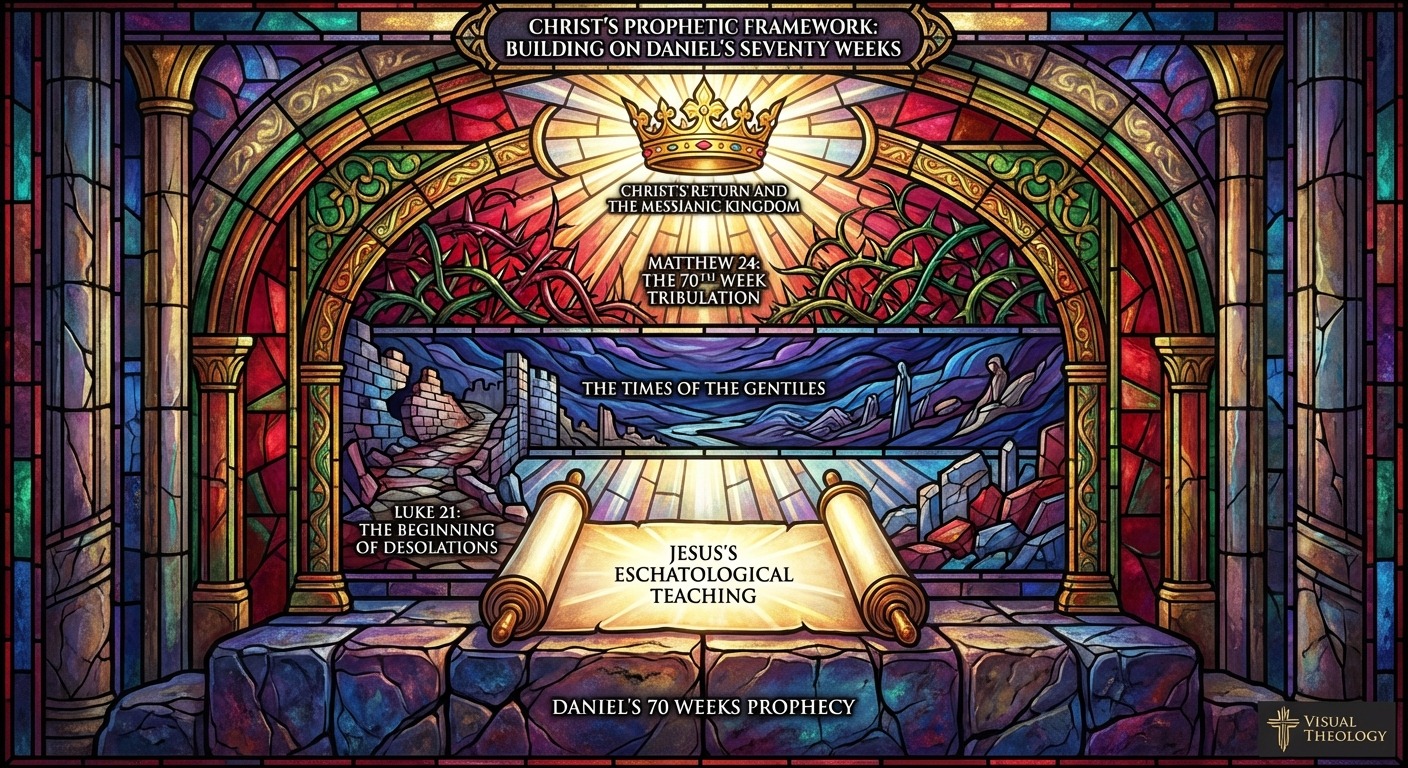
Click chart to view larger
From the teaching in: The Master Key: Daniel's 70th Week
Jesus builds directly upon Daniel’s prophetic framework, making the connection between Jesus’s teachings and Daniel’s prophecy a
The Olivet Discourse and Daniel's Framework
Jesus builds directly upon Daniel’s prophetic framework, making the connection between Jesus’s teachings and Daniel’s prophecy absolutely foundational. Rather than presenting prophecy as a series of isolated predictions, this relationship reveals a unified and coherent unfolding of God’s plan throughout history. In particular, Daniel’s “seventy weeks” prophecy serves as the structural backbone for Jesus’s eschatological teaching. By recognizing this connection, we gain deeper clarity into both Daniel’s visi
This chart shows the structure. What follows explains each part.
When Jesus sat down on the Mount of Olives and answered His disciples' questions about the end of the age, He did not invent a new prophetic framework -- He interpreted an existing one. Matthew 24:15 makes this explicit: He pointed His disciples not to His own words but to Daniel's, telling them that the key sign of the end was something Daniel the prophet had already described. What this means is that the Olivet Discourse is not a self-contained eschatological unit; it is Jesus's authoritative commentary on Daniel 9, and it cannot be read correctly without reading it that way. This article establishes the foundational relationship between Christ's words and Daniel's structure -- a relationship that will only become more important as we move through the Synoptic accounts in the articles that follow.
When Jesus sat down on the Mount of Olives and answered His disciples' questions about the end of the age, He did not invent a new prophetic framework -- He interpreted an existing one. Matthew 24:15 makes this explicit: He pointed His disciples not to His own words but to Daniel's, telling them that the key sign of the end was something Daniel the prophet had already described. What this means is that the Olivet Discourse is not a self-contained eschatological unit; it is Jesus's authoritative commentary on Daniel 9, and it cannot be read correctly without reading it that way. This article establishes the foundational relationship between Christ's words and Daniel's structure -- a relationship that will only become more important as we move through the Synoptic accounts in the articles that follow.
The Foundational Link: Jesus’s Olivet Discourse and Daniel’s Prophecy
Jesus’s prophetic teaching, as recorded in the Olivet Discourse, stands not as a novel eschatological system but as the authoritative interpretation and expansion of the framework already established by Daniel. The relationship between Christ’s words in Matthew 24, Mark 13, and Luke 21 and the visions of Daniel is not incidental; it is absolutely foundational. Jesus anchors His entire prophetic discourse in the seventy weeks prophecy of Daniel 9:24-27, making this Old Testament revelation the structural backbone for understanding the unfolding of God’s plan for the ages.
This connection is made explicit when Jesus references the “abomination of desolation, spoken of by Daniel the prophet” (Matthew 24:15). By directing His followers to Daniel’s prophecy, Jesus signals that the events of the end times must be interpreted through the lens of Daniel’s vision. Daniel 9:27 describes one who “shall confirm the covenant with many for one week: and in the midst of the week he shall cause the sacrifice and the oblation to cease, and for the overspreading of abominations he shall make it desolate.” Jesus adopts this precise chronology, identifying the abomination as the pivotal event that divides the final week, and thus provides the interpretive key to the entire prophetic sequence.
Further, Jesus’s description of the Great Tribulation in Matthew 24:21—“For then shall be great tribulation, such as was not since the beginning of the world to this time, no, nor ever shall be”—directly parallels Daniel 12:1, which foretells “a time of trouble, such as never was since there was a nation even to that same time.” In echoing Daniel’s language, Jesus does not replace or supersede the prophetic vision but clarifies and expands its meaning, showing the unity and continuity of divine revelation.
A Twofold Exposition of Daniel’s Timeline
The Olivet Discourse, therefore, is best understood as a twofold exposition of Daniel’s timeline, with Luke 21 addressing the beginning of the “desolations determined” (Daniel 9:26)—the destruction of Jerusalem and the subsequent scattering of Israel—and Matthew 24 focusing on the end of the desolations and the fulfillment of the seventieth week.
Luke records Jesus’s warning: “And when ye shall see Jerusalem compassed with armies, then know that the desolation thereof is nigh” (Luke 21:20), pointing to the historical fulfillment of Daniel’s prophecy in 70 AD and the commencement of the “times of the Gentiles” (Luke 21:24). This period, characterized by Jerusalem being “trodden down of the Gentiles,” is the gap between the sixty-ninth and seventieth weeks of Daniel’s prophecy, a time during which Israel is set aside nationally and the focus of God’s redemptive activity shifts.
Matthew’s account, on the other hand, addresses the conclusion of this period. The sign of the abomination of desolation marks the midpoint of the seventieth week, ushering in the unparalleled tribulation that precedes the return of Christ. The discourse culminates in the visible, glorious return of the Son of Man, fulfilling the prophetic hope of Daniel and the prophets. This sequence reveals that Jesus’s eschatological teaching is not a collection of disconnected predictions but a unified exposition of the prophetic framework laid down in Daniel.
The Coherence of God’s Plan
This unified approach to prophecy demonstrates that God’s plan unfolds coherently across history. The seventy weeks prophecy of Daniel is not an isolated prediction but the chronological and theological foundation for all subsequent eschatological revelation. Jesus, as the ultimate Prophet, interprets and expands this framework, providing clarity about the gap period—the “desolations determined”—and the certainty of their appointed end. The Church Age, revealed more fully through Paul as the “mystery” (Ephesians 3:3-5), fits within this structure as the parenthesis between Israel’s dispersion and restoration.
By recognizing the foundational role of Daniel’s seventy weeks in Jesus’s prophetic teaching, we gain deeper clarity into both Daniel’s visions and the Lord’s instruction about the end times. This connection secures our confidence in the reliability of Scripture and the certainty of God’s unfolding plan, reminding us that prophecy is not merely about future events but about the revelation of Christ and His purposes. The unity of Daniel’s framework and Christ’s teaching calls believers to watchfulness, holy living, and confident expectation as we await the fulfillment of all that the prophets have spoken.
The Olivet Discourse is rooted in Daniel's framework -- that is now established. But Christ's prophetic instruction was not a single, seamless discourse: it addressed two different questions, given in two different settings, speaking to two different segments of the timeline. What Luke's account covers specifically is addressed next -- and it begins not with the distant future but with an event that was, from the disciples' perspective, still a generation away.
The Olivet Discourse is rooted in Daniel's framework -- that is now established. But Christ's prophetic instruction was not a single, seamless discourse: it addressed two different questions, given in two different settings, speaking to two different segments of the timeline. What Luke's account covers specifically is addressed next -- and it begins not with the distant future but with an event that was, from the disciples' perspective, still a generation away.
Every chart in this series is free to explore online.
 Get the full chart set (PDF – $8)
Members get all PDFs included → Why Membership
Log in with an active membership to download printable PDFs on this site. Purchased on the shop? Access downloads from your shop account.
If you would like to help fund this work:
These charts are based on the following book:

The Master Key: Daniel's 70th Week
The Bible's Framework for Understanding Prophecy - 230 Page Paperback Edition
View Related Book