
Visual Theology – Bible Prophecy Charts
The Visual Theology charts are designed to help you see the structure and movement of Scripture. They highlight patterns, contrasts, and developments that are often difficult to hold together when reading line by line.
These charts show the structure of the argument. The accompanying articles develop each part in full.
This approach follows a long tradition of visual teaching in the Church. The well-known charts of Clarence Larkin helped many grasp the broad outline of Scripture. In the same spirit, these charts aim to make visible what the Word of God is revealing.
Charts and teaching notes for the book of Bible Prophecy Charts. Select a chart below to view the image and article.
Click chart to view larger
From the teaching in: The Master Key: Daniel's 70th Week
The Desolations: Understanding the Gap
The Desolations: Understanding the Gap
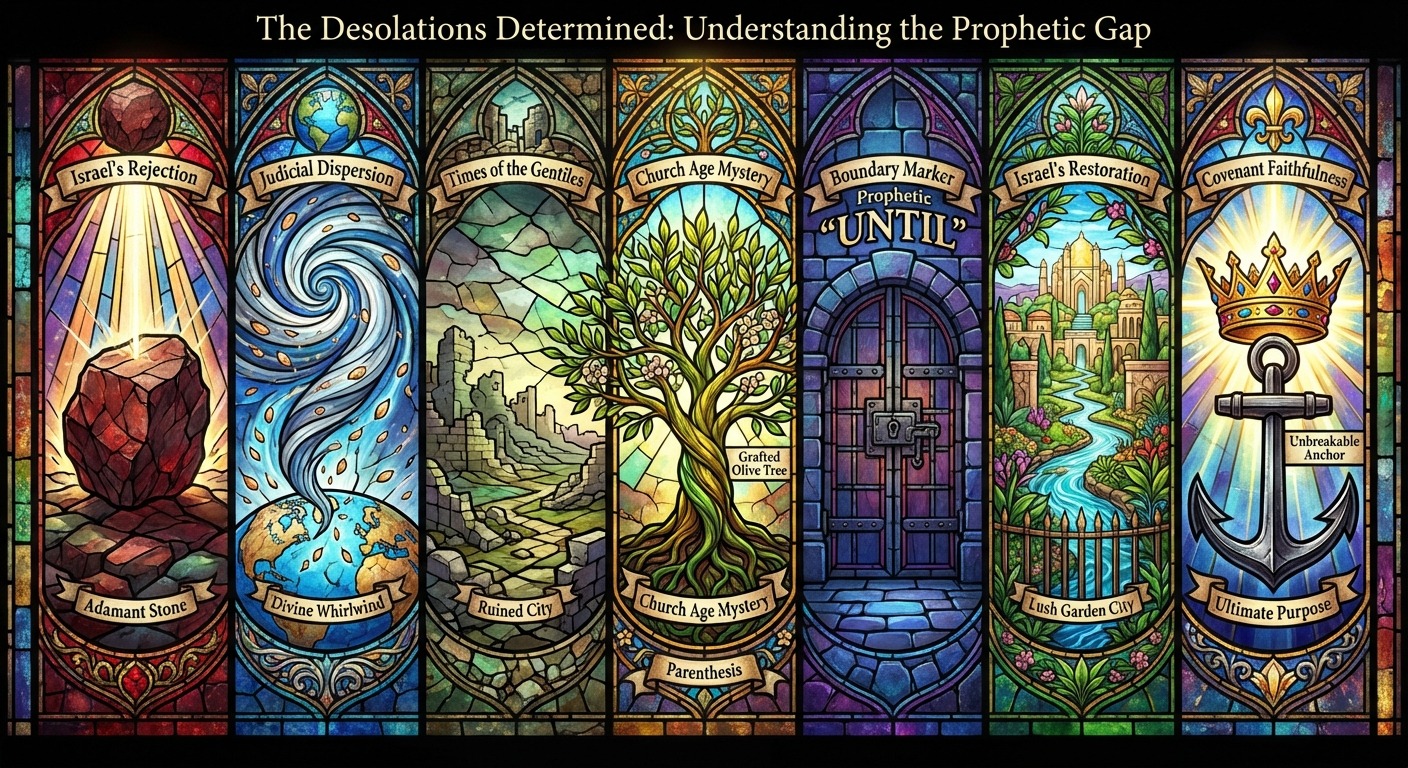
This chart shows the structure. What follows explains each part.
There is a phrase in Daniel 9:26 that deserves more attention than it usually receives: 'unto the end of the war desolations are determined.' It is not decorative language -- it is prophetic vocabulary, and it names a specific condition that has characterized Israel's history for nearly two millennia. Understanding what 'desolations' means in Daniel's framework, and how Jesus picked up that word in His own prophetic teaching, is not a minor lexical question. It is the question that names the period we are in -- and locating ourselves in that period with precision changes how we read both the Old Testament's promises to Israel and the New Testament's instructions to the Church.
There is a phrase in Daniel 9:26 that deserves more attention than it usually receives: 'unto the end of the war desolations are determined.' It is not decorative language -- it is prophetic vocabulary, and it names a specific condition that has characterized Israel's history for nearly two millennia. Understanding what 'desolations' means in Daniel's framework, and how Jesus picked up that word in His own prophetic teaching, is not a minor lexical question. It is the question that names the period we are in -- and locating ourselves in that period with precision changes how we read both the Old Testament's promises to Israel and the New Testament's instructions to the Church.
The Meaning of "Desolations Determined" in Daniel 9:26
In Daniel 9:26, the phrase "and unto the end of the war desolations are determined" introduces a vital prophetic vocabulary that illuminates the period between the sixty-ninth and seventieth weeks of Daniel's vision. These "desolations" are not merely poetic expressions but serve as precise terminology for the long dispersion of Israel among the nations—a period in which Jerusalem remains under Gentile control and the Jewish people are scattered.
The Prophetic Roots of Desolation
The roots of this concept are made clear in Zechariah 7, where the Lord addresses those who mourned during the Babylonian captivity. The prophet recounts the reason for judgment: Israel's refusal to execute true judgment, to show mercy, and to heed the law and the words sent by the former prophets. Zechariah 7:12 describes their hearts as "an adamant stone," resistant to God's word. The consequence follows in Zechariah 7:13-14: "Therefore it is come to pass, that as he cried, and they would not hear; so they cried, and I would not hear, saith the LORD of hosts: But I scattered them with a whirlwind among all the nations whom they knew not. Thus the land was desolate after them, that no man passed through nor returned: for they laid the pleasant land desolate." Here, the vocabulary of "desolation" is directly linked to Israel's scattering—a judicial dispersion rooted in covenant disobedience.
This theme of desolation is echoed throughout the prophetic writings. Ezekiel, for instance, repeatedly speaks of Israel’s "desolate places" and "waste cities." In Ezekiel 36:33-36, the Lord promises future restoration: "In the day that I shall have cleansed you from all your iniquities I will also cause you to dwell in the cities, and the wastes shall be builded. And the desolate land shall be tilled, whereas it lay desolate in the sight of all that passed by. And they shall say, This land that was desolate is become like the garden of Eden; and the waste and desolate and ruined cities are become fenced, and are inhabited." The repeated use of "desolate" ties the present state of the land and people to the prophetic period described in Daniel 9:26.
The "Times of the Gentiles"
Luke 21:24 identifies this period with remarkable clarity: "And they shall fall by the edge of the sword, and shall be led away captive into all nations: and Jerusalem shall be trodden down of the Gentiles, until the times of the Gentiles be fulfilled." The "times of the Gentiles" is another expression for the "desolations determined"—the gap between the sixty-ninth and seventieth weeks. This is a specific, temporary epoch in which Israel is set aside nationally, Jerusalem is under Gentile authority, and God's redemptive focus shifts to calling out the Church from among both Jews and Gentiles.
The Temporary Nature: Marked by "Until"
A key pattern in prophetic Scripture is the use of the word "until" to mark the temporariness of this condition. Jesus declares to the Jewish leaders, "Ye shall not see me henceforth, till ye shall say, Blessed is he that cometh in the name of the Lord" (Matthew 23:39). Paul writes, "blindness in part is happened to Israel, until the fulness of the Gentiles be come in" (Romans 11:25). Hosea prophesies, "I will go and return to my place, till they acknowledge their offence: in their affliction they will seek me early" (Hosea 5:15). These "until" statements establish that the desolations are not permanent but have a determined end in God's prophetic calendar.
The Divine Purpose Behind the Desolation
The purpose behind such a lengthy period of desolation is further revealed in Ezekiel 36:22-23: "Thus saith the Lord GOD; I do not this for your sakes, O house of Israel, but for mine holy name's sake, which ye have profaned among the heathen, whither ye went. And I will sanctify my great name, which was profaned among the heathen, which ye have profaned in the midst of them; and the heathen shall know that I am the LORD, saith the Lord GOD, when I shall be sanctified in you before their eyes." The scattering of Israel and the desolation of the land cause the nations to question God's faithfulness. Therefore, the ultimate restoration of Israel is not only for their blessing but as a public vindication of God's character and the reliability of His word.
Conclusion: Desolation and Redemptive Purpose
The "desolations determined" thus form part of God's judicial response to Israel's rejection of their Messiah. Yet, even in judgment, God's redemptive purposes are evident. This period of national hardening allowed for the mystery of the Church to be revealed and for Gentiles to be grafted into God's redemptive plan. When the "fulness of the Gentiles" is complete, God will turn again to Israel, ending the desolations and fulfilling the promises of the seventieth week.
Understanding this prophetic vocabulary is essential for grasping the gap between Daniel's sixty-ninth and seventieth weeks. The Old Testament prophets anticipated this interval through terms such as "desolations," "many days without a king," and "times of the Gentiles." While the full revelation of the Church was hidden, the framework for this gap was present: a period of scattering and desolation would precede Israel's final restoration and the completion of the seventy weeks. Those living in this present age can look back at the precise fulfillment of these prophecies and forward with assurance to the day when the desolations will end and Israel will be restored to her appointed destiny in the prophetic program.
The desolations have been defined -- the long dispersion, the trampling of Jerusalem, the period of Gentile dominion that Daniel named and Jesus confirmed. But a framework only helps if you can orient yourself within it, and that requires asking the question the next article presses: given what Daniel's prophecy says, and given what has already been fulfilled with precision, what does the prophetic landscape look like from where we stand today?
The desolations have been defined -- the long dispersion, the trampling of Jerusalem, the period of Gentile dominion that Daniel named and Jesus confirmed. But a framework only helps if you can orient yourself within it, and that requires asking the question the next article presses: given what Daniel's prophecy says, and given what has already been fulfilled with precision, what does the prophetic landscape look like from where we stand today?
Every chart in this series is free to explore online.
 Get the full chart set (PDF – $8)
Members get all PDFs included → Why Membership
Log in with an active membership to download printable PDFs on this site. Purchased on the shop? Access downloads from your shop account.
If you would like to help fund this work:
These charts are based on the following book:

The Master Key: Daniel's 70th Week
The Bible's Framework for Understanding Prophecy - 230 Page Paperback Edition
View Related Book