
Visual Theology – Bible Prophecy Charts
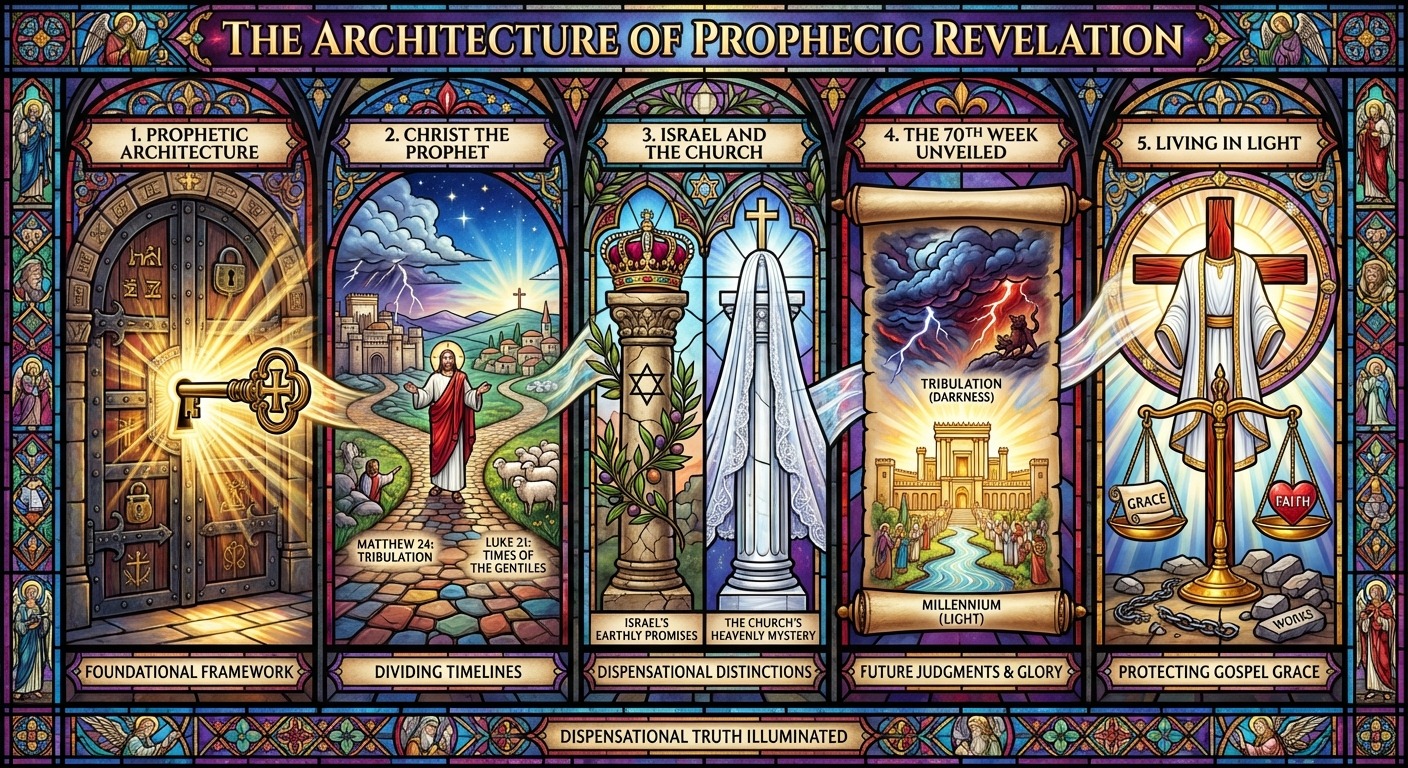
The Visual Theology charts are designed to help you see the structure and movement of Scripture. They highlight patterns, contrasts, and developments that are often difficult to hold together when reading line by line.
These charts show the structure of the argument. The accompanying articles develop each part in full.
This approach follows a long tradition of visual teaching in the Church. The well-known charts of Clarence Larkin helped many grasp the broad outline of Scripture. In the same spirit, these charts aim to make visible what the Word of God is revealing.
Charts and teaching notes for the book of Bible Prophecy Charts. Select a chart below to view the image and article.
Click chart to view larger
From the teaching in: The Master Key: Daniel's 70th Week
What This Book Covers
Book Overview: From Daniel's Framework to Gospel Purity
This chart shows the structure. What follows explains each part.
There are few things more disorienting than opening a subject as vast as biblical prophecy without a map -- and there are few maps more reliable than the one God gave through Daniel. What follows in this series is not another tour through signs and speculations, but a walk along a specific architectural argument: that Daniel's 70 weeks, recorded in Daniel 9:24-27, is the structural key to every other prophetic word in Scripture, including the words of Jesus, Paul, and John. This opening overview lays the whole edifice before you -- its foundation, its divisions, its final room -- so that when we examine each piece in sequence, you already know where you are standing and why it matters that you remain oriented. The goal is not prophetic expertise for its own sake, but the kind of grounded clarity that protects the gospel and anchors the soul.
There are few things more disorienting than opening a subject as vast as biblical prophecy without a map -- and there are few maps more reliable than the one God gave through Daniel. What follows in this series is not another tour through signs and speculations, but a walk along a specific architectural argument: that Daniel's 70 weeks, recorded in Daniel 9:24-27, is the structural key to every other prophetic word in Scripture, including the words of Jesus, Paul, and John. This opening overview lays the whole edifice before you -- its foundation, its divisions, its final room -- so that when we examine each piece in sequence, you already know where you are standing and why it matters that you remain oriented. The goal is not prophetic expertise for its own sake, but the kind of grounded clarity that protects the gospel and anchors the soul.
The Master Key to Prophecy
The prophecy of Daniel’s 70 weeks, recorded in Daniel 9:24-27, stands as the master key to all biblical prophecy. These four verses provide the foundational framework upon which the entire edifice of prophetic revelation rests. Without this divinely established chronology, the interpretation of prophetic Scripture becomes fragmented and contradictory. With it, however, every prophetic passage finds its proper place, and the unity of God’s plan is revealed with clarity.
The Architecture of Prophecy
The architecture of prophecy begins with Daniel, a man justified by faith yet deeply burdened for his nation. The structure of the 70 weeks prophecy is not merely a matter of historical interest; it is essential for understanding the distinction between God’s program for Israel and His program for the Church. Daniel’s vision includes a crucial prophetic gap between the 69th and 70th weeks—a gap whose purpose is explained only with the later revelation of the Church as a mystery, as Paul teaches. The Old Testament prophets, unable to see the intervening period, looked ahead to the culmination of Israel’s promises, but it is Paul’s revelation that illuminates the reason for this interval.
Jesus Himself built His prophetic teachings on Daniel’s foundation, making it explicit that understanding the end-times requires reference to Daniel’s timeline. In Matthew 24, the Lord focuses on the future fulfillment of the 70th week, warning of the coming abomination of desolation and urging His disciples to heed the words spoken by Daniel the prophet. In Luke 21, by contrast, Jesus addresses the historical destruction of Jerusalem in 70 AD and the commencement of the “times of the Gentiles.” This careful distinction refutes the claims of preterism and demonstrates that Christ interpreted Daniel’s prophecy literally, not allegorically.
The Distinction Between Israel and the Church
Central to the integrity of biblical prophecy is the recognition of the distinction between Israel and the Church. Paul’s revelation of the Church as a mystery—unknown to the prophets—explains why the Church is not the recipient of Israel’s specific promises. The New Covenant promise to remove the “heart of stone” (Ezekiel 36:26) is directed to Israel; the Church, as the body of Christ, never had such a heart to be removed. Through Ezekiel’s vision, it becomes clear that God’s redemptive work for Israel will be accomplished during the 70th week. Replacement theology, which claims that the Church has supplanted Israel, is not a mere interpretive disagreement but a doctrine that impugns God’s character by denying the literal fulfillment of His promises.
Progressive Unveiling in the New Testament
The progressive unveiling of prophecy continues through the New Testament. The abomination of desolation, first revealed to Daniel, is further developed in the teachings of Jesus, Paul, and John. The book of Revelation is thoroughly dependent on Daniel’s framework—the tribulation period, the beast system, and the time references all trace back to Daniel’s vision. The millennial temple, described as a memorial and museum of redemption, underscores the literal nature of God’s promises to Israel. Daniel himself was disappointed to learn how long the timeline would extend, but those who live at the end of the age stand where Daniel longed to be, witnessing the convergence of prophetic fulfillment.
Why Prophetic Clarity Matters
Rightly dividing prophecy is not merely an academic exercise; it is essential for maintaining the purity of the gospel. Confused eschatology produces confused soteriology. When the distinctions established by Daniel’s framework are blurred—when Israel’s promises are spiritualized or misapplied to the Church—the result is inevitably a drift toward works-based sanctification and the erosion of gospel assurance. The prophetic word is intended as a source of comfort and hope, revealing that believers are “not appointed to wrath, but to obtain salvation” (cf. 1 Thessalonians 5:9), and that the Church is destined for glory, not for the judgments of the Tribulation.
Living in light of prophecy means guarding against the dangers of date-setting and understanding the true nature of biblical watchfulness. It involves recognizing the three distinct judgments—the Bema Seat for the Church, the Sheep and Goat judgment for the nations, and the Great White Throne for the lost—and thus preserving the grace of the gospel from the corruption of legalism and fear. As 2 Peter 1:19 declares, “We have also a more sure word of prophecy; whereunto ye do well that ye take heed, as unto a light that shineth in a dark place, until the day dawn, and the day star arise in your hearts.”
The Bedrock of Gospel Assurance
The study of Daniel’s 70 weeks is therefore not a peripheral matter for prophecy enthusiasts, but the bedrock upon which gospel assurance and clarity rest. To maintain the distinction between Israel and the Church is to uphold the character of God and the purity of the gospel. The prophetic framework given through Daniel is a light for our path, guiding us until the day when Christ appears and we see Him face to face. Even so, come, Lord Jesus (Revelation 22:20).
What has been introduced here is not merely a prophetic system but a claim about God's character -- that He is the kind of God who orders history precisely, who keeps His covenantal word to a specific people without revoking it, and who does so in a way that upholds rather than erodes the purity of the gospel. That claim will either stand or fall on the strength of its foundation, and so we begin there: with what prophecy actually is, and what it was given to reveal.
What has been introduced here is not merely a prophetic system but a claim about God's character -- that He is the kind of God who orders history precisely, who keeps His covenantal word to a specific people without revoking it, and who does so in a way that upholds rather than erodes the purity of the gospel. That claim will either stand or fall on the strength of its foundation, and so we begin there: with what prophecy actually is, and what it was given to reveal.
Every chart in this series is free to explore online.
 Get the full chart set (PDF – $8)
Members get all PDFs included → Why Membership
Log in with an active membership to download printable PDFs on this site. Purchased on the shop? Access downloads from your shop account.
If you would like to help fund this work:
These charts are based on the following book:

The Master Key: Daniel's 70th Week
The Bible's Framework for Understanding Prophecy - 230 Page Paperback Edition
View Related Book