Visual Theology – Bible Prophecy Charts
The Visual Theology charts are designed to help you see the structure and movement of Scripture. They highlight patterns, contrasts, and developments that are often difficult to hold together when reading line by line.
These charts show the structure of the argument. The accompanying articles develop each part in full.
This approach follows a long tradition of visual teaching in the Church. The well-known charts of Clarence Larkin helped many grasp the broad outline of Scripture. In the same spirit, these charts aim to make visible what the Word of God is revealing.
Charts and teaching notes for the book of Bible Prophecy Charts. Select a chart below to view the image and article.
Click chart to view larger
From the teaching in: The Master Key: Daniel's 70th Week
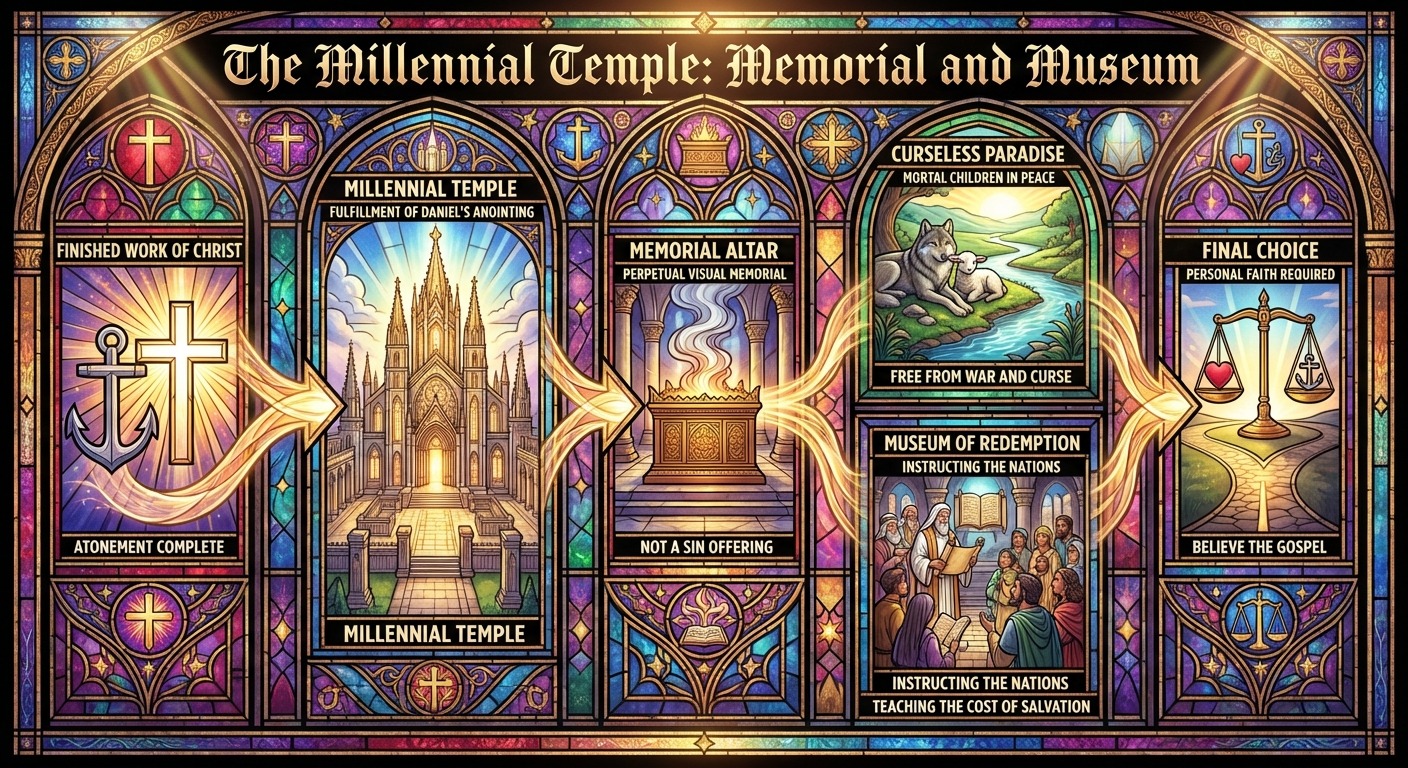
The Millennial Temple: A Memorial and a Museum
The Purpose of the Millennial Temple
This chart shows the structure. What follows explains each part.
When Ezekiel describes the millennial temple in the final chapters of his prophecy -- its dimensions, its courts, its priesthood, its sacrifices -- many readers experience something like category confusion: if Christ has been offered once for all, why would there be animal sacrifices in a future temple? The question is real, and it deserves a real answer rather than a symbolic retreat. This article reads Daniel's phrase 'anoint the most Holy' alongside Ezekiel's vision and Paul's distinction between Israel and the Church, and arrives at an answer that neither requires ignoring the language nor re-instituting a sin-offering system -- because the millennial temple is not a step backward in redemptive history but a memorial forward into it.
When Ezekiel describes the millennial temple in the final chapters of his prophecy -- its dimensions, its courts, its priesthood, its sacrifices -- many readers experience something like category confusion: if Christ has been offered once for all, why would there be animal sacrifices in a future temple? The question is real, and it deserves a real answer rather than a symbolic retreat. This article reads Daniel's phrase 'anoint the most Holy' alongside Ezekiel's vision and Paul's distinction between Israel and the Church, and arrives at an answer that neither requires ignoring the language nor re-instituting a sin-offering system -- because the millennial temple is not a step backward in redemptive history but a memorial forward into it.
The Millennial Temple: A Memorial of Redemption
One of the most profound features of Daniel’s prophecy is the phrase “to anoint the most Holy” in Daniel 9:24. This points directly to the consecration of the millennial temple—the sanctuary that will stand in Jerusalem during Christ’s thousand-year reign. The establishment of this temple is not merely a return to ancient ritual, but the culmination of God’s prophetic program for Israel, fulfilling the deepest longings of the Old Testament prophets for a day when God’s glory would fill the earth and His name would be sanctified among the nations.
A Literal Blueprint
Ezekiel 40-48 provides an unparalleled level of detail regarding this future temple, offering exact measurements, dimensions, and specifications that rival the descriptions of the tabernacle in Exodus or Solomon’s temple in Kings. These are not allegorical or symbolic visions, but blueprints for a literal structure in a literal Jerusalem. To ignore the plain meaning of these eight chapters is to overlook the precision with which God’s prophetic word operates.
The Purpose of Millennial Sacrifices
A common question arises: Why would there be sacrifices in the millennium when Christ’s sacrifice has already been offered once for all? The answer is found in the nature and intent of these offerings. The sacrifices of the millennial temple will not be sin offerings to atone for transgression—Christ’s work is complete and needs no supplement. Instead, these will be memorial burnt offerings, much in the same way believers now observe the Lord’s Supper to shew the Lord’s death till he come (1 Corinthians 11:26). The temple will serve as a perpetual memorial, a visible testimony pointing back to the finished work of Christ.
The burnt offering, as described in Leviticus 1:9, represented total devotion and consecration to God. Unlike the sin or trespass offerings, the entire animal was consumed on the altar, ascending as a sweet savour unto the LORD. This sacrifice prefigured Christ’s perfect obedience and love for the Father, who loved the Father with all his heart, soul, mind, and strength (Mark 12:30). The blood of the burnt offering sanctified the altar, making it holy and providing the basis for all other offerings.
In the millennial temple, burnt offerings will stand as an enduring reminder of God’s delight in His beloved Son, the pleasure the Father takes in Christ’s perfect devotion. As Paul writes, we are accepted in the beloved (Ephesians 1:6), and we are unto God a sweet savour of Christ (2 Corinthians 2:15). The memorial burnt offerings in the millennium will not repeat Christ’s sin-bearing, but will celebrate His perfect consecration, by which believers are made acceptable in God’s presence.
A Teaching Memorial for a New World
The necessity of this memorial becomes clear when considering the unique conditions of the millennial kingdom. At the end of the 70th week, Christ will return and reign from Jerusalem. Survivors from the nations—the “sheep nations” of Matthew 25:31-46—will enter the kingdom in their natural bodies. They will marry, have children, and repopulate the earth in a world transformed: a world without war, without rampant disease, and without the curse operating in its fullness. The wolf shall dwell with the lamb, the lion shall eat straw like the ox, and a little child shall lead them (Isaiah 11:6-7).
Generations born during the millennium will not have experienced the brokenness of the present age. How will they grasp the horror of sin, the reality of death, and the magnitude of Christ’s sacrifice? The memorial temple will function as a “museum of redemption,” providing continual instruction about what Christ accomplished and why the blessings of the kingdom are possible. The law will go forth from Zion, and the temple’s services will teach each generation the gospel and the foundation of their peace.
Zechariah 14:16-19 reveals that the nations will be required to come to Jerusalem each year to worship and keep the Feast of Tabernacles. Those who refuse will face judgment, for even in the millennium, faith will not be coerced. The memorial temple ensures that every generation has access to the truth, preserving the memory of redemption and the means by which the kingdom was established.
This memorial role also explains the final rebellion described in Revelation 20:7-9. After a thousand years, Satan will be released and will deceive the nations, leading a multitude to rebel against Christ. Even after centuries of visible blessing, peace, and righteousness, the human heart will still need to choose faith. The existence of the temple and its memorial sacrifices will have provided every possible opportunity for each person to hear and respond to the truth, yet some will harbor secret unbelief. The final rebellion exposes the necessity of personal faith, regardless of external circumstances.
Magnifying Christ’s Finished Work
Far from diminishing the sufficiency of Christ’s sacrifice, the millennial temple magnifies it. Every burnt offering will point back to Calvary, ensuring that the blessings of the kingdom are never detached from the cross. The temple stands as a perpetual testimony that all peace, healing, and restoration flow from Christ’s finished work. It is not a supplement to Calvary, but a memorial of it—so that no generation forgets the price of redemption or takes for granted the grace that sustains their blessed condition.
The Anchor of Faith
When Daniel received the prophecy of the 70 weeks, culminating in the anointing of the most Holy (Daniel 9:24), he was deeply moved by the vision of the temple described in Ezekiel 40-48. Daniel’s longing was not for religious duty, but for the fulfillment of God’s purposes—a vision that sustained him through exile and disappointment. Though the timeline was extended beyond what he hoped, the promise of the temple and the kingdom remained the anchor of his faith.
Today, standing on the threshold of these fulfillments, we see that the millennial temple will serve as the crowning feature of God’s covenant with Israel and His redemptive plan for the world. It will be the visible sign that God dwells among His people, that His promises are sure, and that Christ’s finished work is eternally celebrated before all creation.
The millennial temple's purpose has been defined -- a memorial of redemption, a museum of God's faithfulness, not a recapitulation of the sacrificial system that Christ has completed. With that in place, the series is ready to step back from the specific features of the prophetic timeline and ask the larger question that animates this entire study: what is prophecy for? Not just in theory, but in practice -- what fruit should prophetic understanding actually produce in the life of the person who receives it?
The millennial temple's purpose has been defined -- a memorial of redemption, a museum of God's faithfulness, not a recapitulation of the sacrificial system that Christ has completed. With that in place, the series is ready to step back from the specific features of the prophetic timeline and ask the larger question that animates this entire study: what is prophecy for? Not just in theory, but in practice -- what fruit should prophetic understanding actually produce in the life of the person who receives it?
Every chart in this series is free to explore online.
 Get the full chart set (PDF – $8)
Members get all PDFs included → Why Membership
Log in with an active membership to download printable PDFs on this site. Purchased on the shop? Access downloads from your shop account.
If you would like to help fund this work:
These charts are based on the following book:

The Master Key: Daniel's 70th Week
The Bible's Framework for Understanding Prophecy - 230 Page Paperback Edition
View Related Book