
Visual Theology – Bible Prophecy Charts
The Visual Theology charts are designed to help you see the structure and movement of Scripture. They highlight patterns, contrasts, and developments that are often difficult to hold together when reading line by line.
These charts show the structure of the argument. The accompanying articles develop each part in full.
This approach follows a long tradition of visual teaching in the Church. The well-known charts of Clarence Larkin helped many grasp the broad outline of Scripture. In the same spirit, these charts aim to make visible what the Word of God is revealing.
Charts and teaching notes for the book of Bible Prophecy Charts. Select a chart below to view the image and article.
Click chart to view larger
From the teaching in: The Master Key: Daniel's 70th Week
The Bema Seat: The Believer's Evaluation
The Bema Seat
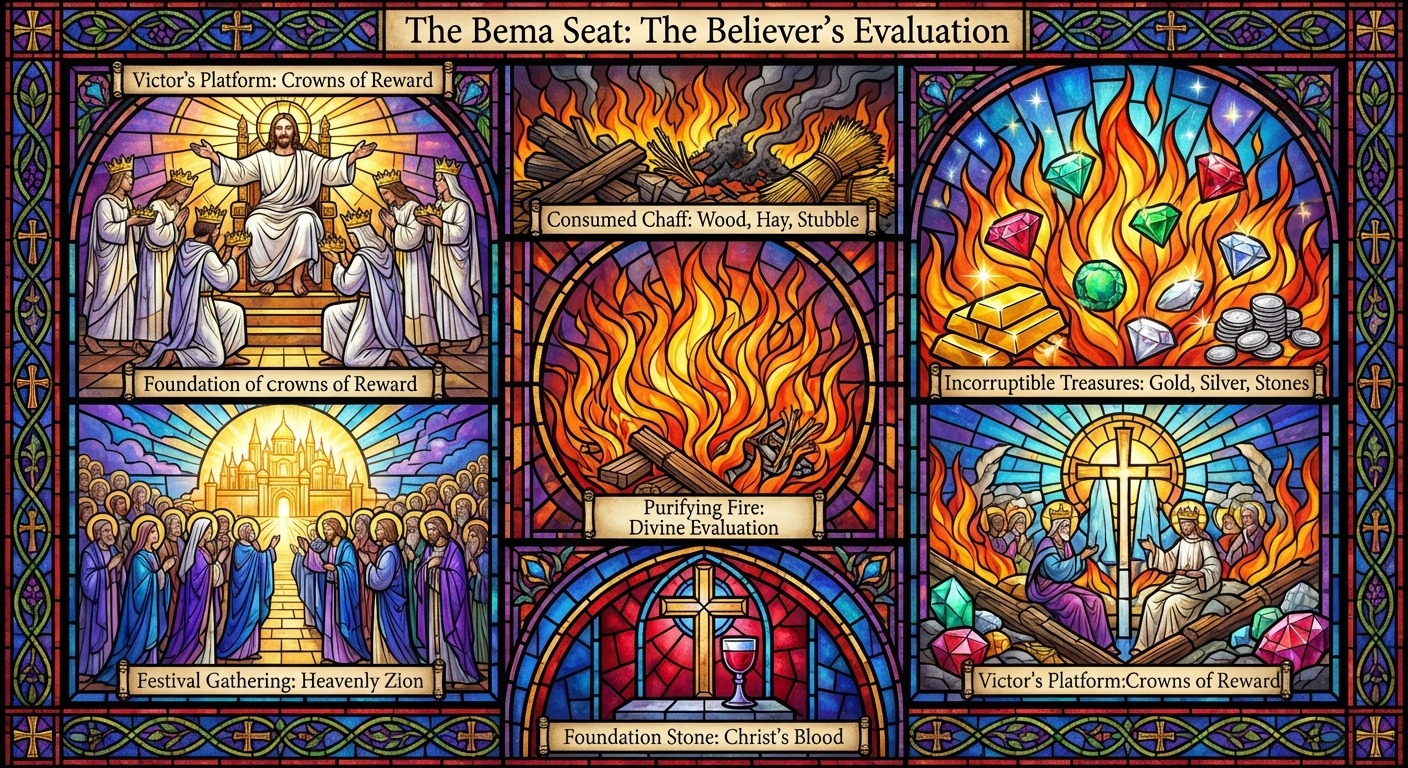
This chart shows the structure. What follows explains each part.
Of the three biblical judgments the previous article distinguished, the one that touches the Church most personally -- and the one most frequently misunderstood -- is the Bema Seat. It is a judgment in the sense that it is an evaluation, a day of accounting; but it is not a judgment that determines whether you stand or fall before God, because that question has already been resolved by the death and resurrection of Christ. The Bema Seat determines something else entirely -- and understanding what it determines changes the texture of the Christian life in a way that is more motivating and more honest than either the fear of punishment or the indifference of cheap grace.
Of the three biblical judgments the previous article distinguished, the one that touches the Church most personally -- and the one most frequently misunderstood -- is the Bema Seat. It is a judgment in the sense that it is an evaluation, a day of accounting; but it is not a judgment that determines whether you stand or fall before God, because that question has already been resolved by the death and resurrection of Christ. The Bema Seat determines something else entirely -- and understanding what it determines changes the texture of the Christian life in a way that is more motivating and more honest than either the fear of punishment or the indifference of cheap grace.
The Bema Seat of Christ
The Bema Seat, or the judgment seat of Christ, is the first judgment in God’s prophetic program and concerns only the Church. Paul writes, “For we must all appear before the judgment seat of Christ; that every one may receive the things done in his body, according to that he hath done, whether it be good or bad” (2 Corinthians 5:10). But this judgment is not about determining salvation or punishment; it is the evaluation of the believer’s works for the purpose of reward.
A New Atmosphere: From Fear to Festival
To rightly understand the Bema Seat, we must recognize that everything has changed since the resurrection of Christ. Under the law, we approached God in fear, as slaves under condemnation, trembling at Mount Sinai. Now, as Hebrews 12 proclaims, “ye are come unto mount Sion, and unto the city of the living God, the heavenly Jerusalem, and to an innumerable company of angels, To the general assembly and church of the firstborn, which are written in heaven, and to God the Judge of all, and to the spirits of just men made perfect, And to Jesus the mediator of the new covenant, and to the blood of sprinkling, that speaketh better things than that of Abel” (Hebrews 12:22-24). The spirit of bondage has been replaced by the Spirit of adoption (Romans 8:15), so that we cry, “Abba, Father.” The smile on the Father’s face is the fundamental reality of our new position in Christ. The atmosphere is no longer one of terror, but of festival rejoicing.
The Pattern Set at Pilate’s Bema
The first mention of the “Bema” in the New Testament is crucial for understanding the believer’s judgment seat. In Matthew 27, Pilate sat on the Bema seat and judged Jesus, declaring, “I find in him no fault at all” (John 18:38). Yet, though Jesus was innocent, He was condemned, while Barabbas, a guilty man, was set free. This is the pattern: at the Bema seat, the innocent is judged in the place of the guilty. Barabbas is a picture of us—guilty, condemned, worthy of death. Jesus, the spotless substitute, is judged in our place. The condemnatory aspect of the Bema seat has already been accomplished. Christ has already stood at the judgment seat for us—judged, condemned, and executed in our place.
When we appear at the Bema seat of Christ, we are not meeting Pilate, but Jesus—our advocate, our friend, our beloved bridegroom. As John writes, “If any man sin, we have an advocate with the Father, Jesus Christ the righteous” (1 John 2:1). The judge is our advocate. He stands at the judgment seat and declares, “My blood answers for them. My righteousness is theirs. They are clothed in Me. If you can find fault in Me, you can find fault in them—but you cannot find fault in Me.”
A Day of Salvation, Not Condemnation
This is why the Scripture describes Christ’s return for believers in terms radically different from His coming in judgment on the world. Hebrews declares, “And as it is appointed unto men once to die, but after this the judgment: So Christ was once offered to bear the sins of many; and unto them that look for him shall he appear the second time without sin unto salvation” (Hebrews 9:27-28). He appears without reference to sin, unto salvation. The day of Christ is not a day of condemnation, but a day of salvation for believers. If we see His appearing as condemnation, we shrink back in fear; but if we see it as salvation, we run to Him in eager anticipation.
Peter exhorts us to “gird up the loins of your mind, be sober, and hope to the end for the grace that is to be brought unto you at the revelation of Jesus Christ” (1 Peter 1:13). The revelation of Jesus Christ—the day we stand before Him—will be a day of grace, not a day of shame or rebuke, but a day when grace is brought to us in ways we cannot yet comprehend. This is the Bema seat: a place of blessing, not bondage.
The Nature of the Judgment: Works, Not the Worker
Paul explains the nature of this judgment in 1 Corinthians 3:11-15: “For other foundation can no man lay than that is laid, which is Jesus Christ. Now if any man build upon this foundation gold, silver, precious stones, wood, hay, stubble; Every man’s work shall be made manifest: for the day shall declare it, because it shall be revealed by fire; and the fire shall try every man’s work of what sort it is. If any man’s work abide which he hath built thereupon, he shall receive a reward. If any man’s work shall be burned, he shall suffer loss: but he himself shall be saved; yet so as by fire.” What is judged is the work, not the worker. The issue is reward or loss of reward, not salvation or damnation. Sin, condemnation, and punishment are never mentioned. Even the word “bad” in 2 Corinthians 5:10 refers to what is worthless, not evil. The fire consumes the worthless, and it is never referenced again. God will not display our failures for all to see; rather, the worthless is burned off and forgotten, while what Christ has accomplished through us remains and is rewarded.
Romans 14:4 makes the purpose of this judgment clear: “Who art thou that judgest another man’s servant? to his own master he standeth or falleth. Yea, he shall be holden up: for God is able to make him stand.” At the Bema seat, God’s purpose is not to strike us down, but to hold us up. Justification transforms the judgment seat from a place of terror into a place of celebration.
A Celebration, Not a Courtroom
The Bema seat is a celebration, not a courtroom. The term “Bema” refers to the victor’s platform at the Greek Olympics, where winners received their crowns amid joyful crowds. Even those whose works are burned are themselves saved, though without reward. This judgment is entirely consistent with the gospel of grace: believers stand before Christ clothed in His righteousness, and the judgment concerns what He has accomplished through them, not what they have accomplished for Him.
What survives the fire are incorruptible materials—gold, silver, precious stones. Gold speaks of faith, silver of redemption, precious stones of the living stones that form God’s habitation. Even more, we ourselves are someone’s fruit. Paul called the Thessalonian believers his crown and rejoicing at the Lord’s coming (1 Thessalonians 2:19). Those who ministered to us, prayed for us, encouraged us in Christ, will find we are their reward. God is not unrighteous to forget your work and labour of love (Hebrews 6:10).
There is also fruit known only to the Lord—the secret walk, the tears, the longing for Him, the moments of weakness turned to Him for comfort. These are treasures the Lord keeps, memorials of our devotion, and they too will be revealed and rewarded at the Bema seat (Psalm 56:8).
The Final Transformation
The transformation that occurs when we are caught up to meet the Lord will itself burn off everything of the flesh. In that instant, we will be glorified, transfigured, clothed in incorruption. What remains after this purifying fire will be the spontaneous manifestation of who we have become through Christ’s working in us. We will each shine with varying degrees of glory (1 Corinthians 15:41-42), not because some deserved more, but because God apportioned different measures of grace and service. Yet all will be crowned, all will rejoice, and all will cast their crowns at Jesus’ feet, confessing that His grace alone produced any lasting fruit.
Living Without Fear
Therefore, we must not live under a cloud of fear regarding the Bema seat. “There is no fear in love; but perfect love casteth out fear: because fear hath torment. He that feareth is not made perfect in love” (1 John 4:18). If we fear the judgment seat, imagining Jesus will punish us for our failures, we will shrink back instead of running to Him. Fear produces bondage, not fruit; it is the opposite of the Spirit-led life that bears eternal fruit.
The Bema seat is meant to motivate, not terrify. It inspires us to run the race with eager anticipation, knowing that at the finish line stands not a taskmaster with a whip, but a smiling bridegroom eager to celebrate with His bride. He longs to reward every act of faith, every word of grace, every cup of cold water given in His name (Matthew 10:42). He seeks opportunities to reward, not reasons to condemn. This is the judgment seat of Christ—the Bema seat—the believer’s evaluation, the celebration of Christ’s life in us, and the assurance that there is now no condemnation to them which are in Christ Jesus (Romans 8:1).
The Bema Seat has been examined: not a bar of divine condemnation but a moment of grace-based evaluation, where the quality of a life lived in Christ is assessed not for salvation but for reward, where loss is real without being eternal, and reward is given freely without being earned by effort alone. With the Bema Seat in view, we have arrived at the end of this series -- and the final article does not introduce a new argument but brings the whole study home, asking what it means to hold all of this together and what kind of person this framework is designed, by God's design, to produce.
The Bema Seat has been examined: not a bar of divine condemnation but a moment of grace-based evaluation, where the quality of a life lived in Christ is assessed not for salvation but for reward, where loss is real without being eternal, and reward is given freely without being earned by effort alone. With the Bema Seat in view, we have arrived at the end of this series -- and the final article does not introduce a new argument but brings the whole study home, asking what it means to hold all of this together and what kind of person this framework is designed, by God's design, to produce.
Every chart in this series is free to explore online.
 Get the full chart set (PDF – $8)
Members get all PDFs included → Why Membership
Log in with an active membership to download printable PDFs on this site. Purchased on the shop? Access downloads from your shop account.
If you would like to help fund this work:
These charts are based on the following book:

The Master Key: Daniel's 70th Week
The Bible's Framework for Understanding Prophecy - 230 Page Paperback Edition
View Related Book