
Visual Theology – Bible Prophecy Charts
The Visual Theology charts are designed to help you see the structure and movement of Scripture. They highlight patterns, contrasts, and developments that are often difficult to hold together when reading line by line.
These charts show the structure of the argument. The accompanying articles develop each part in full.
This approach follows a long tradition of visual teaching in the Church. The well-known charts of Clarence Larkin helped many grasp the broad outline of Scripture. In the same spirit, these charts aim to make visible what the Word of God is revealing.
Charts and teaching notes for the book of Bible Prophecy Charts. Select a chart below to view the image and article.
Click chart to view larger
From the teaching in: The Master Key: Daniel's 70th Week
Proper Prophetic Application
Proper Prophetic Application
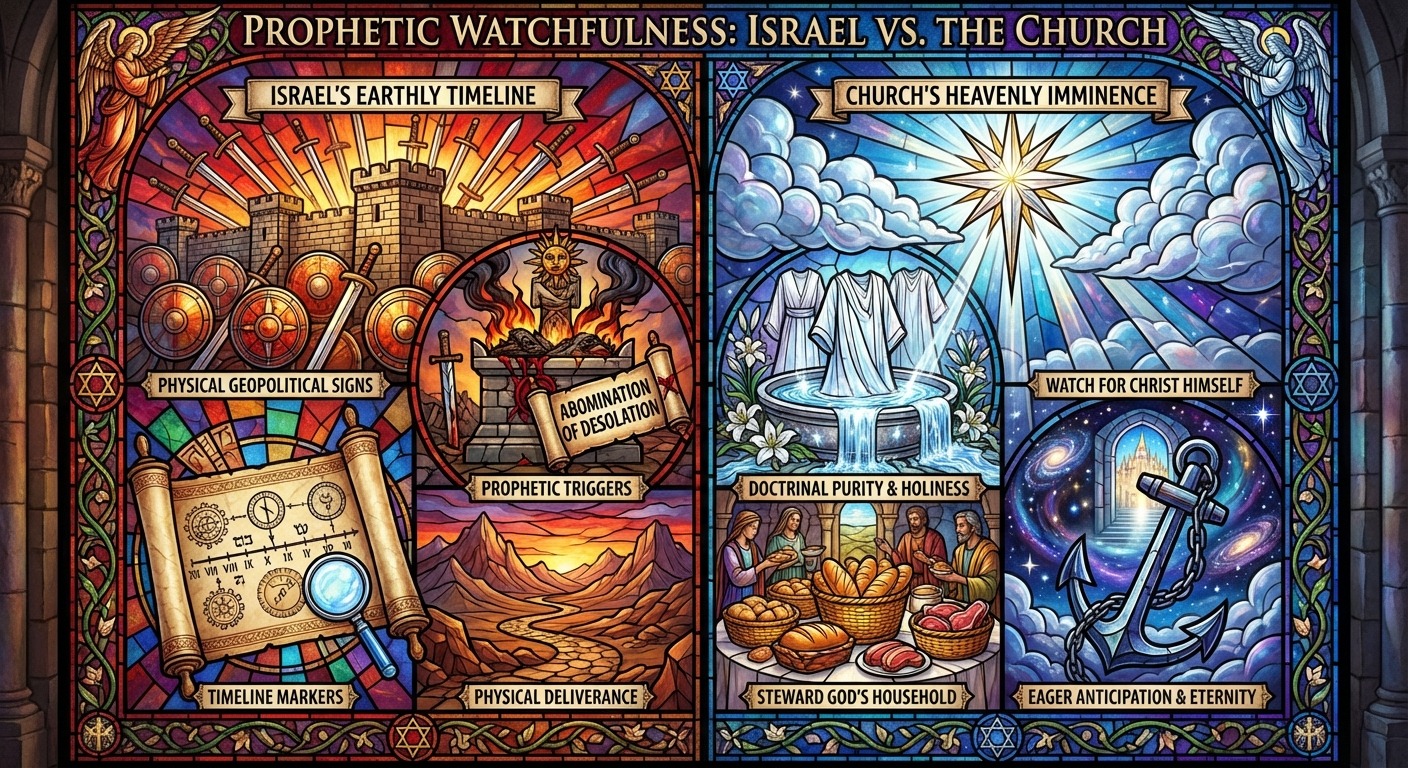
This chart shows the structure. What follows explains each part.
The two extremes in prophetic engagement are easy to name: on one side, the person who reads every geopolitical headline as a fulfillment and whose prophetic interest is functionally indistinguishable from anxiety; on the other, the person who has written off the whole subject as too speculative to be worth the effort and who meets any prophetic discussion with weary skepticism. Scripture charts a course between these two that takes prophecy seriously as a word from God, holds its specific applications with appropriate tentativeness, and allows it to do what it was actually given to do -- stabilize, comfort, orient, and motivate toward holiness. This article examines what that course looks like in practice.
The two extremes in prophetic engagement are easy to name: on one side, the person who reads every geopolitical headline as a fulfillment and whose prophetic interest is functionally indistinguishable from anxiety; on the other, the person who has written off the whole subject as too speculative to be worth the effort and who meets any prophetic discussion with weary skepticism. Scripture charts a course between these two that takes prophecy seriously as a word from God, holds its specific applications with appropriate tentativeness, and allows it to do what it was actually given to do -- stabilize, comfort, orient, and motivate toward holiness. This article examines what that course looks like in practice.
The Proper Application of Prophecy
The proper application of prophecy is a subject that demands careful attention, especially in an age when many are either obsessed with decoding current events or dismissive of prophetic study altogether. Scripture provides a balanced approach that upholds watchfulness while rejecting speculative date-setting. Jesus Himself made this distinction clear: after declaring that no one knows the day or hour, He immediately called His followers to vigilance, saying, "Watch therefore: for ye know not what hour your Lord doth come" (Matthew 24:42). This biblical watchfulness is not about calculating timelines or matching headlines to prophecy, but about living in readiness and ordering our lives in light of eternity.
The Nature of Watchfulness Varies
A crucial aspect of understanding prophecy is recognizing that God gives different instructions to different groups at different times. The nature of watchfulness varies according to God's prophetic program.
For Israel, prophetic watchfulness is event-based, tied to specific signs and timelines. For example, believers in Jerusalem during the first century were given a particular sign: "And when ye shall see Jerusalem compassed with armies, then know that the desolation thereof is nigh. Then let them which are in Judaea flee to the mountains" (Luke 21:20-21). Their obedience to this sign, recorded in history when Christians fled to Pella after the Roman armies withdrew, demonstrates that their watchfulness was linked to observable geopolitical events and required immediate physical action.
In the same way, the believing remnant of Israel during Daniel's 70th week will be given a specific event to watch for: the abomination of desolation. Jesus instructed, "When ye therefore shall see the abomination of desolation, spoken of by Daniel the prophet, stand in the holy place, (whoso readeth, let him understand:) Then let them which be in Judaea flee into the mountains" (Matthew 24:15-16). Here, watchfulness is again tied to a defined prophetic marker—a blasphemous act committed by the Antichrist in the temple—and requires a timely and tangible response.
The Church's Distinct Watchfulness
However, the Church's watchfulness is of a different character altogether. We are not watching for armies around Jerusalem or for the abomination of desolation; those belong to Israel's prophetic timeline. The Church is not given a set of events that must precede the coming of Christ for His own. To do so would undermine the doctrine of imminence—the teaching that Christ could return at any moment.
Instead, the Church is called to a person-based watchfulness: we watch for Christ Himself. As Peter writes, we have "a more sure word of prophecy; whereunto ye do well that ye take heed, as unto a light that shineth in a dark place, until the day dawn, and the day star arise in your hearts" (2 Peter 1:19). Our watchfulness consists of guarding the testimony of Jesus Christ, maintaining sound doctrine, and living in anticipation of His appearing.
This distinction guards us from the error of "rapture bingo"—the constant speculation about current events and their supposed prophetic significance. When believers become preoccupied with matching news headlines to Scripture or insisting that the rapture must occur within a certain window, they are not practicing biblical watchfulness as the Church is instructed. Such speculation is a distraction, not a fulfillment of our calling. The Church is to watch by giving "meat in due season" (Matthew 24:45), by abiding in Christ "that, when he shall appear, we may have confidence, and not be ashamed before him at his coming" (1 John 2:28), and by pursuing holiness and maintaining our first love.
The Practical Outworking: Motivation for Godly Living
The practical outworking of this approach is seen throughout the New Testament. Paul connects the anticipation of Christ's return with godly living: "For the grace of God that bringeth salvation hath appeared to all men, Teaching us that, denying ungodliness and worldly lusts, we should live soberly, righteously, and godly, in this present world; Looking for that blessed hope, and the glorious appearing of the great God and our Saviour Jesus Christ" (Titus 2:11-13). The hope of Christ's return is not an excuse for passivity or for obsessive calculations, but a motivation for active pursuit of holiness and good works.
John echoes this connection: "Beloved, now are we the sons of God, and it doth not yet appear what we shall be: but we know that, when he shall appear, we shall be like him; for we shall see him as he is. And every man that hath this hope in him purifieth himself, even as he is pure" (1 John 3:2-3). The certainty of Christ's return inspires purity, not speculation. Peter likewise exhorts, "Seeing then that all these things shall be dissolved, what manner of persons ought ye to be in all holy conversation and godliness, Looking for and hasting unto the coming of the day of God... Wherefore, beloved, seeing that ye look for such things, be diligent that ye may be found of him in peace, without spot, and blameless" (2 Peter 3:11-14).
Prophecy and Evangelistic Urgency
Prophetic understanding should also stir evangelistic urgency. Jesus Himself linked the preaching of the gospel to the end: "And this gospel of the kingdom shall be preached in all the world for a witness unto all nations; and then shall the end come" (Matthew 24:14). Knowing that opportunities to share the gospel are limited by the coming consummation of God's plan should spur us to prioritize the Great Commission.
Conclusion: Spiritual Stability
Believers who embrace this balanced, grace-based approach to prophecy are marked by spiritual stability. They are neither tossed about by sensational headlines nor distracted from faithful ministry by endless speculation. Instead, they serve with diligence and hope, waiting for Christ Himself and living in the light of His imminent return. This is the proper application of prophecy: not as a playground for speculation, but as a source of hope, motivation, and godly living in the present age.
Proper prophetic application has been outlined -- watchful without frantic, attentive without calculating, grounded without indifferent. The framework that makes this balance possible is not merely a set of habits; it is a theological posture, and it has a name. The grace-based dispensational perspective holds together the precision of God's program for Israel, the distinct calling of the Church, and the gospel sufficiency that prevents prophetic study from sliding into works-based spirituality -- and that perspective is the subject of the next article.
Proper prophetic application has been outlined -- watchful without frantic, attentive without calculating, grounded without indifferent. The framework that makes this balance possible is not merely a set of habits; it is a theological posture, and it has a name. The grace-based dispensational perspective holds together the precision of God's program for Israel, the distinct calling of the Church, and the gospel sufficiency that prevents prophetic study from sliding into works-based spirituality -- and that perspective is the subject of the next article.
Every chart in this series is free to explore online.
 Get the full chart set (PDF – $8)
Members get all PDFs included → Why Membership
Log in with an active membership to download printable PDFs on this site. Purchased on the shop? Access downloads from your shop account.
If you would like to help fund this work:
These charts are based on the following book:

The Master Key: Daniel's 70th Week
The Bible's Framework for Understanding Prophecy - 230 Page Paperback Edition
View Related Book