
Visual Theology – Bible Prophecy Charts
The Visual Theology charts are designed to help you see the structure and movement of Scripture. They highlight patterns, contrasts, and developments that are often difficult to hold together when reading line by line.
These charts show the structure of the argument. The accompanying articles develop each part in full.
This approach follows a long tradition of visual teaching in the Church. The well-known charts of Clarence Larkin helped many grasp the broad outline of Scripture. In the same spirit, these charts aim to make visible what the Word of God is revealing.
Charts and teaching notes for the book of Bible Prophecy Charts. Select a chart below to view the image and article.
Click chart to view larger
From the teaching in: The Master Key: Daniel's 70th Week
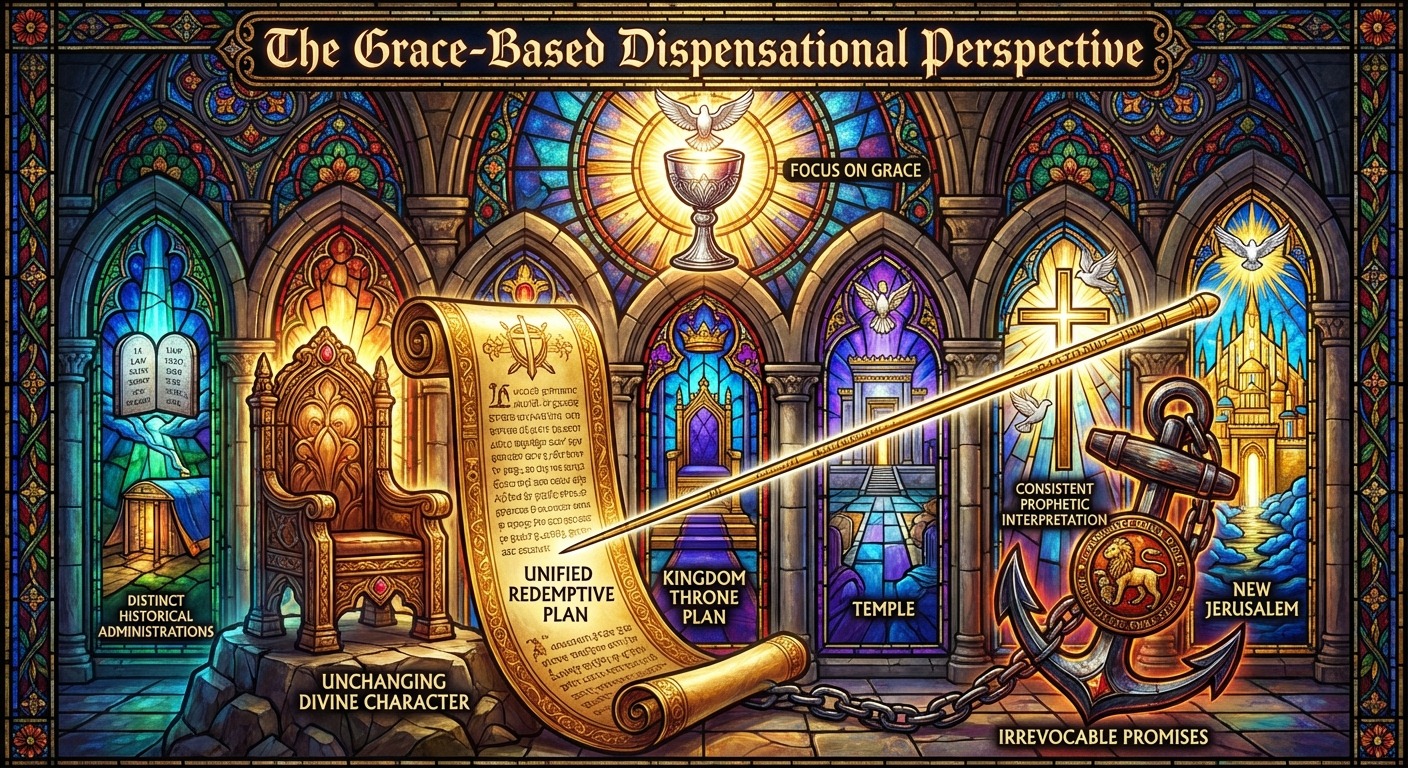
The Grace-Based Dispensational Perspective
The Grace-Based Dispensational Perspective
This chart shows the structure. What follows explains each part.
Dispensationalism as a theological method has sometimes been presented in ways that emphasize system over gospel -- the timelines, the charts, the distinctions -- without anchoring all of it in the grace that is the constant of every era, every program, every divine dealing with human beings. The result can be a posture that is intellectually rigorous but pastorally cool, precise about categories but thin on comfort. This article insists that the dispensational perspective, rightly understood, is not primarily a prophetic system but a framework for protecting the purity of the gospel -- because it is the distinctions between Israel and the Church, between law and grace, between program and promise, that prevent eschatological confusion from bleeding into soteriological confusion.
Dispensationalism as a theological method has sometimes been presented in ways that emphasize system over gospel -- the timelines, the charts, the distinctions -- without anchoring all of it in the grace that is the constant of every era, every program, every divine dealing with human beings. The result can be a posture that is intellectually rigorous but pastorally cool, precise about categories but thin on comfort. This article insists that the dispensational perspective, rightly understood, is not primarily a prophetic system but a framework for protecting the purity of the gospel -- because it is the distinctions between Israel and the Church, between law and grace, between program and promise, that prevent eschatological confusion from bleeding into soteriological confusion.
Understanding Prophecy Through a Grace-Based Framework
Understanding prophecy rightly requires a theological framework that honors the distinctions God has established while recognizing the unity of His redemptive plan. The grace-based dispensational perspective provides this essential framework, allowing us to interpret prophetic passages with consistency while maintaining focus on God’s grace. At its heart, this perspective affirms that God works in different ways during different periods of history, yet He never changes His character or revokes His promises. This divine faithfulness is the bedrock of biblical prophecy.
Paul’s declaration in Romans 11:29—“For the gifts and calling of God are without repentance”—underscores that God does not revoke His promises or change His mind about His chosen people. His dealings with Israel and the Church are governed by the same unchanging character, but He administers His purposes through distinct historical economies. This is not a matter of God improvising or altering His intentions; rather, He unfolds His unified redemptive plan through a series of administrations, each marked by unique responsibilities and revelations, yet always anchored in His eternal faithfulness.
A Necessary Safeguard for the Gospel
The grace-based dispensational perspective is not merely an abstract theological construct; it is the necessary safeguard for the clarity of the gospel. When we recognize that God’s promises to Israel remain intact, and that the Church is a distinct entity—neither Jew nor Greek, but a new creation in Christ—we preserve the purity of grace. Confusion arises when these distinctions are blurred, particularly in the realm of prophecy. For example, misunderstanding Daniel’s 70th week (Daniel 9) or conflating the Church with Israel leads to practical errors that undermine assurance and introduce subtle forms of works-righteousness into the Christian life.
The Changed Atmosphere of Grace
This perspective insists that the atmosphere has changed entirely since the resurrection of Christ. No longer do we approach God as trembling slaves at Sinai, but as sons who have received the Spirit of adoption, whereby we cry, Abba, Father (Romans 8:15). Hebrews 12:22-24 describes our present approach: “But ye are come unto mount Sion, and unto the city of the living God, the heavenly Jerusalem... And to Jesus the mediator of the new covenant, and to the blood of sprinkling, that speaketh better things than that of Abel.” The believer’s standing is not one of bondage or fear, but of festival gathering and rejoicing, grounded in Christ’s finished work.
Rightly Dividing Future Judgments
Within this framework, the distinct judgments of Scripture are rightly divided, protecting believers from the pastoral damage that comes when these are confused. These include:
* The Bema Seat for the Church (2 Corinthians 5:10): This is not a tribunal of condemnation but a celebration of grace, where the believer’s works are evaluated for reward, not for salvation or punishment.
* The Judgment of the Nations: This pertains to those surviving the Tribulation, not the Church.
* The Great White Throne: This is the final judgment of unbelievers, not of those in Christ.
Maintaining these distinctions is not an exercise in theological hair-splitting, but a defense of the gospel itself.
The Consequence of Confusion
When teachers neglect these distinctions, the result is not merely academic confusion but real spiritual harm. The gospel becomes muddied with works-based requirements, assurance is lost, and believers are left in fear rather than in the liberty of Christ. The grace-based dispensational perspective, by contrast, preserves the clarity of God’s grace and the certainty of His promises. It ensures that prophecy remains a source of hope and motivation, not anxiety or bondage.
The Foundation of a Unified Plan
God’s unified redemptive plan is consistent throughout history, but it unfolds through distinct administrations according to His wisdom. The grace that saves, sanctifies, and secures the believer is the same grace that guarantees the fulfillment of every prophetic promise. Thus, the study of prophecy is not a secondary matter; it is foundational to maintaining the purity of the gospel. As we honor the distinctions God has established and trust in His unchanging faithfulness, we are kept in the liberty and assurance that belong to all who are in Christ.
The grace-based dispensational perspective has been grounded: not as a system imposed on Scripture but as the hermeneutical posture that follows from taking God's distinctions seriously and holding fast to the sufficiency of grace in every era. That posture, however, is not merely about prophetic clarity -- it has direct gospel stakes, and those stakes are highest precisely where the distinctions matter most: in the question of the three biblical judgments and what happens when they are confused. That question, and the pastoral damage that follows from it, is the subject of the next article.
The grace-based dispensational perspective has been grounded: not as a system imposed on Scripture but as the hermeneutical posture that follows from taking God's distinctions seriously and holding fast to the sufficiency of grace in every era. That posture, however, is not merely about prophetic clarity -- it has direct gospel stakes, and those stakes are highest precisely where the distinctions matter most: in the question of the three biblical judgments and what happens when they are confused. That question, and the pastoral damage that follows from it, is the subject of the next article.
Every chart in this series is free to explore online.
 Get the full chart set (PDF – $8)
Members get all PDFs included → Why Membership
Log in with an active membership to download printable PDFs on this site. Purchased on the shop? Access downloads from your shop account.
If you would like to help fund this work:
These charts are based on the following book:

The Master Key: Daniel's 70th Week
The Bible's Framework for Understanding Prophecy - 230 Page Paperback Edition
View Related Book