
Visual Theology – Galatians
The Visual Theology charts are designed to help you see the structure and movement of Scripture. They highlight patterns, contrasts, and developments that are often difficult to hold together when reading line by line.
These charts show the structure of the argument. The accompanying articles develop each part in full.
This approach follows a long tradition of visual teaching in the Church. The well-known charts of Clarence Larkin helped many grasp the broad outline of Scripture. In the same spirit, these charts aim to make visible what the Word of God is revealing.
Charts and teaching notes for the book of Galatians. Select a chart below to view the image and article.
Click chart to view larger
From the teaching in: Galatians - Christ in Me As Life - the Spirit as the Blessing of the Gospel
Galatians Acts 24:5
Introduction to the Conflict in Galatia
Galatians Acts 24:5 -- Introduction to the Conflict in Galatia
This chart shows the structure. What follows explains each part.
Having established the core revelation of 'Christ in you' as the mystery of the New Creation, we now turn to see how this truth collided with the religious establishment. This article moves from the theological foundation to the historical conflict it ignited, introducing the specific battle lines drawn in Galatia between Paul's revealed gospel and the Judaizers' system of legalism.
The first ten articles established the gospel Paul preaches and why it is what it is. Now Galatians turns to history -- to the actual crisis in the churches, the people involved, and what was really at stake when the Judaizers arrived. This is not abstract theology anymore; it is a conflict with real participants, real locations, real consequences for the Gentile believers who had come to faith through Paul's preaching. The Judaizers were not random troublemakers. They had a coherent theological position, institutional backing, and the not-inconsiderable advantage of making Paul look like an outlier. This article maps the opening of that conflict before the detail work begins.
Galatians Acts 24:5
For we have found this man a pestilent fellow, and a mover of sedition among all the Jews throughout the world, and a ringleader of the sect of the Nazarenes.
The Conflict in Galatia: Legalism vs. Grace
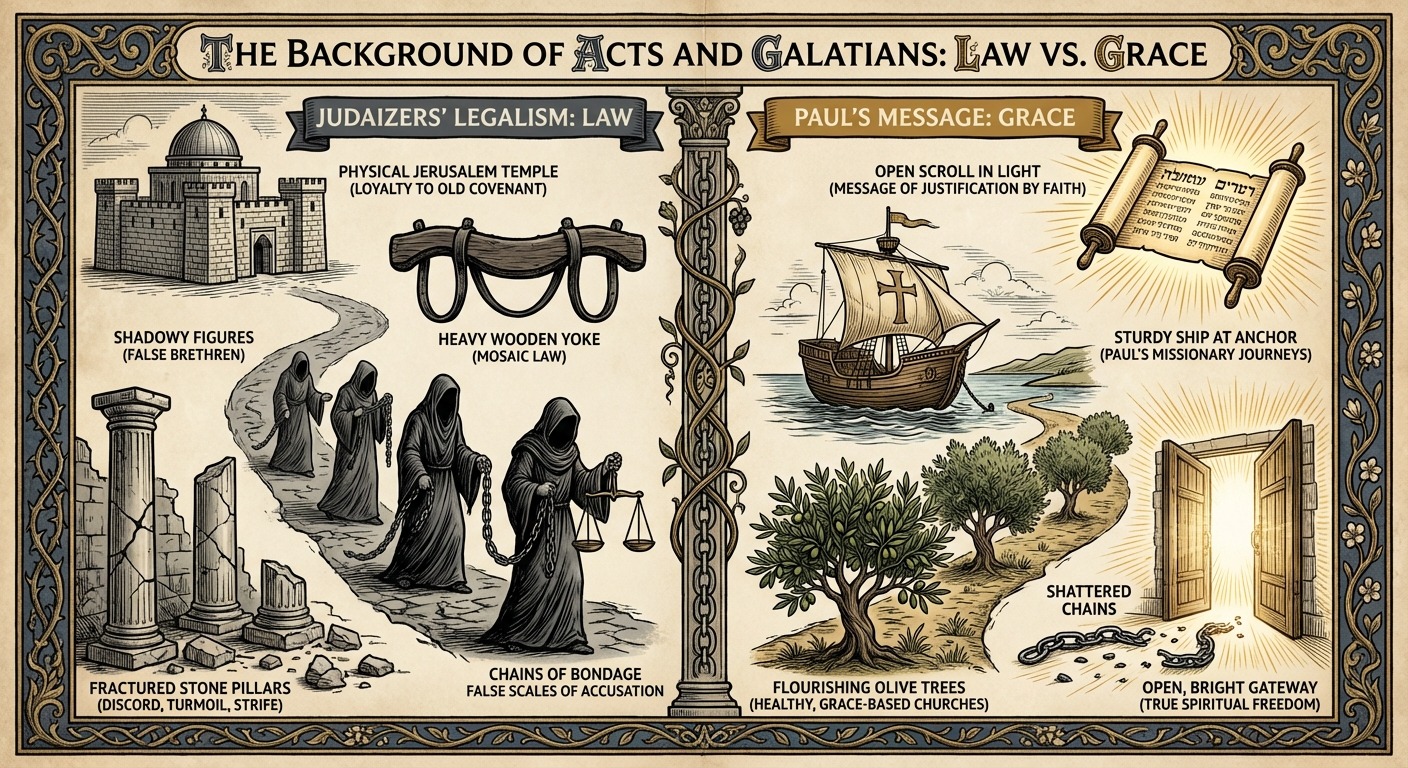
The epistle to the Galatians opens a window onto a decisive conflict that shaped the early church: the struggle between the Judaizers’ legalism and Paul’s message of grace. At the heart of this conflict stands the question of whether believers are to be tethered to the old covenant, symbolized by the physical Jerusalem Temple and the imposing yoke of the Mosaic law, or whether they are to stand fast in the liberty wherewith Christ hath made them free (Galatians 5:1).
The Yoke of the Judaizers
The Judaizers, often referred to as false brethren, did not simply advocate for the law as a matter of heritage or custom; rather, they carried chains of bondage and false scales of accusation, seeking to bind Gentile converts to the entirety of the Mosaic code. Their influence was not benign. As Paul recounts, these shadowy figures sowed discord and turmoil, fracturing the unity of the early churches. The outcome of their teaching was not spiritual health, but rather crumbling stone pillars—communities marked by strife, accusation, and division. Paul warns the Galatians that to embrace this path is to return to bondage, to submit again to a yoke that Christ has already broken (Galatians 2:4; Galatians 5:1).
The Open Scroll of Paul’s Gospel
In contrast, Paul’s message begins not with the old covenant’s physical trappings, but with an open scroll bathed in light—the message of justification by faith. This gospel, received not from men but by the revelation of Jesus Christ, sets forth that righteousness is not attained by the works of the law, but by believing on Him who justifies the ungodly (Galatians 1:6-9). Paul’s missionary journeys, likened to a sturdy ship anchoring in new harbors, carried this message to the Gentile world, planting healthy, grace-based churches. These churches, symbolized as flourishing olive trees, were rooted not in legal observance, but in the life-giving liberty of Christ.
The Outcome: Freedom and Truth
The true outcome of Paul’s gospel is spiritual freedom and the defense of the truth. Where the Judaizers’ system culminates in fractured relationships and spiritual bondage, the message of grace shatters chains and opens a bright gateway to fellowship and peace. Paul insists that this liberty is not license, but the very defense of the gospel’s truth against all distortion. The Galatians are called to stand in this freedom, to resist any return to the yoke of legalism, and to recognize that only in Christ is there true unity and spiritual flourishing.
Thus, the conflict in Galatia is not a matter of secondary importance, but a watershed for the church’s understanding of the gospel. The choice remains stark: either the heavy yoke and bondage of the law, with its attendant strife, or the open, light-filled path of justification by faith, leading to genuine freedom and peace in Christ.
The conflict in Galatia now has a shape: on one side, false brethren with chains of bondage and false scales of accusation, crumbling the columns of what Paul had built; on the other, an open scroll of justification by faith producing flourishing, free churches. But the historical conflict did not stay abstract -- it landed in a specific city, at a specific table, and involved a specific confrontation between Paul and someone whose defection made the stakes unmistakably clear. That confrontation is coming. But first, the article sequence pauses to examine what the old earthly system that the Judaizers represented actually looks like from the inside -- and why it is so attractive even to people who should know better.
With the conflict's opposing forces now clearly defined—legalism versus grace, bondage versus freedom—we must examine the specific nature of the system Paul opposed. The next article will dissect the 'religious flesh' of the Judaizers, showing why its scriptural appearance and traditional weight made it such a potent and dangerous alternative to the heavenly reality of Christ.
Every chart in this series is free to explore online.
 Get the full chart set (PDF – $8)
Members get all PDFs included → Why Membership
Log in with an active membership to download printable PDFs on this site. Purchased on the shop? Access downloads from your shop account.
If you would like to help fund this work:
These charts are based on the following book:

Galatians - Christ in Me As Life - the Spirit as the Blessing of the Gospel
A biblical commentary on Galatians, exploring how Christ is revealed throughout Scripture. Deep theological insights for serious students of the Word.
View Related Book