
Visual Theology – Galatians
The Visual Theology charts are designed to help you see the structure and movement of Scripture. They highlight patterns, contrasts, and developments that are often difficult to hold together when reading line by line.
These charts show the structure of the argument. The accompanying articles develop each part in full.
This approach follows a long tradition of visual teaching in the Church. The well-known charts of Clarence Larkin helped many grasp the broad outline of Scripture. In the same spirit, these charts aim to make visible what the Word of God is revealing.
Charts and teaching notes for the book of Galatians. Select a chart below to view the image and article.
Click chart to view larger
From the teaching in: Galatians - Christ in Me As Life - the Spirit as the Blessing of the Gospel
Galatians 5:19-26
Burden Bearers vs. Taskmasters
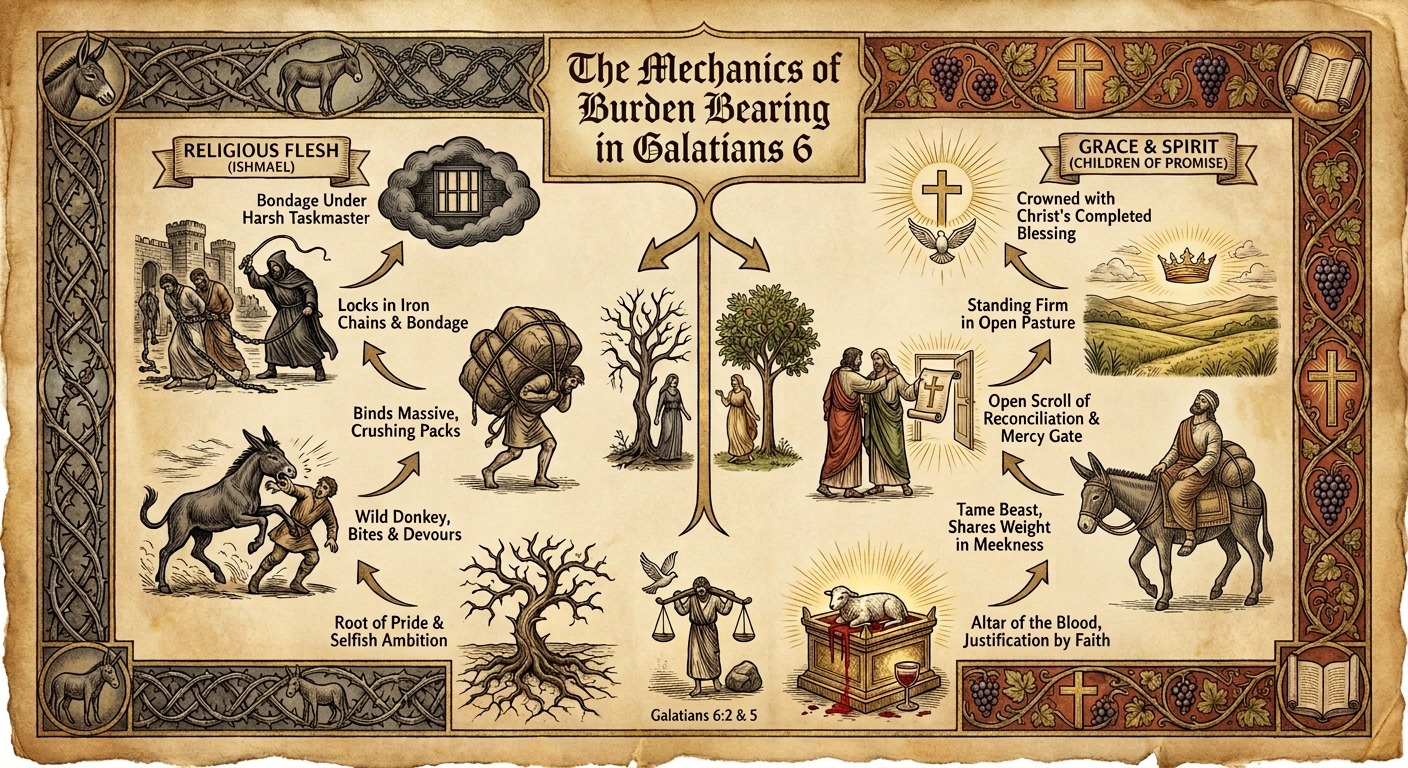
Galatians 5:19-26 -- Burden Bearers vs. Taskmasters
This chart shows the structure. What follows explains each part.
Having seen how the law lawfully exposes the flesh, we now turn to the practical outworking of this truth within the Christian community. This article examines the stark contrast between two systems of relationship and ministry that emerge from living either under the flesh or under the Spirit. The test is not merely doctrinal correctness, but whether our interactions become marked by the heavy hand of a taskmaster or the gentle support of a burden-bearer.
The practical test of the gospel's truth in community is not whether the doctrine is correct but whether the relationships are free. A community of law-keepers is necessarily a community of taskmasters: someone has to enforce the standard, someone has to judge whether it is being met, someone has to apply the burden of the expectation to those who are struggling. A community of people living from the Spirit looks different -- not because the standard is lower, but because the motive is different and the supply is different. Burden-bearing, as Paul describes it, is the mark of those who are living from grace rather than from law, because only those who know they have been borne can bear others.
Galatians 5:19-26
Now the works of the flesh are manifest, which are these; Adultery, fornication, uncleanness, lasciviousness, idolatry, witchcraft, hatred, variance, emulations, wrath, strife, seditions, heresies, envyings, murders, drunkenness, revellings, and such like: of the which I tell you before, as I have also told you in time past, that they which do such things shall not inherit the kingdom of God. But the fruit of the Spirit is love, joy, peace, longsuffering, gentleness, goodness, faith, meekness, temperance: against such there is no law. And they that are Christ's have crucified the flesh with the affections and lusts. If we live in the Spirit, let us also walk in the Spirit. Let us not be desirous of vain glory, provoking one another, envying one another.
Two Systems in the Church
Within the life of the church, two systems contend for influence: the false system of the flesh and the true system of the Spirit. Galatians draws a sharp distinction between these, setting forth the allegory of Ishmael and the Children of Promise (Galatians 4:21-31) to typify their mechanics and outcomes.
The System of the Flesh
The fleshly system, rooted in pride and selfish ambition, takes its cue from Ishmael, described as "a wild man whose hand is against every man" (Genesis 16:12). In this sense, the religious flesh manifests as a wild, kicking donkey—restless, biting, and devouring its brothers, as Paul warns: "But if ye bite and devour one another, take heed that ye be not consumed one of another" (Galatians 5:15).
This system does not stop at strife; it imposes intolerable burdens upon others. Like a taskmaster, it binds massive, crushing packs—the burdens of the law and religious rules—onto the backs of fellow believers. These are not the gentle yoke of Christ but the heavy weights of human effort and religious pride. The final result is bondage: believers are locked in heavy iron chains, delivered into servitude under a harsh master wielding a whip. This is the fate of those who seek to be justified by the law, for "ye are fallen from grace" (Galatians 5:4), and the inheritance is lost to the children of the bondwoman.
The System of the Spirit
In contrast, the true system of the Spirit begins at the altar of the blood, where justification by faith is established. Here, the believer is made a child of promise, not by works, but by receiving the blessing of Christ. The Spirit produces a spirit of meekness, transforming the believer into a tame beast of burden. Instead of loading others with burdens, the believer steps under the heavy packs to lift and share the weight off their fallen brothers, fulfilling the command: "Bear ye one another's burdens, and so fulfil the law of Christ" (Galatians 6:2).
This ministry is marked not by judgment but by reconciliation. Rather than wielding the whip of condemnation, the believer extends an open scroll of reconciliation and points to the open gate of God's mercy. The direction is upward, leading to the open pasture of true liberty, where believers are no longer bound but stand firm in the completed blessing of Christ: "Stand fast therefore in the liberty wherewith Christ hath made us free, and be not entangled again with the yoke of bondage" (Galatians 5:1).
The Choice Before the Believer
Thus, every believer faces the choice between being a burden-bearer in the Spirit or a taskmaster in the flesh. The former is grounded in the finished work of Christ and moves in meekness and mercy; the latter arises from pride and ambition, multiplying burdens and leading to bondage. The call of Galatians is to forsake the wild, kicking donkey of religious flesh and to walk in the liberty and blessing bestowed upon the children of promise.
Burden-bearing as the expression of the law of Christ -- fulfilling love rather than the law of Sinai -- is the community form of what faith working by love looks like in individual life. The contrast with the taskmaster pattern is total: where the taskmaster weights down, the burden-bearer lifts; where the taskmaster accuses, the burden-bearer restores in a spirit of meekness. All of this flows from the same source: the cross, the blood, the altar of reconciliation. And the cross is where Paul ends the letter -- not with a principle but with a person, and with a boast. What he glories in, and why, is the final movement of Galatians.
Understanding this contrast between burden-bearing and taskmastering prepares us for Paul's ultimate conclusion. Having established the practical fruit of these two systems in community, he will now bring his entire argument to a single, piercing point: the only proper ground for our boasting, and the only source of true freedom from both the law and human approval, is found exclusively in the cross of Christ.
Every chart in this series is free to explore online.
 Get the full chart set (PDF – $8)
Members get all PDFs included → Why Membership
Log in with an active membership to download printable PDFs on this site. Purchased on the shop? Access downloads from your shop account.
If you would like to help fund this work:
These charts are based on the following book:

Galatians - Christ in Me As Life - the Spirit as the Blessing of the Gospel
A biblical commentary on Galatians, exploring how Christ is revealed throughout Scripture. Deep theological insights for serious students of the Word.
View Related Book