
Visual Theology – Galatians
The Visual Theology charts are designed to help you see the structure and movement of Scripture. They highlight patterns, contrasts, and developments that are often difficult to hold together when reading line by line.
These charts show the structure of the argument. The accompanying articles develop each part in full.
This approach follows a long tradition of visual teaching in the Church. The well-known charts of Clarence Larkin helped many grasp the broad outline of Scripture. In the same spirit, these charts aim to make visible what the Word of God is revealing.
Charts and teaching notes for the book of Galatians. Select a chart below to view the image and article.
Click chart to view larger
From the teaching in: Galatians - Christ in Me As Life - the Spirit as the Blessing of the Gospel
Galatians Romans 3:28
Faith vs. Works
Galatians Romans 3:28 -- Faith vs. Works
This chart shows the structure. What follows explains each part.
Having established that Christ absorbed the law's curse to secure the Spirit's promise, Paul now sharpens the contrast to its ultimate point. This article examines the fundamental binary he presents: justification is either by faith or by works. These are not complementary paths but mutually exclusive systems with radically different mechanics, demands, and destinations.
Paul has established that the curse of the law is real and that Christ bore it. He has established that the promise to Abraham preceded the law and cannot be undone by it. Now he sharpens the contrast to its finest point: justification is either by faith or by works, and the two are not complementary pathways toward the same destination -- they are mutually exclusive operating systems. The article you are about to read takes up that sharp binary and traces what each path looks like at every stage: what the works-path demands, what it produces, where it ends; and what the faith-path receives, what it rests on, and where it arrives.
Galatians Romans 3:28
Therefore we conclude that a man is justified by faith without the deeds of the law.
The Heart of Galatians: Justification by Faith vs. Works
The heart of the epistle to the Galatians is the contrast between seeking justification by works and receiving justification by faith. Paul presses upon his readers that faith is not a matter of “doing something” to put God in our debt, but rather believing the Gospel as it is declared in Christ crucified. In Galatians 2:16, the apostle writes, “Knowing that a man is not justified by the works of the law, but by the faith of Jesus Christ, even we have believed in Jesus Christ, that we might be justified by the faith of Christ, and not by the works of the law: for by the works of the law shall no flesh be justified.”
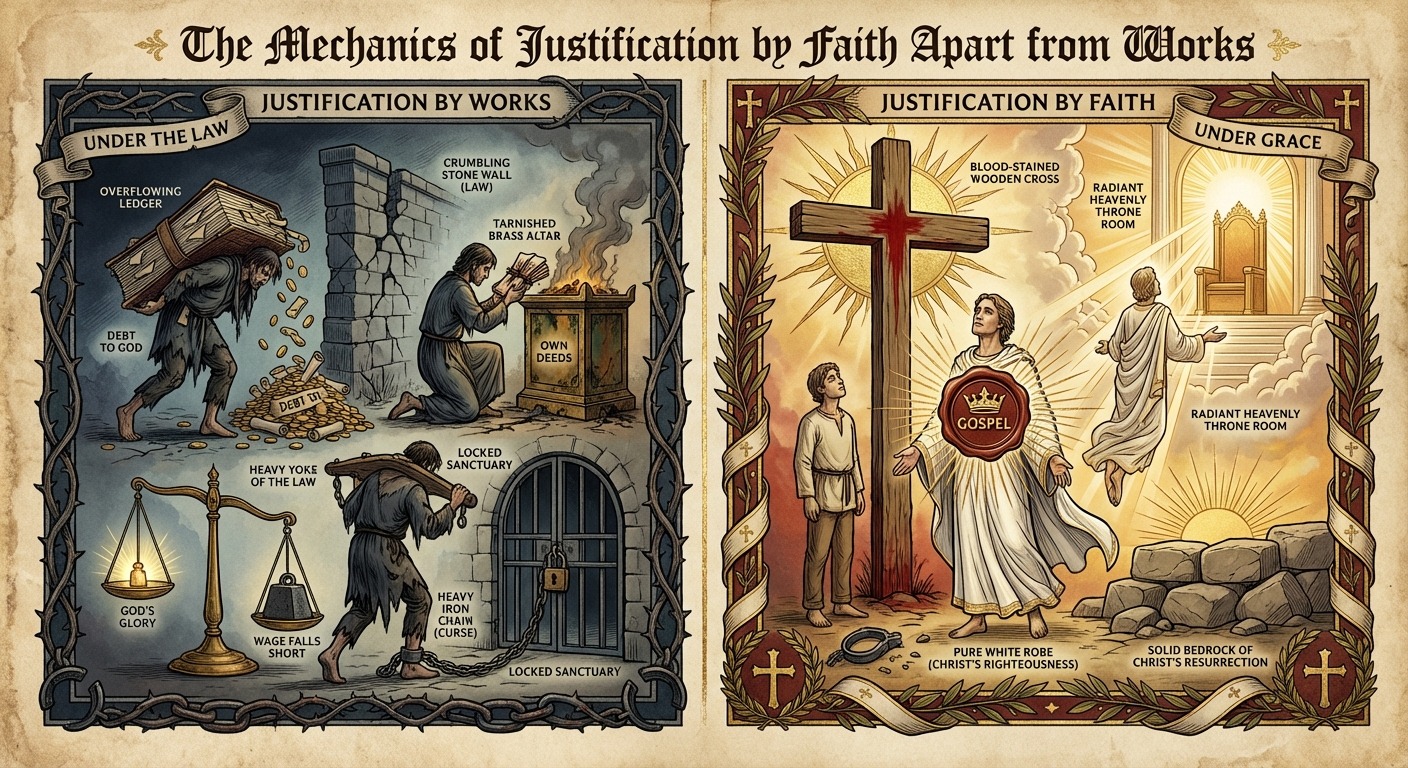
Here, the futility of works is exposed. The soul that attempts to earn acceptance before God by keeping the law is pictured as burdened with a heavy, overflowing ledger—a record of deeds that only deepens the sense of debt. The law itself looms as a crumbling, rigid stone wall, offering no comfort, only the threat of collapse under its impossible demands.
The Burden and Curse of the Law
Such a person lays their own efforts upon a tarnished brass altar, hoping to tip the scales in their favor. Yet the divine balance remains unyielding, for as Romans 3:23 declares, “For all have sinned, and come short of the glory of God.” The wage of works is always insufficient, and the result is not liberty but bondage—a heavy iron chain, the curse of the law, that locks the sinner out of the sanctuary of God. Galatians 3:10 solemnly warns, “For as many as are of the works of the law are under the curse: for it is written, Cursed is every one that continueth not in all things which are written in the book of the law to do them.”
The Empty-Handed Reception of Christ
In contrast, justification by faith is not a transaction of merit but the empty-handed reception of Christ. The believer stands with nothing to offer, looking only to the blood-stained wooden cross where Christ was made a curse for us, as Galatians 3:13 declares: “Christ hath redeemed us from the curse of the law, being made a curse for us.” Faith is not an achievement, but a gaze fixed on the Gospel, sealed with the royal authority of God’s promise. Over the believer is stamped the royal wax seal of the Gospel, signifying God’s acceptance on the basis of Christ alone.
Clothed not in their own efforts, but in a pure white robe—the perfect righteousness of Christ—the believer is no longer subject to the tyranny of the law’s demands. Romans 4:5 affirms, “But to him that worketh not, but believeth on him that justifieth the ungodly, his faith is counted for righteousness.” Instead of earning a wage, the one who believes is lifted directly into the radiant throne room of heaven, fully separated from the yoke of the law and resting securely on the unshakeable foundation of Christ’s resurrection. Galatians 2:21 makes it plain: “I do not frustrate the grace of God: for if righteousness come by the law, then Christ is dead in vain.”
The Only Ground of Justification
Thus, faith is not an act of self-effort or a means of putting God in debt. It is the simple, total reliance upon the finished work of Christ, the acceptance of the Gospel, and the confident standing in His righteousness alone. This is the only ground on which a sinner is justified—by believing the Gospel, not by “doing something.”
The ledger of works on one side, the empty hands of faith on the other -- the royal seal of the promise received rather than earned. Paul has now established the binary so clearly that only one question remains before the positive statement of the law's true purpose: what did Christ actually do with the curse, and how does the blessing of the Spirit flow from that act? The mechanics of redemption from the curse are the subject of the article that follows -- specifically, how the cross becomes the turning point from the mystical legalism of works to the gospel rest of faith.
With the stark antithesis between faith and works clearly defined, a crucial question remains: what is the nature of the promise that faith receives? The next article examines the covenant structure itself, showing why the promise made to Abraham—and fulfilled in Christ—cannot be altered or conditioned by the law that came centuries later.
Every chart in this series is free to explore online.
 Get the full chart set (PDF – $8)
Members get all PDFs included → Why Membership
Log in with an active membership to download printable PDFs on this site. Purchased on the shop? Access downloads from your shop account.
If you would like to help fund this work:
These charts are based on the following book:

Galatians - Christ in Me As Life - the Spirit as the Blessing of the Gospel
A biblical commentary on Galatians, exploring how Christ is revealed throughout Scripture. Deep theological insights for serious students of the Word.
View Related Book