
Visual Theology – Galatians
The Visual Theology charts are designed to help you see the structure and movement of Scripture. They highlight patterns, contrasts, and developments that are often difficult to hold together when reading line by line.
These charts show the structure of the argument. The accompanying articles develop each part in full.
This approach follows a long tradition of visual teaching in the Church. The well-known charts of Clarence Larkin helped many grasp the broad outline of Scripture. In the same spirit, these charts aim to make visible what the Word of God is revealing.
Charts and teaching notes for the book of Galatians. Select a chart below to view the image and article.
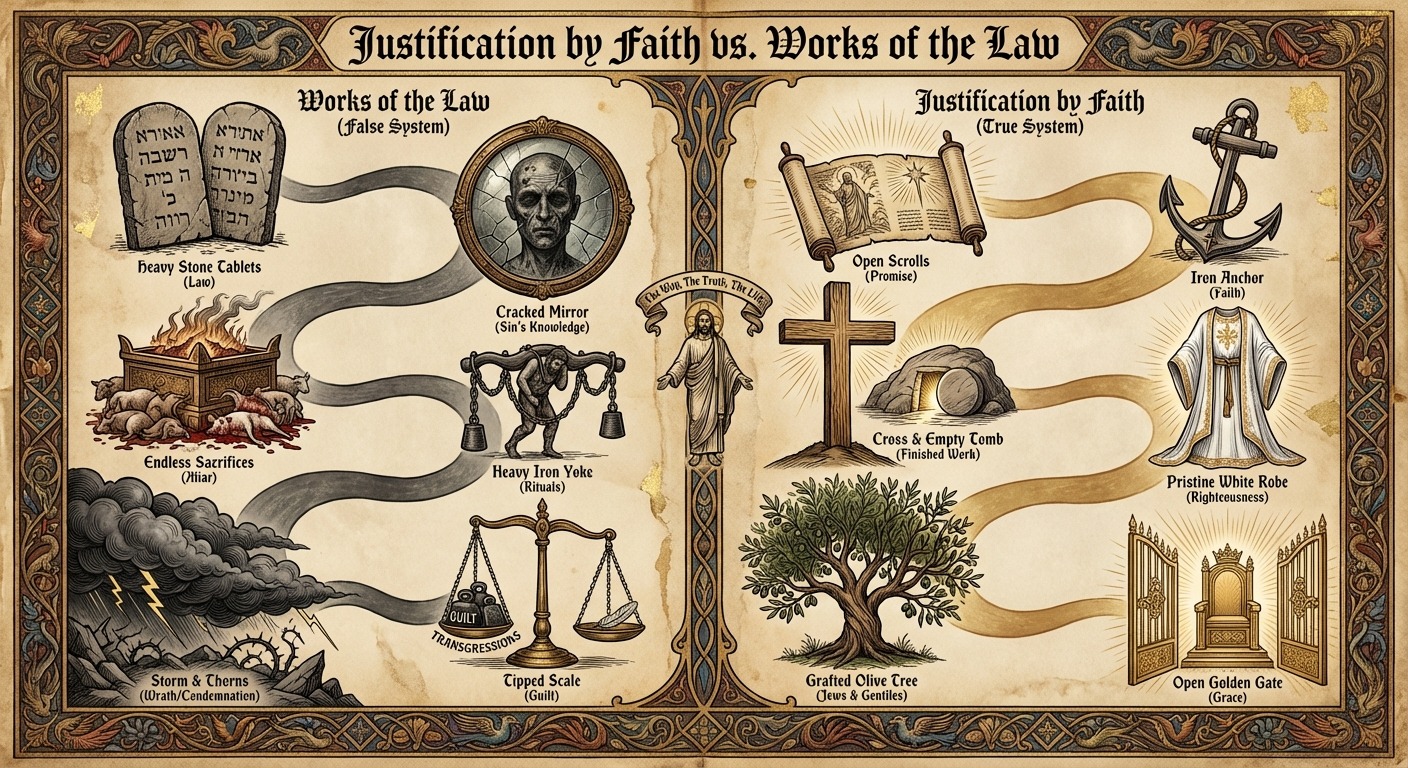
Click chart to view larger
From the teaching in: Galatians - Christ in Me As Life - the Spirit as the Blessing of the Gospel
Galatians 2:15-21
Justification by Faith vs. Works
Galatians 2:15-21 -- Justification by Faith vs. Works
This chart shows the structure. What follows explains each part.
Having exposed the theological implications of Peter's withdrawal in Antioch, Paul now moves from narrative to direct theological argument. This article examines the core antithesis Paul establishes in Galatians 2:15-21: the fundamental, irreconcilable distinction between justification by works of the law and justification by faith in Christ. Here, the mechanics of each system are laid bare, answering the essential question of how a person actually stands righteous before God.
Paul has told the story of the conflict -- the Judaizers, the false brethren, Peter at Antioch, the rebuke. Now he turns from narrative to argument, from biography to mechanics. The question he is pressing in this section of Galatians is the one that everything else depends on: how does a person stand before God? Not in theory, but in the actual structure of what happens when a human being is declared righteous. The works-of-the-law system and the faith-in-Christ system are both attempting to answer that question. Paul's argument is that they are not two different answers to the same question -- they are answers to two different questions, and only one of them is addressing the question that actually matters.
Galatians 2:15-21
We who are Jews by nature, and not sinners of the Gentiles, knowing that a man is not justified by the works of the law, but by the faith of Jesus Christ, even we have believed in Jesus Christ, that we might be justified by the faith of Christ, and not by the works of the law: for by the works of the law shall no flesh be justified. But if, while we seek to be justified by Christ, we ourselves also are found sinners, is therefore Christ the minister of sin? God forbid. For if I build again the things which I destroyed, I make myself a transgressor. For I through the law am dead to the law, that I might live unto God. I am crucified with Christ: nevertheless I live; yet not I, but Christ liveth in me: and the life which I now live in the flesh I live by the faith of the Son of God, who loved me, and gave himself for me. I do not frustrate the grace of God: for if righteousness come by the law, then Christ is dead in vain.
The Sharp Distinction in Galatians
The epistle to the Galatians draws a sharp and necessary distinction between justification by works of the law and justification by faith. The apostle Paul exposes the futility of seeking righteousness through the heavy stone tablets of the law, which serve not as a ladder to life, but as a cracked mirror reflecting blemishes—revealing the knowledge of sin rather than providing escape from its grip. As Galatians 2:16 declares, "Knowing that a man is not justified by the works of the law, but by the faith of Jesus Christ, even we have believed in Jesus Christ, that we might be justified by the faith of Christ, and not by the works of the law: for by the works of the law shall no flesh be justified." The law, far from conferring life, exposes transgression and multiplies the awareness of guilt.
The Futility of the Law's Works
This system of works proceeds inexorably toward endless temple sacrifices at a bronze altar, each offering a reminder that the iron yoke of religious rituals cannot lift the weight of condemnation. The scale of divine justice, rather than tipping toward acquittal, is heavily weighted with guilt. The outcome is not peace, but the gathering of dark storm clouds and thorns—wrath and condemnation that no human effort can dispel. As Galatians 3:10 warns, "For as many as are of the works of the law are under the curse: for it is written, Cursed is every one that continueth not in all things which are written in the book of the law to do them." The law demands perfection, and in its light, all stand condemned.
The True Mechanism of Justification by Faith
In contrast, the true mechanism of justification is traced through the open prophetic scrolls, which foretell the coming Seed. The saints of old, anchored by faith, looked forward in hope, trusting not in their own merit but in the promise of God. This iron anchor of faith finds its fulfillment in the central wooden cross and the empty tomb—Christ's finished work. Here, the demand of the law is satisfied, and the curse is borne away. As Galatians 3:13 proclaims, "Christ hath redeemed us from the curse of the law, being made a curse for us."
From the cross grows a flourishing olive tree, its natural branches representing the Jews and its wild branches the Gentiles, grafted together in one new people. The ground of their unity is not the iron yoke of ritual, but the imputed righteousness that springs from faith. The outcome is a pristine white robe, not earned but given, and an open golden gate leading to the throne of grace. Galatians 3:26-27 affirms, "For ye are all the children of God by faith in Christ Jesus. For as many of you as have been baptized into Christ have put on Christ."
The Absolute Contrast
Thus, justification by faith is not a matter of human striving, but of receiving what Christ has accomplished. The law reveals the need, but only the cross provides the remedy. The believer stands not in the shadow of storm clouds, but robed in righteousness, welcomed into the presence of God. The contrast is absolute: where works end in condemnation, faith opens the way to grace and life.
Justification by faith has now been named and framed -- the solid rock, the gate, the robe of righteousness that does not depend on the wearer's performance to remain white. But Paul is about to press the argument into more uncomfortable territory: what does it mean to be 'justified as sinners'? If faith in Christ is the mechanism of justification, does that mean Christ has become the minister of sin? It sounds like an absurd question -- but it is exactly the accusation the Judaizers were making, and Paul's answer to it opens up one of the most important passages in the letter.
Having established the sharp distinction between two opposing principles of justification, Paul anticipates a critical objection. If we are justified by faith while still being sinners, does that make Christ a promoter of sin? This question, which arises directly from the logic of justification by faith alone, is the precise focus of our next article.
Every chart in this series is free to explore online.
 Get the full chart set (PDF – $8)
Members get all PDFs included → Why Membership
Log in with an active membership to download printable PDFs on this site. Purchased on the shop? Access downloads from your shop account.
If you would like to help fund this work:
These charts are based on the following book:

Galatians - Christ in Me As Life - the Spirit as the Blessing of the Gospel
A biblical commentary on Galatians, exploring how Christ is revealed throughout Scripture. Deep theological insights for serious students of the Word.
View Related Book