
Visual Theology – Galatians
The Visual Theology charts are designed to help you see the structure and movement of Scripture. They highlight patterns, contrasts, and developments that are often difficult to hold together when reading line by line.
These charts show the structure of the argument. The accompanying articles develop each part in full.
This approach follows a long tradition of visual teaching in the Church. The well-known charts of Clarence Larkin helped many grasp the broad outline of Scripture. In the same spirit, these charts aim to make visible what the Word of God is revealing.
Charts and teaching notes for the book of Galatians. Select a chart below to view the image and article.
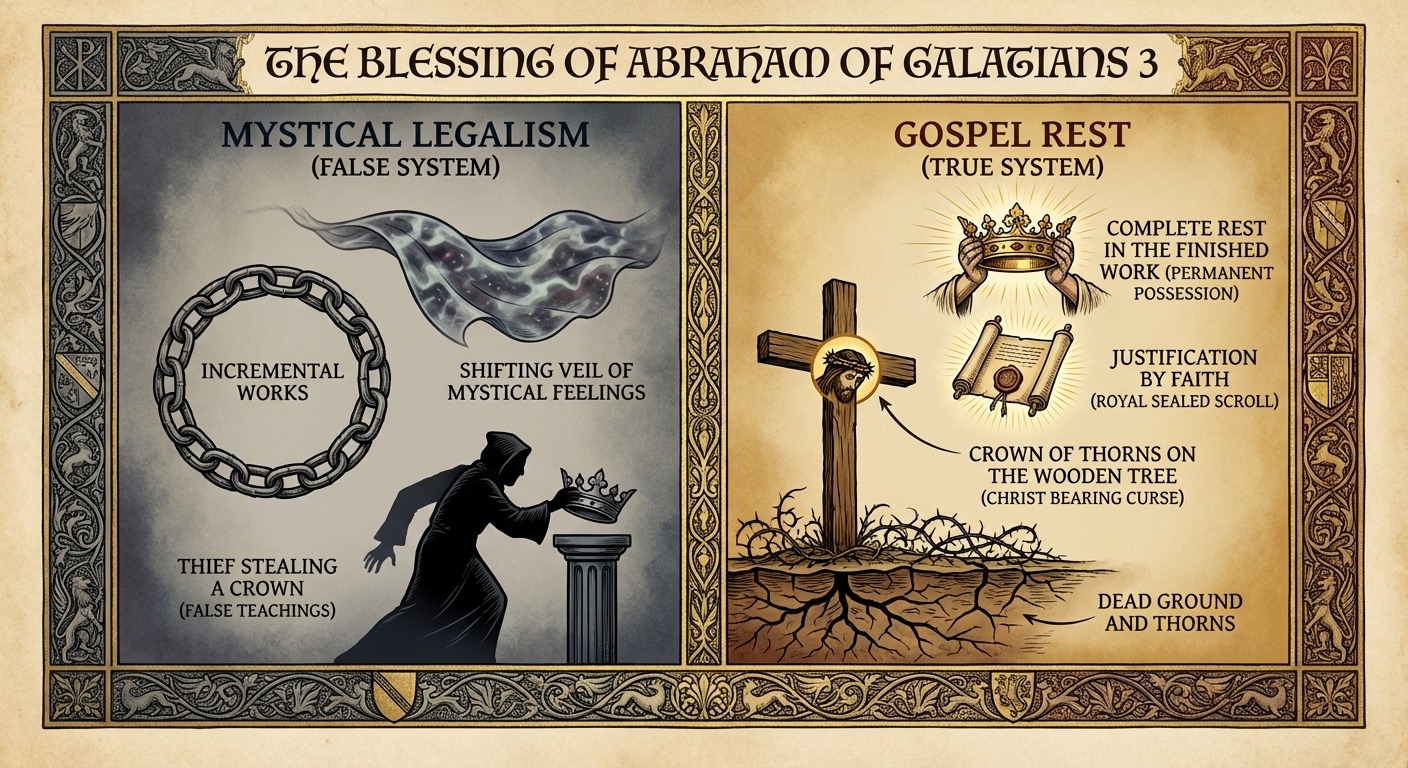
Click chart to view larger
From the teaching in: Galatians - Christ in Me As Life - the Spirit as the Blessing of the Gospel
Galatians 3:13-14
Redemption from the Curse and the Promise of the Spirit
Galatians 3:13-14 -- Redemption from the Curse and the Promise of the Spirit
This chart shows the structure. What follows explains each part.
Having established the inescapable reality of the law's curse upon all who seek justification through works, we now turn to the divine solution. This article examines the specific transaction of Galatians 3:13-14, where Christ Himself becomes the curse-bearer on the tree. Here, the condemnation we faced is not merely set aside but decisively absorbed by Christ in a finished work of substitution, opening the floodgates for the blessing of Abraham and the promised Spirit to flow to believers.
Galatians 3:13 is one of the hinge verses of the New Testament: 'Christ hath redeemed us from the curse of the law, being made a curse for us: for it is written, Cursed is every one that hangeth on a tree.' Paul is not offering a theory here -- he is describing a transaction. The curse that the law pronounces on everyone who fails to keep it in its entirety was borne by Christ, on the tree, in our place. That is not a sentiment; it is a legal substitution with real consequences on both sides: the curse has been absorbed, and what flows in on the other side is the blessing of Abraham to the Gentiles, the promise of the Spirit received through faith. The article traces that transaction from the curse borne to the rest received.
Galatians 3:13-14
Christ hath redeemed us from the curse of the law, being made a curse for us: for it is written, Cursed is every one that hangeth on a tree: That the blessing of Abraham might come on the Gentiles through Jesus Christ; that we might receive the promise of the Spirit through faith.
Two Systems: Mystical Legalism vs. Gospel Rest
The epistle to the Galatians draws a sharp line between two systems: the false mechanics of Mystical Legalism and the true mechanics of Gospel Rest. The former ensnares believers in a cycle of endlessly seeking an unearned blessing, where each effort is chained to the next, producing only spiritual exhaustion. This system is characterized by heavy chains of incremental works and a shifting veil, as those caught in it rely not on the stable foundation of truth but on unstable mystical feelings. The result is a shadow of a thief that robs believers of their crown, representing how false teachings can strip away the sense of completeness that belongs to those in Christ.
The Backdrop of the Curse
In contrast, the true mechanics of redemption begin with the recognition of the original curse pronounced upon the ground for man's sake, as described in Genesis 3:17-18: "Cursed is the ground for thy sake; in sorrow shalt thou eat of it all the days of thy life; Thorns also and thistles shall it bring forth to thee." This curse, the dead ground and thorns, forms the backdrop for understanding the necessity and sufficiency of Christ's redemptive work.
Christ, the Curse-Bearer
Galatians 3:13-14 proclaims, "Christ hath redeemed us from the curse of the law, being made a curse for us: for it is written, Cursed is every one that hangeth on a tree: That the blessing of Abraham might come on the Gentiles through Jesus Christ; that we might receive the promise of the Spirit through faith." Here, Christ is seen bearing the crown of thorns on the wooden tree, directly intercepting the flow of the curse. His act is not an incremental work but a completed event—He became the curse so that the curse might be removed from those who believe.
Justification by Faith: A Sealed Promise
Out of this finished work flows justification by faith, not by works. Galatians 2:16 declares, "Knowing that a man is not justified by the works of the law, but by the faith of Jesus Christ, even we have believed in Jesus Christ, that we might be justified by the faith of Christ, and not by the works of the law: for by the works of the law shall no flesh be justified." This justification is not a vague hope but a royal sealed scroll, granting the believer the official promise of the Spirit. The believer is thus not left in uncertainty, groping for mystical experiences, but is given a firm and permanent possession.
The Spirit Received by Faith
Galatians 3:2 asks, "Received ye the Spirit by the works of the law, or by the hearing of faith?" The answer is clear: the Spirit is received by faith, not by works. The flow of blessing ends with the believer holding fast to a shining golden crown, which signifies complete rest in the finished work of Christ. This is Gospel Rest—a state where the believer is no longer striving for what has already been given, but stands secure in the permanent possession of the Spirit and the completeness that comes from Christ.
The Certainty of Rest
Thus, the blessing by faith is not a reward for mystical striving or legalistic effort, but the direct result of Christ's bearing the curse and granting justification and the Spirit to all who rest in His finished work. The believer is delivered from the endless loop of seeking and is established in the restful certainty of the promise, holding the crown that cannot be stolen.
Redemption from the curse and the promise of the Spirit received through faith: these are the two faces of the same transaction at Golgotha. The cross is not only where forgiveness was purchased -- it is where the entire framework of law-as-path-to-God was exhausted and replaced with the promise-path of faith. Having traced the mechanism of redemption, Paul now turns to the question of inheritance -- who actually receives what was promised, and on what basis. That is where the next article begins: the false system of wages earned versus the true system of inheritance received through the singular Heir.
With the curse fully borne by Christ and the Spirit received as a secure inheritance through faith, the logical next question demands our attention. Having seen what Christ has done for us, we must now examine the two exclusive pathways before us: the futile system of works and the restful reception of faith. The next article will sharpen this ultimate contrast between these two mutually exclusive operating systems for justification.
Every chart in this series is free to explore online.
 Get the full chart set (PDF – $8)
Members get all PDFs included → Why Membership
Log in with an active membership to download printable PDFs on this site. Purchased on the shop? Access downloads from your shop account.
If you would like to help fund this work:
These charts are based on the following book:

Galatians - Christ in Me As Life - the Spirit as the Blessing of the Gospel
A biblical commentary on Galatians, exploring how Christ is revealed throughout Scripture. Deep theological insights for serious students of the Word.
View Related Book