
Visual Theology – Galatians
The Visual Theology charts are designed to help you see the structure and movement of Scripture. They highlight patterns, contrasts, and developments that are often difficult to hold together when reading line by line.
These charts show the structure of the argument. The accompanying articles develop each part in full.
This approach follows a long tradition of visual teaching in the Church. The well-known charts of Clarence Larkin helped many grasp the broad outline of Scripture. In the same spirit, these charts aim to make visible what the Word of God is revealing.
Charts and teaching notes for the book of Galatians. Select a chart below to view the image and article.
Click chart to view larger
From the teaching in: Galatians - Christ in Me As Life - the Spirit as the Blessing of the Gospel
Galatians 2:19-21
Galatians 2: Crucified with Christ
Galatians 2:19-21 -- Galatians 2: Crucified with Christ
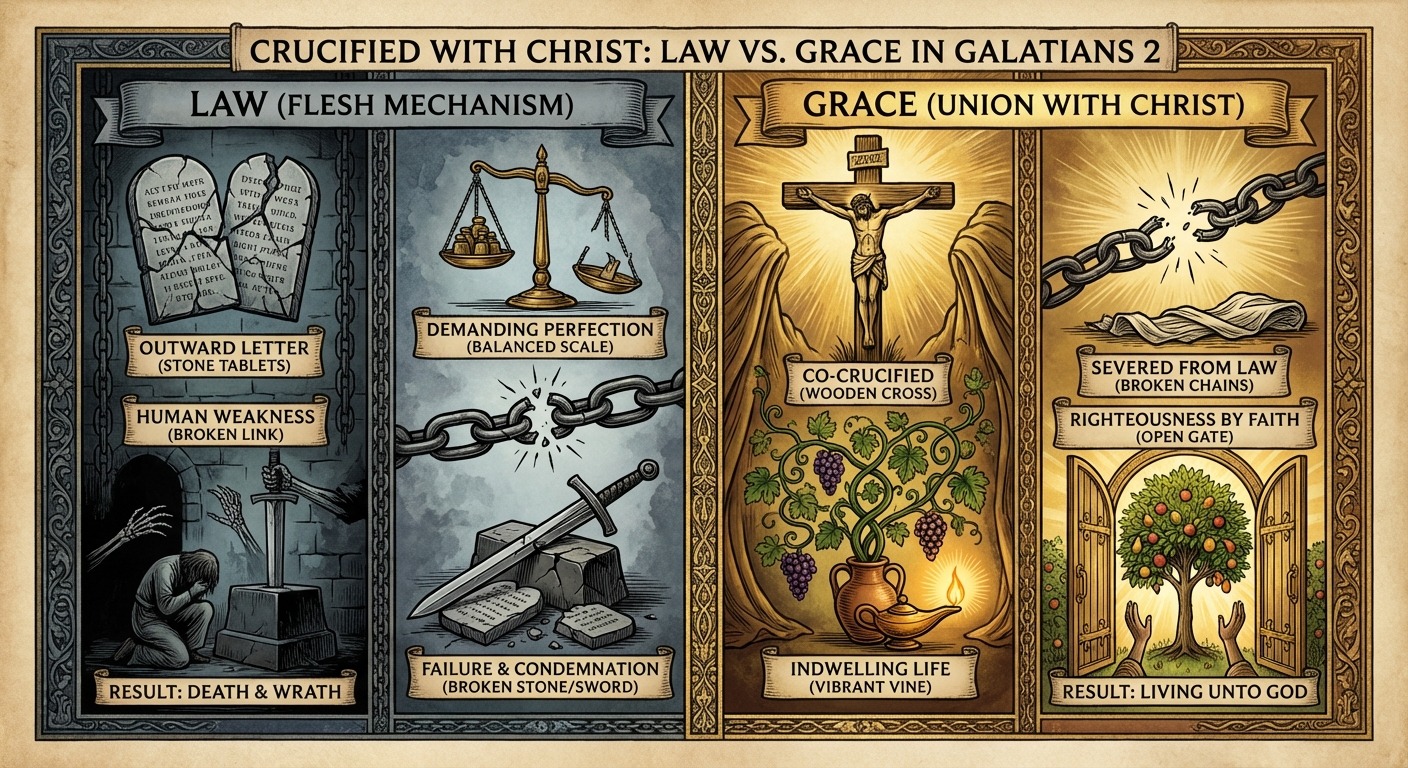
This chart shows the structure. What follows explains each part.
Having established the catastrophic contradiction of rebuilding the law's demolished structure, Paul now reveals the positive reality that replaces it. This article examines the precise mechanics of that new reality: what it means to be 'crucified with Christ' and how this union fundamentally alters the source and operation of the believer's life.
Galatians 2:20 is one of those verses that you can read a hundred times and still not exhaust -- 'I am crucified with Christ: nevertheless I live; yet not I, but Christ liveth in me.' The verse is doing several things simultaneously: it is a statement of identification with Christ's death, a declaration of continued existence, a negation of the self as the operative life-principle, and an affirmation of Christ's life as the actual content of what is now lived. Paul is not describing a mystical experience available to advanced believers. He is describing the basic mechanics of what the gospel produces in everyone who receives it by faith. This article opens those mechanics.
Galatians 2:19-21
For I through the law am dead to the law, that I might live unto God. I am crucified with Christ: nevertheless I live; yet not I, but Christ liveth in me: and the life which I now live in the flesh I live by the faith of the Son of God, who loved me, and gave himself for me. I do not frustrate the grace of God: for if righteousness come by the law, then Christ is dead in vain.
The Two Mechanisms: Law and Grace
The epistle to the Galatians sets forth a profound distinction between two mechanisms by which men relate to God: the old system of the law and the new system of grace. In Galatians 2:19-21, the Apostle Paul declares, "For I through the law am dead to the law, that I might live unto God. I am crucified with Christ: nevertheless I live; yet not I, but Christ liveth in me: and the life which I now live in the flesh I live by the faith of the Son of God, who loved me, and gave himself for me. I do not frustrate the grace of God: for if righteousness come by the law, then Christ is dead in vain." Here, Paul unfolds how the believer's relationship to the law is fundamentally altered through union with Christ.
The Mechanism of the Law
Under the old system, the mechanism of the law of the letter operates through the flesh. Its starting point is the outward letter—commandments engraved on stone tablets—demanding from man a continuous, unbroken perfection. The law requires an unceasing balance of works, but because the flesh is weak, this mechanism inevitably results in failure. The inability of the flesh to uphold the law leads to a shattering of the standard, akin to a broken link in a chain. The consequence of this failure is not mere inadequacy but condemnation and the wrath of God against unrighteousness. In this system, the law stands as an executioner, with its verdict leading to death. The attempt to attain righteousness through the law ultimately frustrates the grace of God and leaves the soul under the sentence of death.
The Mechanism of Grace
By contrast, the new mechanism introduced by the Gospel is grounded in the believer's co-crucifixion with Christ. Through this death, the believer is permanently severed from the law's demands and its power to condemn. As Paul testifies, "I am crucified with Christ," indicating a decisive break with the old system. The chains of obligation to the law are broken, and the burial shroud of condemnation is cast aside. No longer does the believer strive for outward conformity by human effort; instead, the indwelling life of Christ becomes the new principle of operation. This life is not generated by the flesh but is sustained entirely by the Spirit.
Righteousness, under this new order, is not earned by the works of the law but is received from faith to faith. The believer lives unto God, not by the strength of the flesh, but by the life of the Son of God within. The Spirit, not the letter, animates and empowers, producing fruitfulness and communion with God. Thus, the Gospel does not merely offer pardon for failure under the law; it establishes a new mechanism altogether—one in which the believer, dead to the law, lives by the indwelling Christ, upheld by grace, and sustained by the Spirit. In this way, the believer enters into the liberty and vitality of living unto God, with the law's condemnation forever set aside.
Co-crucifixion is not the end of living -- it is the end of a particular kind of living, the kind sourced in the self that the law was always trying to regulate. What takes its place is the life of Christ, mediated by the Spirit, received moment by moment through the hearing of faith. That phrase -- 'hearing of faith' -- is about to become the hinge of Paul's argument in chapter three, where he presses the Galatians on a simple biographical question: when did the Spirit come to you -- when you were doing the works of the law, or when you were hearing and believing? The answer to that question is Paul's entire case.
Understanding that our life now flows from Christ's indwelling presence, not from legal compliance, raises a crucial practical question. How, then, do we actually receive and walk in this spiritual life? The next article answers this by contrasting the initial 'hearing of faith' with the futile 'works of the law,' grounding Paul's argument in the Galatians' own experience of the Spirit.
Every chart in this series is free to explore online.
 Get the full chart set (PDF – $8)
Members get all PDFs included → Why Membership
Log in with an active membership to download printable PDFs on this site. Purchased on the shop? Access downloads from your shop account.
If you would like to help fund this work:
These charts are based on the following book:

Galatians - Christ in Me As Life - the Spirit as the Blessing of the Gospel
A biblical commentary on Galatians, exploring how Christ is revealed throughout Scripture. Deep theological insights for serious students of the Word.
View Related Book