
Visual Theology – Galatians
The Visual Theology charts are designed to help you see the structure and movement of Scripture. They highlight patterns, contrasts, and developments that are often difficult to hold together when reading line by line.
These charts show the structure of the argument. The accompanying articles develop each part in full.
This approach follows a long tradition of visual teaching in the Church. The well-known charts of Clarence Larkin helped many grasp the broad outline of Scripture. In the same spirit, these charts aim to make visible what the Word of God is revealing.
Charts and teaching notes for the book of Galatians. Select a chart below to view the image and article.
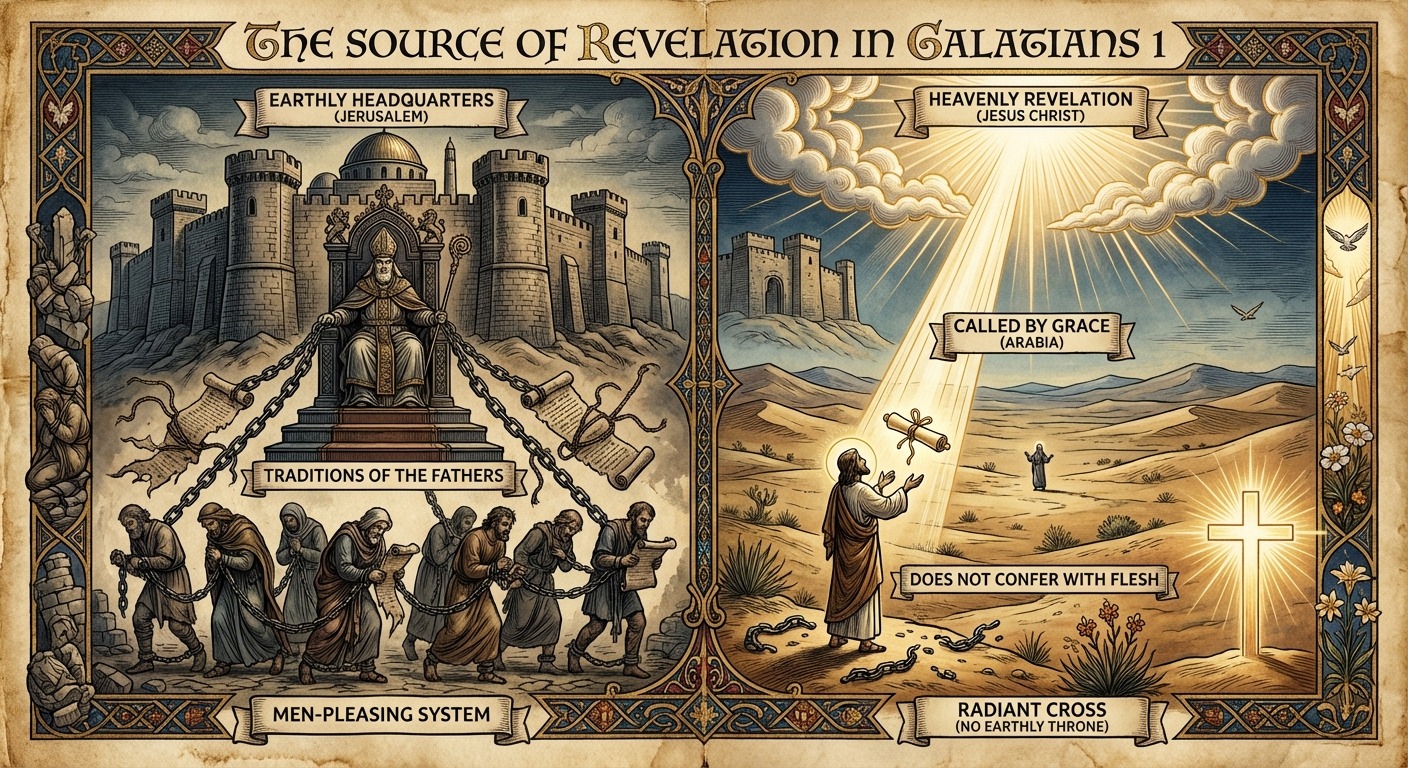
Click chart to view larger
From the teaching in: Galatians - Christ in Me As Life - the Spirit as the Blessing of the Gospel
Galatians 1:12-24
Divine Revelation vs. Human Religion
Galatians 1:12-24 -- Divine Revelation vs. Human Religion
This chart shows the structure. What follows explains each part.
Having seen how a subtle addition can leaven the entire gospel, we now examine the foundational source of that pure gospel. While the previous article showed the mechanism of corruption, this article reveals why Paul's gospel could not be corrupted by human tradition: it came not through an earthly headquarters, but by direct divine revelation. Here we confront the stark contrast between a religion mediated by human authority and a gospel received from God alone.
The Judaizers had a powerful argument from geography: Jerusalem is where the apostles are, where the church began, where the mother community of the faith maintains its authority. If you want to know what the genuine gospel is, follow the chain back to its institutional source. Paul does not dispute the historical importance of Jerusalem -- he disputes the assumption that spiritual authority flows through an earthly chain at all. His argument is biographical: when God revealed His Son in him, he did not go to Jerusalem. He went to Arabia. The wilderness before the institution. The direct encounter before the conference.
Galatians 1:12-24
For I neither received it of man, neither was I taught it, but by the revelation of Jesus Christ. For ye have heard of my conversation in time past in the Jews' religion, how that beyond measure I persecuted the church of God, and wasted it. And profited in the Jews' religion above many my equals in mine own nation, being more exceedingly zealous of the traditions of my fathers. But when it pleased God, who separated me from my mother's womb, and called me by his grace, to reveal his Son in me, that I might preach him among the Gentiles, immediately I conferred not with flesh and blood: neither went I up to Jerusalem to them which were apostles before me, but I went into Arabia, and returned again unto Damascus. Then after three years I went up to Jerusalem to see Peter, and abode with him fifteen days. But other of the apostles saw I none, save James the Lord's brother. Now the things which I write unto you, behold, before God, I lie not. Afterward, I came into the regions of Syria and Cilicia; and was unknown by face unto the churches of Judaea which were in Christ: but they had heard only, That he which persecuted us in times past now preacheth the faith which once he destroyed. And they glorified God in me.
The Contrast of Two Systems
The epistle to the Galatians presents a decisive contrast between the old system of fleshly religion and the new order established by unmediated divine revelation. At the heart of the old system lies the concept of a headquarter-centered religion, where men rely upon physical, geographic authority. This is epitomized by the imposing stone fortress of Jerusalem, which stands as an earthly administrative center. Within its walls sits the heavy, ornate episcopal throne, constructed of masonry, which serves to elevate certain men over others and establish a visible hierarchy.
From this throne descend the iron chains of legalism, binding those below to a system governed by the traditions of the fathers. These dusty scrolls of tradition are handed down, not as living words, but as burdensome decrees, perpetuating a religion of men-pleasing and earthly apostolic pedigree. The system depends on visible succession, on fleshly lineage, and on the authority of those who occupy the seat within the fortress.
The Source of the Gospel
In direct opposition to this stands the new system of grace, as revealed in the gospel that Paul proclaims. Galatians 1:11-12 makes the source of this gospel explicit: "But I certify you, brethren, that the gospel which was preached of me is not after man. For I neither received it of man, neither was I taught it, but by the revelation of Jesus Christ." The gospel comes as a pure beam of heavenly light, descending from above and bypassing entirely the stone fortress of human authority. It does not originate from the traditions of men, nor does it depend upon earthly headquarters.
Instead, its focal point is found in the open, vast wilderness of Arabia, where Paul stands as a solitary believer, severed from the iron chains of tradition. Galatians 1:15-17 underscores this break: "But when it pleased God, who separated me from my mother's womb, and called me by his grace, To reveal his Son in me, that I might preach him among the heathen; immediately I conferred not with flesh and blood: Neither went I up to Jerusalem to them which were apostles before me; but I went into Arabia, and returned again unto Damascus." Here, the calling by grace is received not through human mediation, but by direct revelation—a sealed scroll delivered from heaven.
The New Center of Authority
This new order culminates not in an ornate throne, but in the simple, radiant cross. The authority of the gospel is not conferred by men, nor maintained by adherence to the traditions of the fathers. Rather, it rests upon the unmediated act of God, who reveals His Son apart from all earthly channels. Galatians 2:6 further states, "But of these who seemed to be somewhat, (whatsoever they were, it maketh no matter to me: God accepteth no man's person:) for they who seemed to be somewhat in conference added nothing to me."
Thus, the development of a headquarter concept is exposed as the mechanism of fleshly religion—a system that binds with iron chains and exalts men over others. In contrast, the gospel of grace abolishes the need for such an earthly center, establishing instead a direct, unmediated connection between the believer and the living Christ. The radiant cross stands where once stood the episcopal throne, and the wilderness of Arabia becomes the new place of divine encounter, free from the burdens of tradition and the authority of men.
What this article has shown is that the entire 'headquarters concept' -- the idea that truth must be certified by the right earthly center -- is itself the mechanism of fleshly religion. The chain of succession, the ornate throne, the dusty scrolls of tradition: these are not the guarantors of the gospel but the counterfeits of it. The gospel came to Paul through the radiant cross of the ascended Christ, not through institutional approval. But Paul's break from the old system was not merely geographic -- it was theological, because what he left behind was not just a city but an entire plane of reality. The next article draws that distinction at its sharpest: the earthly shadows versus the ascended mystery.
Understanding that the true gospel bypasses all earthly headquarters prepares us to see its content more clearly. Having established its divine origin, we must now examine what this revelation actually contains. The next article will show how Paul's gospel transcends the earthly shadows of Sinai to unveil the ascended mystery of Christ—moving from the source of revelation to its heavenly substance.
Every chart in this series is free to explore online.
 Get the full chart set (PDF – $8)
Members get all PDFs included → Why Membership
Log in with an active membership to download printable PDFs on this site. Purchased on the shop? Access downloads from your shop account.
If you would like to help fund this work:
These charts are based on the following book:

Galatians - Christ in Me As Life - the Spirit as the Blessing of the Gospel
A biblical commentary on Galatians, exploring how Christ is revealed throughout Scripture. Deep theological insights for serious students of the Word.
View Related Book