
Visual Theology – Galatians
The Visual Theology charts are designed to help you see the structure and movement of Scripture. They highlight patterns, contrasts, and developments that are often difficult to hold together when reading line by line.
These charts show the structure of the argument. The accompanying articles develop each part in full.
This approach follows a long tradition of visual teaching in the Church. The well-known charts of Clarence Larkin helped many grasp the broad outline of Scripture. In the same spirit, these charts aim to make visible what the Word of God is revealing.
Charts and teaching notes for the book of Galatians. Select a chart below to view the image and article.
Click chart to view larger
From the teaching in: Galatians - Christ in Me As Life - the Spirit as the Blessing of the Gospel
Galatians 3:24-29
Baptized into Christ: The Everlasting Covenant vs. The New Covenant
Galatians 3:24-29 -- Baptized into Christ: The Everlasting Covenant vs. The New Covenant
This chart shows the structure. What follows explains each part.
Having established that the inheritance must be received, not seized, we now examine the specific mechanism of that reception. This article focuses on what it means to be 'baptized into Christ'—not as a ritual, but as the definitive placement that determines which covenant governs your inheritance and what that inheritance actually is.
Baptism into Christ is not a ceremony -- it is a statement about location. To be baptized into Christ is to be placed inside the Seed, inside the covenant, inside the One through whom all the promises of God are yes and amen. But Paul's argument here moves toward a distinction that may be the most precise in the entire letter: there are two different inheritances attached to two different covenants, and baptism into Christ is specifically associated with the everlasting covenant, not the Mosaic new covenant of Jeremiah. The Church's inheritance is heavenly; Israel's inheritance is earthly. Confusing the two -- reading the church into Israel's program, or reading Israel's earthly promises into the church's heavenly calling -- is a category error with serious consequences for how you understand the gospel.
Galatians 3:24-29
Wherefore the law was our schoolmaster to bring us unto Christ, that we might be justified by faith. But after that faith is come, we are no longer under a schoolmaster. For ye are all the children of God by faith in Christ Jesus. For as many of you as have been baptized into Christ have put on Christ. There is neither Jew nor Greek, there is neither bond nor free, there is neither male nor female: for ye are all one in Christ Jesus. And if ye be Christ's, then are ye Abraham's seed, and heirs according to the promise.
The Distinction Between Two Inheritances
The distinction between the Church’s inheritance and Israel’s inheritance is rooted in the covenants that govern their destinies.
The Church’s Heavenly Inheritance
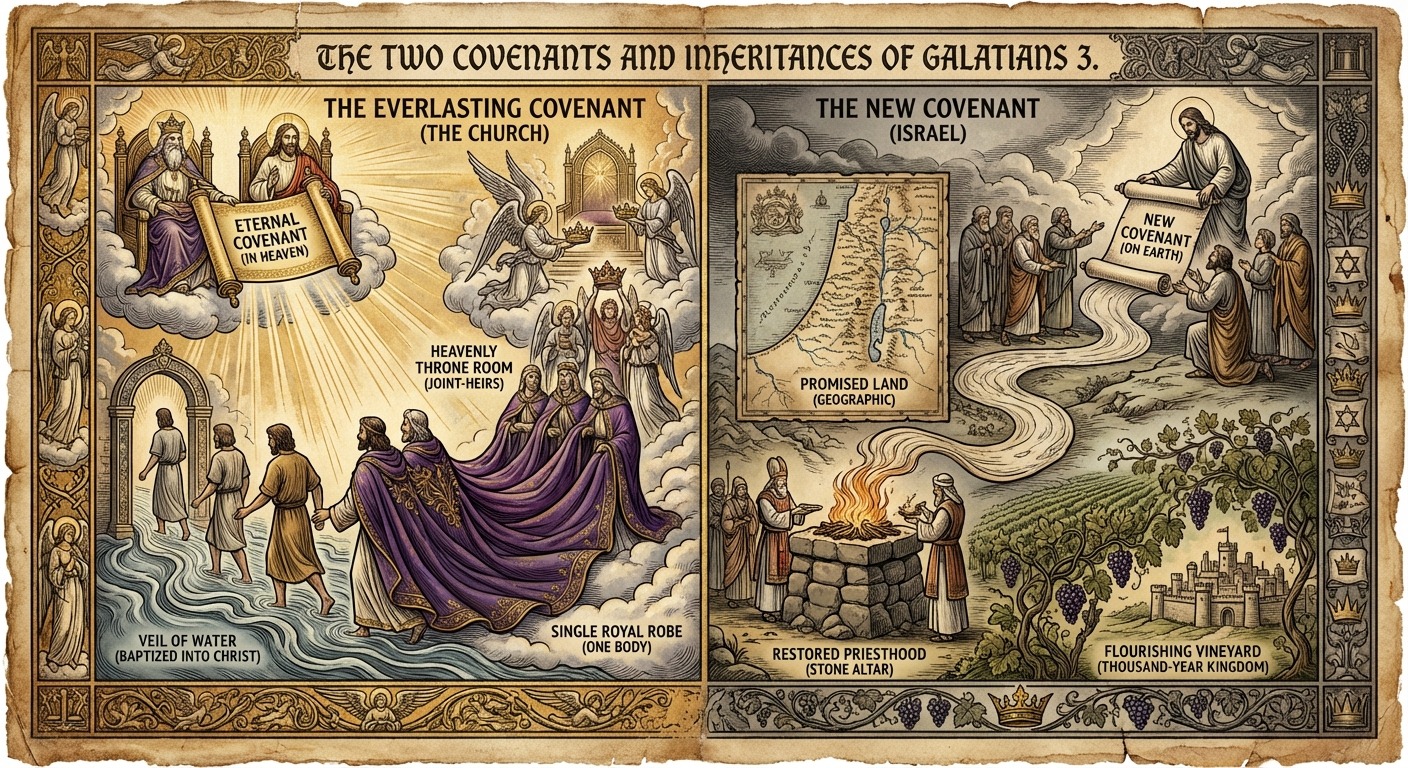
The Church stands under the Everlasting Covenant, which is depicted as a golden scroll held jointly by the Father and the Son—a covenant made in eternity past, before the foundation of the world. This covenant is not entered by natural descent or national identity, but by believers stepping through a veil of water, signifying that they are baptized into Christ. As Galatians 3:27 declares, “For as many of you as have been baptized into Christ have put on Christ.” This act is not merely symbolic but effects a profound union: believers are wrapped in a single, heavy royal robe, putting on Christ Himself, and so are made one body.
This unity in Christ abolishes former distinctions. “There is neither Jew nor Greek, there is neither bond nor free, there is neither male nor female: for ye are all one in Christ Jesus. And if ye be Christ's, then are ye Abraham's seed, and heirs according to the promise” (Galatians 3:28-29). The inheritance of this unified body is not earthly or territorial, but heavenly. The body is elevated to a throne room above, where believers receive crowns as joint-heirs, sharing directly in the inheritance of the Son. As Galatians 4:7 states, “Wherefore thou art no more a servant, but a son; and if a son, then an heir of God through Christ.” This is a royal inheritance anchored in the heavenly places, as Ephesians 2:6 affirms: “And hath raised us up together, and made us sit together in heavenly places in Christ Jesus.” The Church’s inheritance is thus not a matter of land or nation, but of sharing the very life and glory of Christ as sons and heirs.
Israel’s Earthly Inheritance
In contrast, Israel’s inheritance under the New Covenant is distinct and remains earthly. The Son hands a second scroll downward, not to the body already enthroned, but to a gathering of mortals. This inheritance flows into a geographic territory—the Promised Land—where a restored national priesthood will minister at a stone altar. The fulfillment is seen in a flourishing physical vineyard, representing a thousand-year kingdom securely anchored to the earth. This is the inheritance promised to the nation, tied to land, altar, and kingdom, and it is national and visible.
Conclusion: Two Distinct Destinies
Thus, the Church’s inheritance is defined by union with Christ in the Everlasting Covenant, being made one body and elevated to share the Son’s own heavenly inheritance. Israel’s inheritance, under the New Covenant, remains earthly, national, and future, tied to land, priesthood, and kingdom. The two inheritances are not mingled. The Church is not a nation, but a body; not a people of the earth, but of heaven. The mechanics of the inheritance flow from the nature of the covenants: one eternal, heavenly, and corporate in Christ; the other renewed, earthly, and national in Israel. As joint-heirs with Christ, the Church’s destiny is to reign with Him above, crowned in the throne room, heirs because we are in Christ.
What has been established across the covenant articles is the complete framework: an unbreakable promise made to one Seed before Sinai, confirmed in Christ's blood, received through faith rather than seized by the flesh, and entered through baptism into the Seed Himself. The doctrinal work is done. What remains is application -- what the life that flows from these truths actually looks like in practice. Part Five begins here: the believer who has the promise now has to wait for the fullness of it, and how that waiting is done makes all the difference between the Ishmael path and the Isaac path.
Understanding our heavenly inheritance through union with Christ sets the stage for a crucial question: How do we practically live in light of this reality? The next article will examine the interior shift from law-governed striving to Christ-lived life through the decisive reckoning of co-crucifixion.
Every chart in this series is free to explore online.
 Get the full chart set (PDF – $8)
Members get all PDFs included → Why Membership
Log in with an active membership to download printable PDFs on this site. Purchased on the shop? Access downloads from your shop account.
If you would like to help fund this work:
These charts are based on the following book:

Galatians - Christ in Me As Life - the Spirit as the Blessing of the Gospel
A biblical commentary on Galatians, exploring how Christ is revealed throughout Scripture. Deep theological insights for serious students of the Word.
View Related Book