
Visual Theology – Galatians
The Visual Theology charts are designed to help you see the structure and movement of Scripture. They highlight patterns, contrasts, and developments that are often difficult to hold together when reading line by line.
These charts show the structure of the argument. The accompanying articles develop each part in full.
This approach follows a long tradition of visual teaching in the Church. The well-known charts of Clarence Larkin helped many grasp the broad outline of Scripture. In the same spirit, these charts aim to make visible what the Word of God is revealing.
Charts and teaching notes for the book of Galatians. Select a chart below to view the image and article.
Click chart to view larger
From the teaching in: Galatians - Christ in Me As Life - the Spirit as the Blessing of the Gospel
Galatians 2:11-14
Paul Rebukes Peter: Walking Uprightly in the Truth
Galatians 2:11-14 -- Paul Rebukes Peter: Walking Uprightly in the Truth
This chart shows the structure. What follows explains each part.
Having examined the broader conflict between Jerusalem's 'trouble' and Christ's truth, we now focus on the pivotal moment where that conflict became personal and public. This article drills into Paul's direct confrontation with Peter at Antioch, analyzing what it means to 'walk uprightly according to the truth of the gospel' when social pressure demands compromise.
Paul's rebuke of Peter at Antioch has been described in the previous articles, but the full content of what he said -- and why it matters so much -- requires its own examination. Because what Paul says to Peter is not merely a personal correction; it is a sermon, and the sermon is Galatians. The phrase 'walking uprightly according to the truth of the gospel' sets the standard, and Peter's behavior at the table had failed it -- not by preaching false doctrine, but by living in a way that enacted one. Paul's argument is that you cannot separate the way you sit at a table from the theology of who belongs at it. The gospel is not only believed; it is embodied.
Galatians 2:11-14
But when Peter was come to Antioch, I withstood him to the face, because he was to be blamed. For before that certain came from James, he did eat with the Gentiles: but when they were come, he withdrew and separated himself, fearing them which were of the circumcision. And the other Jews dissembled likewise with him; insomuch that Barnabas also was carried away with their dissimulation. But when I saw that they walked not uprightly according to the truth of the gospel, I said unto Peter before them all, If thou, being a Jew, livest after the manner of Gentiles, and not as do the Jews, why compelest thou the Gentiles to live as do the Jews?
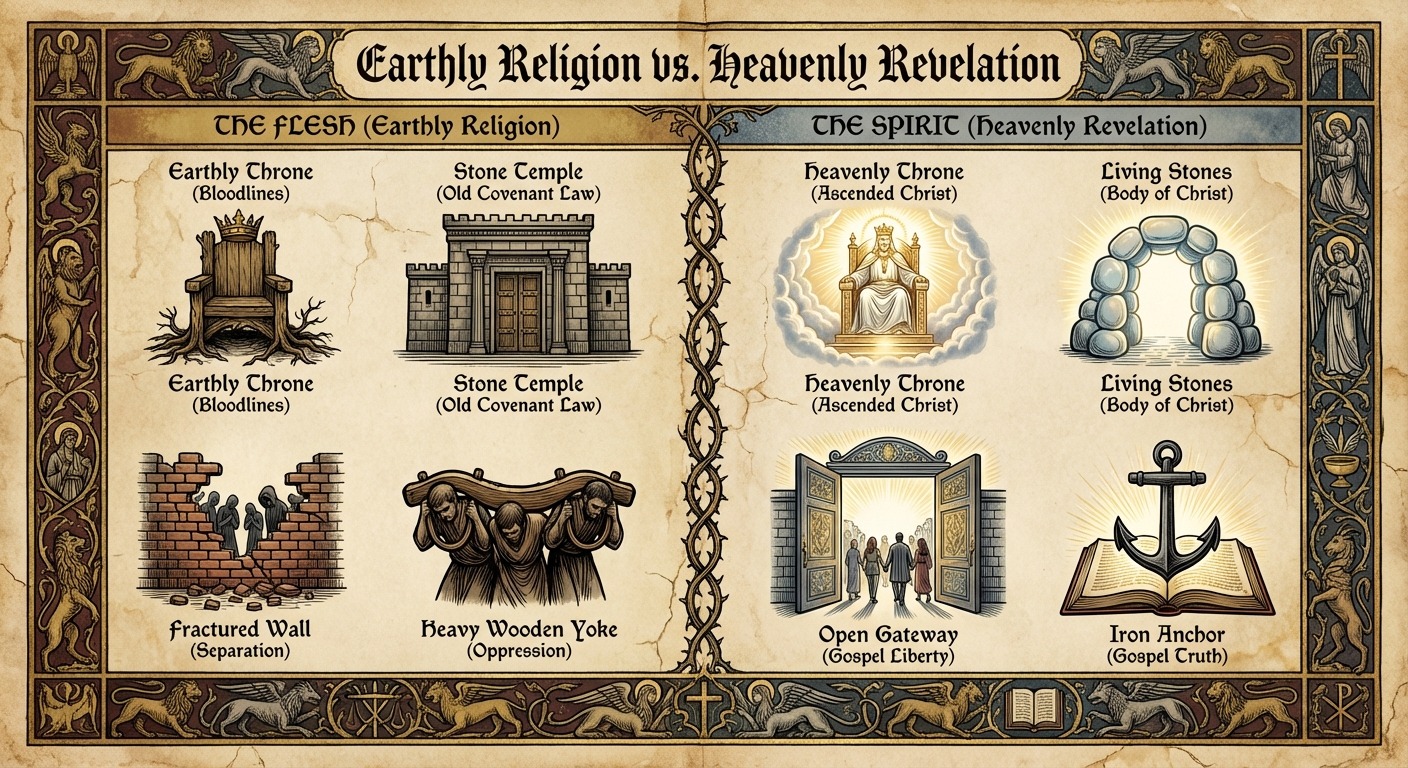
The Conflict in Antioch: Earthly Religion vs. Heavenly Revelation
In Galatians 2:11-14, the apostle Paul confronts Peter over his withdrawal from Gentile believers, exposing a fundamental conflict between the earthly religion of the flesh and the heavenly revelation of the ascended Christ.
The Old System of the Flesh
The old system of the flesh, as embodied by the Jerusalem council and the fear of man, is characterized by authority rooted in human bloodlines and physical lineage. This is seen in the reliance on an earthly throne, signifying a structure where legitimacy and leadership are grounded in natural descent rather than the Spirit.
A heavy stone temple further represents the lingering loyalty to the old covenant law. This attachment to the former order perpetuates a system where the law remains central, and the weight of tradition overshadows the newness of the Gospel. The fractured brick wall depicts the hypocritical separation and withdrawal from Gentiles, a division motivated by fear and an unwillingness to embrace the unity offered in Christ. Such actions reveal the heavy wooden yoke of fleshly religion—a man-centered system that imposes burdens and stumbles even those like Peter, who knew the truth yet faltered under pressure.
The New System of the Spirit
In contrast, Paul proclaims the new system of the Spirit, which is founded upon the heavenly revelation of the ascended Christ. Here, authority is no longer derived from earthly lineage but from the heavenly throne room, where Christ, as the ascended High Priest, dispenses life directly to His people. The unified structure of living stones embodies the mystery of the Body of Christ, where all believers, Jew and Gentile alike, are made equal and are built together by the Spirit.
This new order is marked by a wide open gateway, symbolizing the true liberty and fellowship of the Gospel. In this liberty, fleshly distinctions are abolished, and believers are called to stand uprightly and walk in the truth of the Gospel, as Paul insists in Galatians 2:14: "But when I saw that they walked not uprightly according to the truth of the gospel, I said unto Peter before them all..." The solid iron anchor resting on a foundational scroll further emphasizes that standing and speaking with authority comes not from tradition or human credentials, but from the unshakeable truth of the Gospel itself.
A Clarion Call to Upright Living
Thus, the rebuke of Peter is not merely a personal correction but a clarion call to forsake the mechanics of the earthly religion of the flesh. Believers are exhorted to embrace the heavenly revelation of the ascended Christ, to live as one Body of Christ in true liberty, and to stand uprightly, anchored in the truth that justification and fellowship are found only in Him. This is the path of walking uprightly in the truth, as revealed by the Spirit and upheld by the authority of the ascended Lord.
Walking uprightly in the truth of the gospel turns out to be a more demanding standard than walking uprightly in the law -- because the law gives you a list of rules to keep, while the gospel gives you the logic of the cross to inhabit. The cross says there is no distinction; the table has to say the same thing. With the Antioch confrontation fully in view, Paul now moves from the narrative of conflict into the doctrinal argument that the conflict was always about. The mechanics of legalistic hypocrisy versus gospel fellowship -- and the moment the argument becomes explicitly theological -- is where the next article begins.
Paul's rebuke exposed the mechanics of an earthly religion built on fear and separation. But what were the precise words of that rebuke, and why do they form the theological core of Galatians? The next article will unpack Paul's argument to Peter, showing how a single table fellowship became the battleground for the gospel itself.
Every chart in this series is free to explore online.
 Get the full chart set (PDF – $8)
Members get all PDFs included → Why Membership
Log in with an active membership to download printable PDFs on this site. Purchased on the shop? Access downloads from your shop account.
If you would like to help fund this work:
These charts are based on the following book:

Galatians - Christ in Me As Life - the Spirit as the Blessing of the Gospel
A biblical commentary on Galatians, exploring how Christ is revealed throughout Scripture. Deep theological insights for serious students of the Word.
View Related Book