
Visual Theology – Galatians
The Visual Theology charts are designed to help you see the structure and movement of Scripture. They highlight patterns, contrasts, and developments that are often difficult to hold together when reading line by line.
These charts show the structure of the argument. The accompanying articles develop each part in full.
This approach follows a long tradition of visual teaching in the Church. The well-known charts of Clarence Larkin helped many grasp the broad outline of Scripture. In the same spirit, these charts aim to make visible what the Word of God is revealing.
Charts and teaching notes for the book of Galatians. Select a chart below to view the image and article.
Click chart to view larger
From the teaching in: Galatians - Christ in Me As Life - the Spirit as the Blessing of the Gospel
Galatians 3
Inheritance in Christ
Galatians 3 -- Inheritance in Christ
This chart shows the structure. What follows explains each part.
Having established that the everlasting covenant of promise operates on a fundamentally different principle than the law—confirmed solely by God in Christ rather than human performance—we now examine the practical consequence of this distinction. This article focuses specifically on what it means to receive an inheritance in Christ, contrasting it sharply with earning a wage under the law.
An inheritance and a wage are not the same thing, and the difference matters enormously for how you understand your standing before God. A wage is earned -- you perform, you receive what you are owed. An inheritance is received -- someone else performed, someone else earned it, and now it is given to you on the basis of your relationship to the one who earned it. Paul's entire argument about justification by faith turns on this distinction: you are not a worker being paid for your service; you are a child receiving what the Heir has secured. The law-keeping system treats your standing before God as a wage. The gospel treats it as an inheritance. This article examines what that distinction produces in practice.
Galatians 3
For as many of you as have been baptized into Christ have put on Christ. There is neither Jew nor Greek, there is neither bond nor free, there is neither male nor female: for ye are all one in Christ Jesus. And if ye be Christ's, then are ye Abraham's seed, and heirs according to the promise.
The False System of Law vs. The True System of Grace
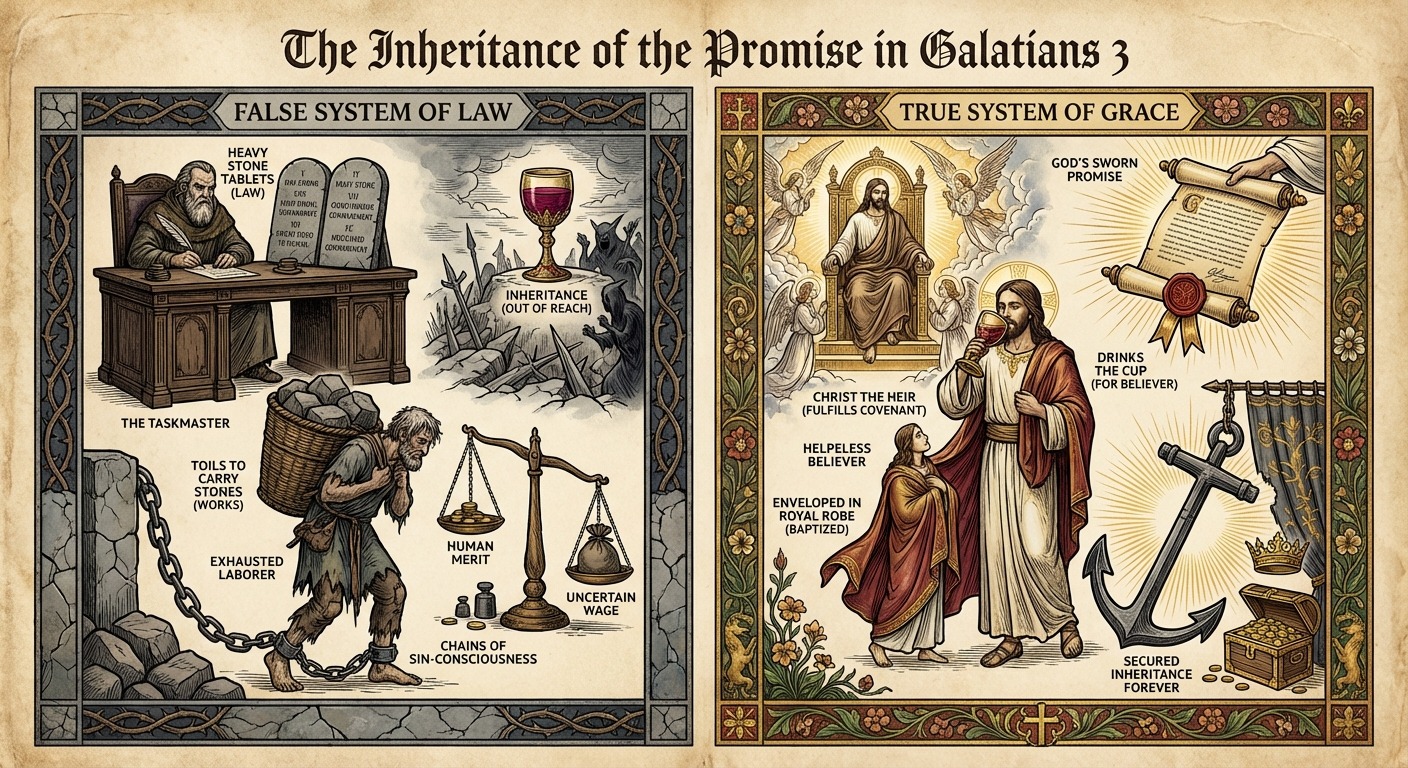
The contrast between the false system of Law and the true system of Grace stands at the heart of Paul's argument in Galatians regarding the inheritance that comes through Christ. Under the Law, the believer is pictured as an exhausted laborer, striving to earn a wage under the watchful eye of a strict taskmaster. The Law, represented by heavy stone tablets, imposes its demands relentlessly, and the laborer toils to carry burdensome stones—an image of works performed in the hope of gaining acceptance. Yet, the outcome of this effort is always uncertain. Human merit is weighed on a scale of balances, and the wage remains in doubt. The laborer's hands are bound by heavy iron chains of sin-consciousness, a continual reminder that the Law cannot remove guilt or secure the promised blessing. The inheritance, symbolized by a rich cup of wine, remains completely out of reach for those who seek it by works.
Christ, the Singular Heir
In stark contrast, the true system of Grace reveals that Christ alone is the singular Heir who accomplishes all that is necessary for redemption. The foundation of this inheritance is God's sworn Promise, depicted as a royal scroll with an unbroken seal—unchangeable and certain. Christ, taking on fully physical human flesh, steps down from His heavenly throne to fulfill the covenant on behalf of helpless humanity. He alone is able to lift and drink the cup of wine, securing the inheritance for those who could never attain it by their own striving.
Union with Christ: The Believer's Status as Heir
For the believer, to be "baptized into Christ" (Galatians 3:27) is to be safely enveloped inside Christ's royal robe, sharing in His status as Heir. This union with Christ is not achieved by labor or merit, but by faith in the finished work of the Redeemer. As Paul writes, "And if ye be Christ's, then are ye Abraham's seed, and heirs according to the promise" (Galatians 3:29, KJV). The believer's inheritance is thus not a wage earned by works, but a gift secured by Christ and received through faith.
The Security of the Inheritance
The security of this inheritance is further established by the image of a heavy iron anchor passing firmly through a thick temple veil. This signifies that the believer's hope is anchored beyond the reach of human failure, resting in the very presence of God. The inheritance is not subject to the fluctuations of human effort or the accusations of sin-consciousness, but is secured forever by the One who has entered within the veil on our behalf (cf. Hebrews 6:19-20).
Summary
In summary, Galatians sets forth the futility of seeking inheritance by the Law, where labor only leads to exhaustion, uncertainty, and bondage. In contrast, redemption in Christ qualifies the believer as an heir, not by works, but by union with the true Heir and by the unbreakable Promise of God. The inheritance is sure, unearned, and eternally secured for all who are in Christ.
The inheritance is received through union with the singular Heir -- Christ -- and baptism into Him is the act that places you inside that union. Not circumcision, not law-keeping, not ethnic descent, but baptism into Christ: 'there is neither Jew nor Greek, there is neither bond nor free, there is neither male nor female: for ye are all one in Christ Jesus. And if ye be Christ's, then are ye Abraham's seed, and heirs according to the promise.' The promise made to Abraham's Seed is now yours, if you are in the Seed. That unilateral, unbreakable covenant promise is the subject of the next article -- the Abrahamic covenant examined at its structural core.
Understanding that our standing before God is an inheritance received, not a wage earned, raises a crucial question: how do we actually approach this inheritance? The next article will examine the fatal error of trying to seize what can only be received, contrasting religious effort with faithful reception of God's gift.
Every chart in this series is free to explore online.
 Get the full chart set (PDF – $8)
Members get all PDFs included → Why Membership
Log in with an active membership to download printable PDFs on this site. Purchased on the shop? Access downloads from your shop account.
If you would like to help fund this work:
These charts are based on the following book:

Galatians - Christ in Me As Life - the Spirit as the Blessing of the Gospel
A biblical commentary on Galatians, exploring how Christ is revealed throughout Scripture. Deep theological insights for serious students of the Word.
View Related Book