
Visual Theology – Galatians
The Visual Theology charts are designed to help you see the structure and movement of Scripture. They highlight patterns, contrasts, and developments that are often difficult to hold together when reading line by line.
These charts show the structure of the argument. The accompanying articles develop each part in full.
This approach follows a long tradition of visual teaching in the Church. The well-known charts of Clarence Larkin helped many grasp the broad outline of Scripture. In the same spirit, these charts aim to make visible what the Word of God is revealing.
Charts and teaching notes for the book of Galatians. Select a chart below to view the image and article.
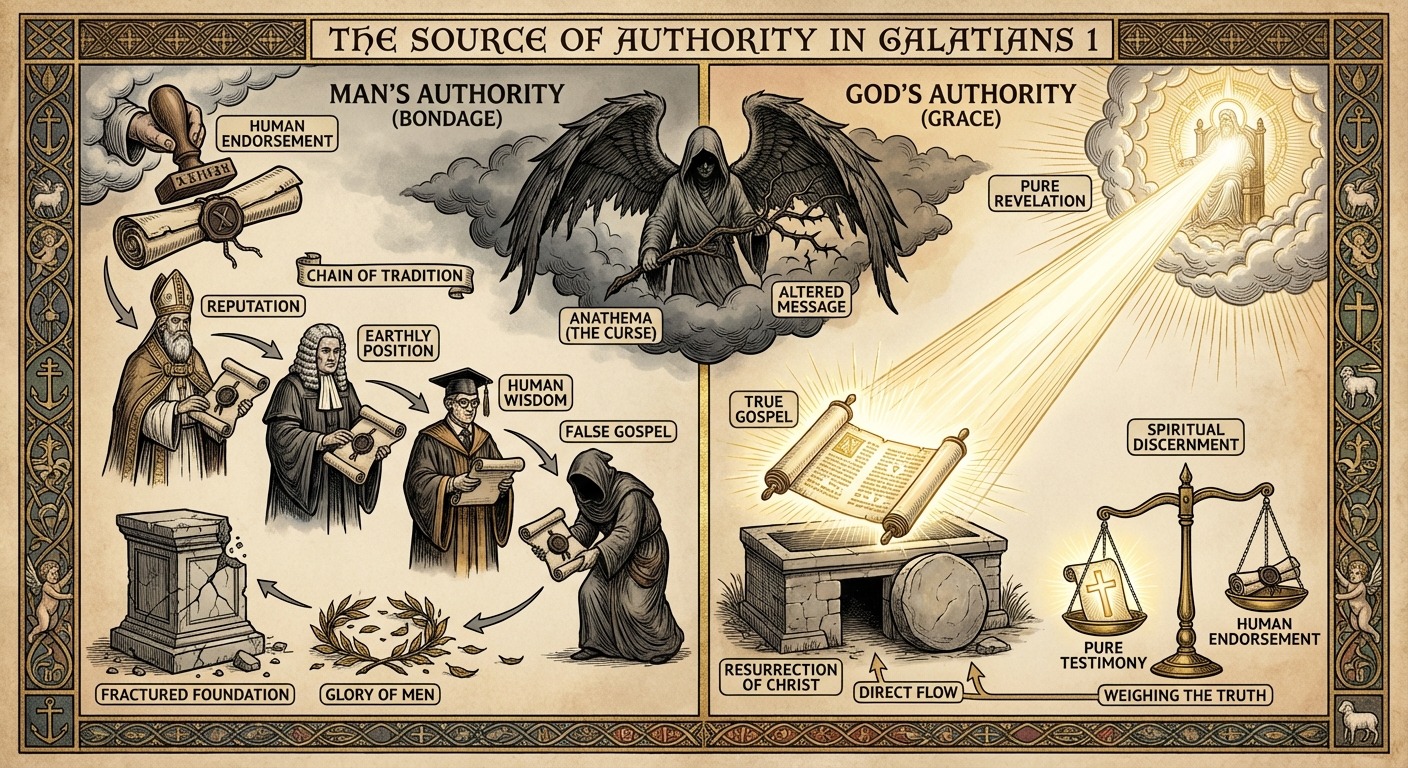
Click chart to view larger
From the teaching in: Galatians - Christ in Me As Life - the Spirit as the Blessing of the Gospel
Galatians 1:1-12
Divine Revelation vs. Human Approval
Galatians 1:1-12 -- Divine Revelation vs. Human Approval
This chart shows the structure. What follows explains each part.
Having established the critical nature of the Galatian crisis in our overview, we now turn to Paul's first line of defense. This chart, 'Divine Revelation vs. Human Approval,' confronts the foundational question of authority head-on. Paul knows that before he can defend the content of his gospel, he must establish its source, and here he draws an unyielding line between a message validated by human tradition and one received directly from God.
Before Paul can press any point about the content of his gospel, he has to answer a prior question that his opponents were certainly raising: who authorized you? In a world where authority meant lineage, apostolic endorsement, and institutional connection, Paul's credentials looked thin -- he had not walked with Jesus in Galilee, he had not been commissioned by the Jerusalem council, and his biography as a persecutor of the church was not exactly a recommendation. The Judaizers knew this, and they used it. So the opening of Galatians is not a warm introduction -- it is a legal brief, and the defendant is the gospel itself.
Galatians 1:1-12
Paul, an apostle, (not of men, neither by man, but by Jesus Christ, and God the Father, who raised him from the dead;) and all the brethren which are with me, unto the churches of Galatia: Grace be to you and peace from God the Father, and from our Lord Jesus Christ, who gave himself for our sins, that he might deliver us from this present evil world, according to the will of God and our Father; to whom be glory for ever and ever. Amen. I marvel that ye are so soon removed from him that called you into the grace of Christ unto another gospel: which is not another; but there be some that trouble you, and would pervert the gospel of Christ. But though we, or an angel from heaven, preach any other gospel unto you than that which we have preached unto you, let him be accursed. As we said before, so say I now again, If any man preach any other gospel unto you than that ye have received, let him be accursed. For do I now persuade men, or God? or do I seek to please men? for if I yet pleased men, I should not be the servant of Christ. But I certify you, brethren, that the gospel which was preached of me is not after man. For I neither received it of man, neither was I taught it, but by the revelation of Jesus Christ.
The Contrast Between Divine Revelation and Human Approval
The contrast between divine revelation and human approval stands at the heart of Paul's defense of the Gospel in Galatians. Paul insists that the message he preaches is not derived from human tradition or sanctioned by any earthly authority, but is received directly from God. "But I certify you, brethren, that the gospel which was preached of me is not after man. For I neither received it of man, neither was I taught it, but by the revelation of Jesus Christ" (Galatians 1:11-12). Here, the apostle draws a sharp line between two systems: one grounded in the shifting approval of men, and the other rooted in the unchanging authority of God's own voice.
The System of Man's Authority
Under the system of man's authority, the Gospel becomes subject to the judgments and endorsements of human reputation. A chain of figures, each concerned with their own position and the approval of others, passes along a message marked with the heavy seal of earthly validation. This process, however, leads only downward—to a fractured foundation and the withering glory of men. The laurel wreath, once a symbol of triumph, is shown here as withered, exposing the emptiness of human acclaim.
Paul warns that when the message of Christ is altered or supplemented to fit the standards of men, it falls under a curse. "But though we, or an angel from heaven, preach any other gospel unto you than that which we have preached unto you, let him be accursed" (Galatians 1:8). The presence of an angel bearing a twisted branch signifies this anathema: no matter how exalted the messenger, any deviation from the pure Gospel brings only condemnation.
The System of God's Authority
In contrast, the system of God's authority is marked by directness and clarity. A beam of bright, clear light descends from the throne of heaven, illuminating the true Gospel in all its purity. This revelation does not pass through the hands of men or depend on their endorsement. Instead, it rests upon the empty stone tomb—the resurrection of Christ—demonstrating that the foundation of the Gospel is not human tradition, but the finished work of the Son of God. The open, radiant scroll is the testimony of Jesus Christ, unsealed and accessible to all who will receive it by faith.
The Call to Spiritual Discernment
At the end of this divine sequence stands the believer, called to spiritual discernment. The testimony of God is not to be weighed against human endorsement, but tested on the balanced scales of truth. Paul insists that "God accepteth no man's person" (Galatians 2:6), making it clear that reputation, position, and tradition have no power to add to or alter the message revealed by Christ. The believer is summoned to obey the truth, not to follow men. The life that emerges from this obedience is not of the flesh, but is lived "by the faith of the Son of God, who loved me, and gave himself for me" (Galatians 2:20).
Thus, the mechanics of revelation in Galatians draw a decisive boundary between what comes from God and what originates in the systems of men. The Gospel is not a sealed scroll passed down through human chains, but a living message, radiant with resurrection light, received by faith from the throne of God. To obey this truth is to stand firm upon the foundation of Christ, discerning the pure testimony of God and refusing the empty glory of men.
The case Paul makes here is airtight on its own terms: the gospel he preaches is not after man, received not from human tradition but by the revelation of Jesus Christ, and its authority rests not on who vouches for it but on what it rests upon -- the resurrection. That settles the question of source. But it immediately raises another: if the message came by direct revelation rather than by human transmission, what exactly was revealed? The next stop examines what resurrection authority actually looks like and why the empty tomb is the final word on who gets to define the gospel.
With the source of the gospel's authority clearly established as divine revelation, a crucial question remains: what is the ultimate proof of that authority? The answer lies not in human credentials, but in a singular, historical event. In the next chart, we will see how Paul anchors this heavenly revelation in the bedrock of Christ's resurrection.
Every chart in this series is free to explore online.
 Get the full chart set (PDF – $8)
Members get all PDFs included → Why Membership
Log in with an active membership to download printable PDFs on this site. Purchased on the shop? Access downloads from your shop account.
If you would like to help fund this work:
These charts are based on the following book:

Galatians - Christ in Me As Life - the Spirit as the Blessing of the Gospel
A biblical commentary on Galatians, exploring how Christ is revealed throughout Scripture. Deep theological insights for serious students of the Word.
View Related Book