
Visual Theology – Galatians
The Visual Theology charts are designed to help you see the structure and movement of Scripture. They highlight patterns, contrasts, and developments that are often difficult to hold together when reading line by line.
These charts show the structure of the argument. The accompanying articles develop each part in full.
This approach follows a long tradition of visual teaching in the Church. The well-known charts of Clarence Larkin helped many grasp the broad outline of Scripture. In the same spirit, these charts aim to make visible what the Word of God is revealing.
Charts and teaching notes for the book of Galatians. Select a chart below to view the image and article.
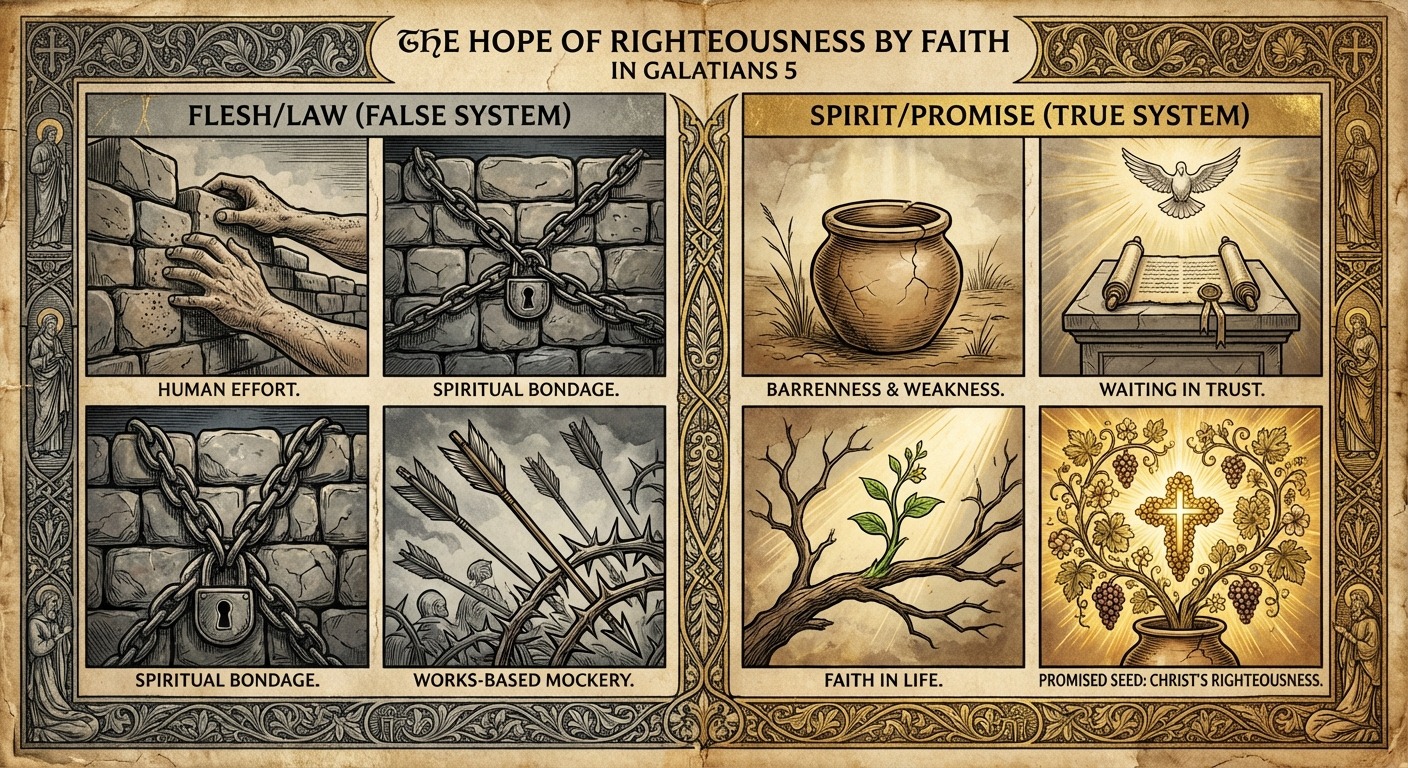
Click chart to view larger
From the teaching in: Galatians - Christ in Me As Life - the Spirit as the Blessing of the Gospel
Galatians 5:5
Waiting on the Promise
Galatians 5:5 -- Waiting on the Promise
This chart shows the structure. What follows explains each part.
Having seen that the Spirit is our all-sufficient supply for living the Christ-life, we now face the practical question of how that supply operates in the waiting seasons of our walk. This article examines Galatians 5:5 to reveal the stark contrast between the flesh's impatient striving and the Spirit's patient reliance on God's promise—showing that true spiritual inheritance comes not through visible achievement but through faith-filled waiting on what only God can produce.
The doctrinal foundations have been laid. The covenant logic is complete. The believer knows -- or at least now has reason to know -- that the promise is secure, that the inheritance is received rather than earned, and that the Spirit of sonship is the inward confirmation of what the covenant has already secured. But knowing the framework and living inside it are two different things, especially in the waiting seasons. The flesh does not retire just because the doctrine is clear. It has another strategy for the waiting season: the same Hagar strategy it has always had, dressed in different clothes. This article examines what waiting on the promise by faith looks like from the inside -- and what it looks like when the flesh's impatience takes over.
Galatians 5:5
For we through the Spirit wait for the hope of righteousness by faith.
The Two Systems: Flesh vs. Promise
The epistle to the Galatians sets forth a striking contrast between two systems: the flesh and the promise. Drawing from the allegory of Hagar and Sarah in Galatians 4:21-31, Paul exposes the mechanics of fleshly boasting as opposed to waiting for God to fulfill His promise by faith.
The System of the Flesh: Bondage and Boasting
The false system, represented by Hagar, is characterized by human effort and the law. In this system, men produce immediate but illegitimate results—actions born out of their own hands, building up what appears to be a strong and impressive structure. Yet beneath this outward boasting and perceived strength lies spiritual bondage. The law, like heavy iron chains, binds all these works, ensuring that those who operate in the flesh are not free but enslaved.
This bondage is not merely a private matter; it manifests in antagonism toward those who rest in grace. The heirs produced by works mock and persecute those who rely on the promise, much as Ishmael persecuted Isaac. In Galatians 4:29, Paul writes, “But as then he that was born after the flesh persecuted him that was born after the Spirit, even so it is now.” Thus, the system of law and flesh not only fails to bring true liberty but also breeds hostility toward the path of faith.
The System of the Spirit: Weakness and Waiting
In stark contrast stands the true system of the Spirit and promise, represented by Sarah. Here, the believer’s journey begins not with visible strength or achievement, but with apparent barrenness and weakness. There is an emptiness, an open vessel that seems to have nothing to offer. Yet in this place of lack, the believer waits in silent trust, holding to the promise of God. The promise is not a product of striving, but a sealed word from God, resting upon the altar.
This waiting is not passive resignation but an active reckoning: the believer considers their own deadness, yet refuses to give up hope. As Paul teaches elsewhere, “Abraham believed God, and it was counted unto him for righteousness” (Romans 4:3).
The Turning Point: Life from the Dead
The turning point comes when the believer reckons their dead state as alive by faith. Out of what is dry and lifeless, there springs a single green shoot—a sign that God alone brings life where there was none. This is not the fruit of human energy, but the miraculous arrival of the Promised Seed. In the fullness of time, Christ is manifested as righteousness and life, bursting forth in abundance from the vessel that once seemed empty. This is the fulfillment of the promise, not by works, but by faith in what God has spoken.
The Call to Faith
Paul’s teaching in Galatians thus calls the believer away from the heavy stones and iron chains of the law, away from the immediate but illegitimate results of the flesh, and into the patient, trusting posture of waiting for God to do what only He can do. The true heir is not born of human effort, but of the promise—Christ Himself as life and righteousness for all who believe.
Waiting on the promise by faith is not passive -- it is the active reckoning of the flesh as dead and the promise as alive, even when natural circumstances say the opposite. The Promised Seed comes through weakness and impossibility, not through the strength of Ishmael. And while the believer waits, the operative principle is not law-keeping but something else entirely -- faith working by love. That is the subject of the next article: what the life of the Spirit actually looks like in motion, not in theory.
Understanding that we wait on the promise by faith, not fleshly striving, naturally raises the question: what then is the active expression of this faith? If we are not under law's compulsion, what energy governs the Christian life? The next article answers this directly by examining how faith, rooted in God's one-way love, becomes the spontaneous working principle of our new life in Christ.
Every chart in this series is free to explore online.
 Get the full chart set (PDF – $8)
Members get all PDFs included → Why Membership
Log in with an active membership to download printable PDFs on this site. Purchased on the shop? Access downloads from your shop account.
If you would like to help fund this work:
These charts are based on the following book:

Galatians - Christ in Me As Life - the Spirit as the Blessing of the Gospel
A biblical commentary on Galatians, exploring how Christ is revealed throughout Scripture. Deep theological insights for serious students of the Word.
View Related Book