
Visual Theology – Galatians
The Visual Theology charts are designed to help you see the structure and movement of Scripture. They highlight patterns, contrasts, and developments that are often difficult to hold together when reading line by line.
These charts show the structure of the argument. The accompanying articles develop each part in full.
This approach follows a long tradition of visual teaching in the Church. The well-known charts of Clarence Larkin helped many grasp the broad outline of Scripture. In the same spirit, these charts aim to make visible what the Word of God is revealing.
Charts and teaching notes for the book of Galatians. Select a chart below to view the image and article.
Click chart to view larger
From the teaching in: Galatians - Christ in Me As Life - the Spirit as the Blessing of the Gospel
Galatians 1:3-4
The Present Evil Age
Galatians 1:3-4 -- The Present Evil Age
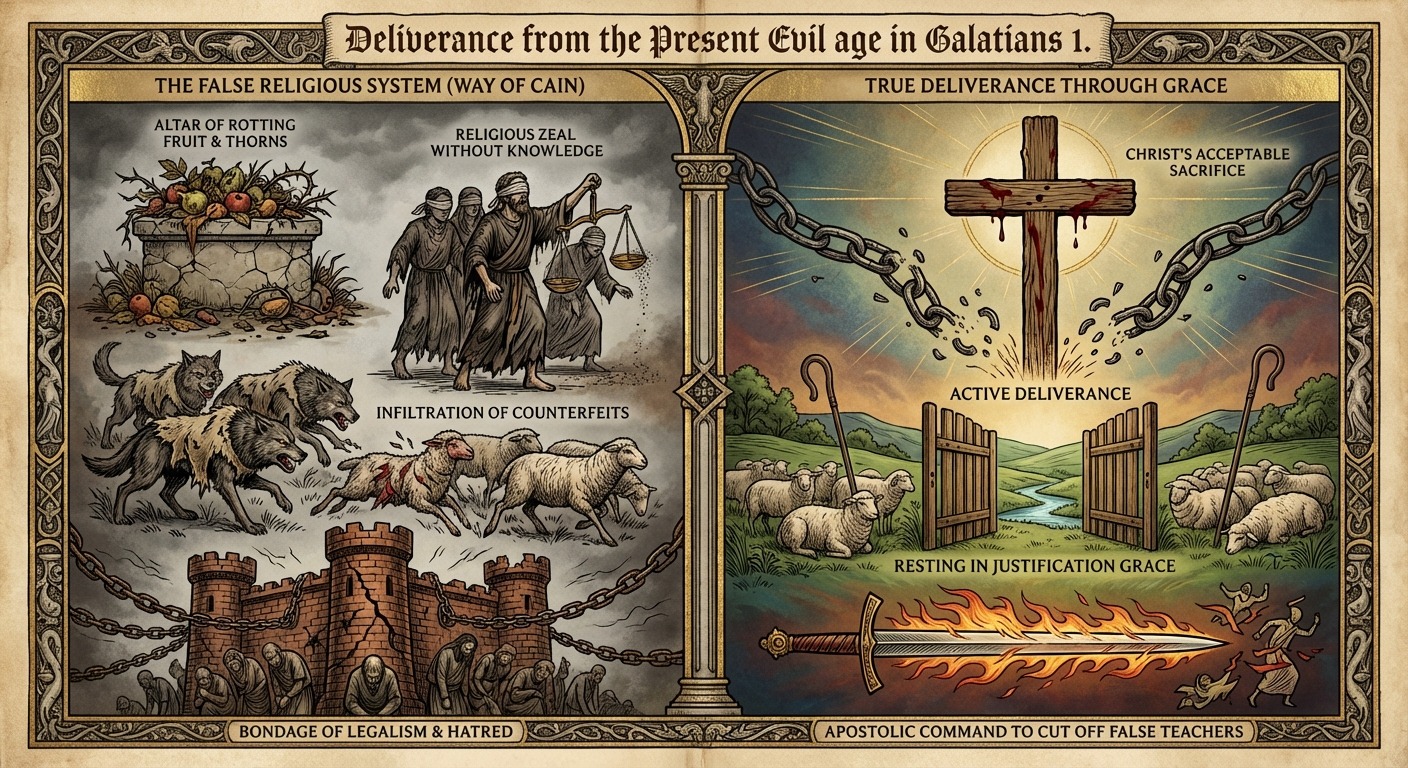
This chart shows the structure. What follows explains each part.
Having established the divine origin of his apostolic authority and its expression within the fellowship of believers, Paul immediately pivots in his greeting to define the very purpose of the gospel he was commissioned to preach. This next article examines the two brief but explosive verses that follow—Galatians 1:3-4—where Paul declares that Christ gave Himself not only for our sins, but to actively deliver us from 'this present evil age.' Here, we move from the foundation of Paul's message to its urgent objective: a rescue mission from a specific and hostile religious system.
Paul does not name Christ's death as merely a transaction for forgiveness and move on -- he says Christ gave himself for our sins 'that he might deliver us from this present evil world.' The word 'deliver' is active and intentional, suggesting a rescue from something that still has gravitational pull. The present evil age, as Paul uses the phrase, is not simply the general sinfulness of the surrounding culture; it is a specific religious system organized around the wrong center -- human effort, works-based righteousness, the altar of Cain rather than the blood of the Lamb. The reader needs to feel the weight of that before the article makes its distinctions, because the danger Paul is warning against is not gross immorality but sincere religion aimed at the wrong object.
Galatians 1:3-4
Grace be to you and peace from God the Father, and from our Lord Jesus Christ; who gave himself for our sins, that he might deliver us from this present evil world, according to the will of God and our Father.
The Present Evil World and the Gospel of Deliverance
In the opening of Galatians, Paul declares that Christ "gave himself for our sins, that he might deliver us from this present evil world, according to the will of God and our Father" (Galatians 1:4, KJV). The present evil world is not merely the general state of human society but is specifically identified as a false religious system, operating in opposition to the Gospel of Grace. This system is characterized by the Way of Cain: a reliance on works-based self-righteousness, which is depicted as an altar of rotting fruit and thorns. Such offerings are unacceptable, for they arise from the flesh rather than faith in Christ's finished work.
Characteristics of the False System
Within this false system, zeal is abundant but blind, as seen in the imagery of blindfolded figures grasping broken scales. This religious zeal lacks true knowledge of God's righteousness and leads to a perverse confidence in human effort. The system is further corrupted by the presence of wolves in torn sheepskins—counterfeits who infiltrate and pervert the truth, undermining the simplicity of the Gospel. These false brethren, described in Galatians 2:4 as "false brethren unawares brought in," seek to spy out the liberty believers have in Christ and to bring them into bondage.
The bondage of the present evil world is not merely a matter of doctrinal error but manifests as heavy iron yokes chaining souls to a crumbling fortress of legalism. This fortress is hostile, animated by a murderous hatred toward those who stand in the liberty of Christ. Such bondage is the inevitable fruit of a system that opposes justification by faith and insists on the law as the means of righteousness.
The Deliverance of the Gospel
In stark contrast, the Gospel of Grace proclaims deliverance. Christ's cross, marked by His blood, is the true and acceptable sacrifice. By His offering, believers are actively delivered from the present evil age. The chains of bondage are shattered, and the soul is brought out of captivity into the freedom of justification. This deliverance is not passive; it is the result of Christ's self-giving and the Father's will.
Justification ushers the believer into rest, pictured as an open gate leading into a peaceful sheepfold. Here, the soul ceases from its own works and finds security in the sufficiency of Christ. The grace of justification is not merely a legal standing but a present rest from the oppressive demands of the false religious system.
The Apostolic Response: Separation
The apostolic response to the present evil world is not accommodation but separation. Paul commands an aggressive stance: "But though we, or an angel from heaven, preach any other gospel unto you than that which we have preached unto you, let him be accursed" (Galatians 1:8, KJV). The boundary is drawn with a flaming sword; false teachers are to be marked, avoided, and cut off in order to protect the flock. This is not a matter of personal preference but of fidelity to the Gospel and the safeguarding of the saints from the bondage and corruption of the present evil world.
Thus, the present evil world is exposed as a religious system of self-effort, blindness, and bondage, standing in direct opposition to the deliverance accomplished by Christ. The believer is called not only to receive deliverance but to stand fast in the liberty wherewith Christ has made us free (Galatians 5:1), refusing to be entangled again in the yoke of bondage. The Gospel of Grace is both the means and the defense of this deliverance, and the apostolic command is to maintain this separation for the sake of the truth and the peace of God's flock.
The picture that emerges here is sobering: the 'present evil age' is not located outside the walls of the church -- it has always been the temptation to drag the religious system of self-righteousness inside, to mix it with grace, and to call the result a more complete gospel. Christ's cross has made a definitive break from that system, and Paul will not allow the break to be soft-pedaled. But the mechanics of how that perversion happens -- how a gospel so clear becomes so leavened -- is precisely what the next article traces. What does it actually look like when grace gets mixed?
Understanding that Christ's death was a deliverance from the enslaving system of 'this present evil age' sets the stage for a direct comparison of the two spiritual economies at war in Galatia. Having seen what we are rescued from, we now turn to examine in detail the stark contrast between the system of grace we inherit and the system of dead works we leave behind.
Every chart in this series is free to explore online.
 Get the full chart set (PDF – $8)
Members get all PDFs included → Why Membership
Log in with an active membership to download printable PDFs on this site. Purchased on the shop? Access downloads from your shop account.
If you would like to help fund this work:
These charts are based on the following book:

Galatians - Christ in Me As Life - the Spirit as the Blessing of the Gospel
A biblical commentary on Galatians, exploring how Christ is revealed throughout Scripture. Deep theological insights for serious students of the Word.
View Related Book