Visual Theology – Galatians
The Visual Theology charts are designed to help you see the structure and movement of Scripture. They highlight patterns, contrasts, and developments that are often difficult to hold together when reading line by line.
These charts show the structure of the argument. The accompanying articles develop each part in full.
This approach follows a long tradition of visual teaching in the Church. The well-known charts of Clarence Larkin helped many grasp the broad outline of Scripture. In the same spirit, these charts aim to make visible what the Word of God is revealing.
Charts and teaching notes for the book of Galatians. Select a chart below to view the image and article.
Click chart to view larger
From the teaching in: Galatians - Christ in Me As Life - the Spirit as the Blessing of the Gospel
Galatians 2:4
The Subtlety of the Leavened Gospel
Galatians 2:4 -- The Subtlety of the Leavened Gospel
This chart shows the structure. What follows explains each part.
Having seen the stark contrast between the true gospel of grace and its outright perversion, we now turn to examine how such a perversion takes hold. The previous article mapped the two opposing roads. This article, focusing on Galatians 2:4, reveals the subtle mechanism of corruption: the leavening of the pure gospel. Here, we see that the false teaching is not a frontal assault but a quiet infiltration, adding just enough conditions to grace to bring the entire structure of faith into bondage.
A little leaven leaveneth the whole lump. Paul's use of that metaphor is not incidental -- it names the mechanism by which the gospel gets corrupted without anyone intending to corrupt it. The false teachers in Galatia were not preaching a different religion from scratch; they were adding to an existing gospel. Just a small addition. Just one qualification. Just the clarification that faith is the beginning, but certain observances are how you mature, how you maintain your standing, how you demonstrate that the grace is real. The addition sounds modest. The effect is total. This article asks you to see that the crack in the foundation does not have to be large to bring the structure down.
Galatians 2:4
And that because of false brethren unawares brought in, who came in privily to spy out our liberty which we have in Christ Jesus, that they might bring us into bondage.
The Pure Gospel of Grace vs. the Leavened Counterfeit
The apostle Paul’s letter to the Galatians confronts the subtle perversion of the true Gospel, warning against what he terms “a little leaven” that corrupts the whole. The distinction between the pure Gospel of Grace and its leavened counterfeit is not merely a matter of vocabulary, but of foundations, experience, and ultimate fruit in the believer’s life.
The Pure Gospel of Grace
The Solid Rock of Justification
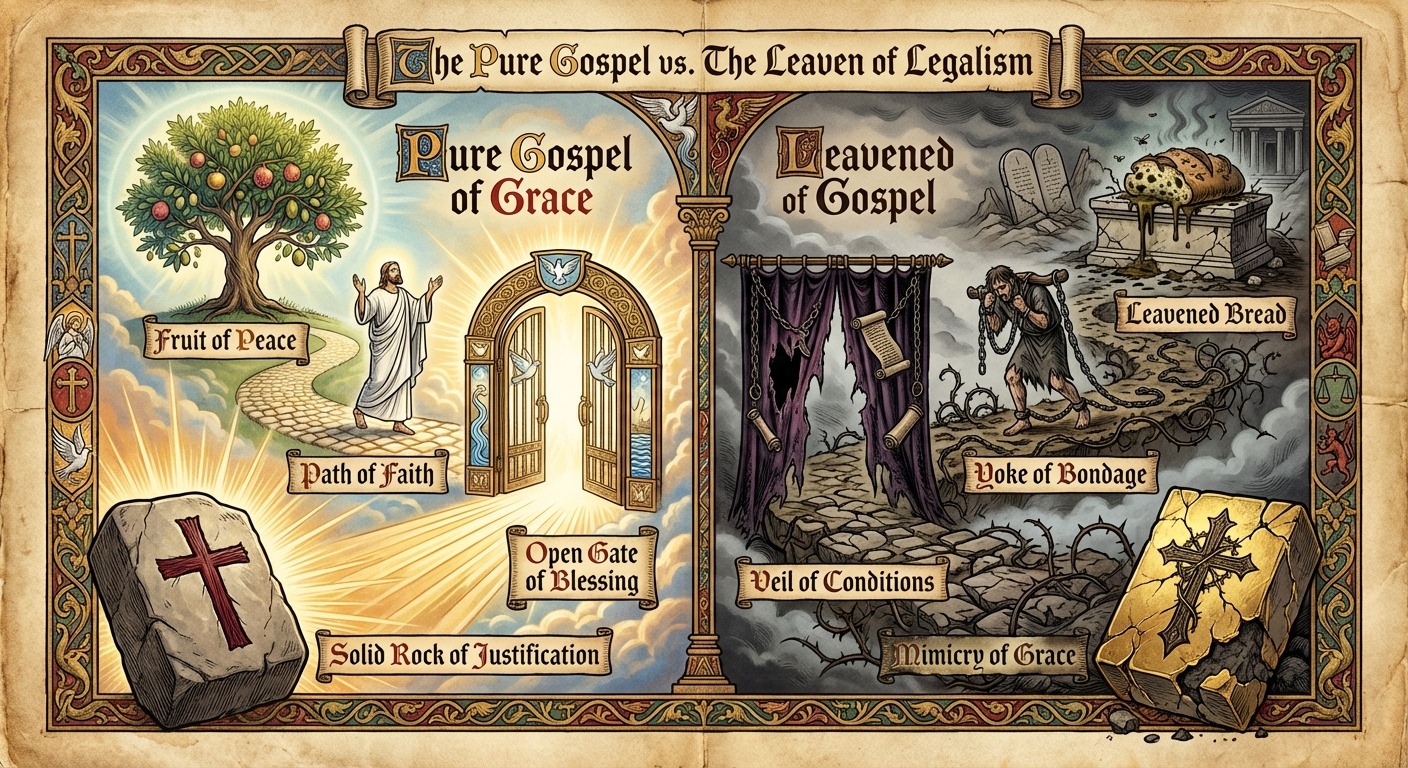
The pure Gospel of Grace begins with the foundational reality that a sinner is declared righteous solely on the basis of Christ’s finished work, as marked by the bloody cross. Paul insists, “Knowing that a man is not justified by the works of the law, but by the faith of Jesus Christ” (Galatians 2:16). This justification is not a process, nor is it maintained by human effort; it is a settled standing, received by faith alone.
The Open Gate of Blessing
From this foundation, the believer enters the freely given promise of the Spirit. Paul’s question is pointed: “Received ye the Spirit by the works of the law, or by the hearing of faith?” (Galatians 3:2). The blessing of the Spirit is not earned, but opened wide to those who rest in Christ’s sufficiency. There is no veil or barrier; the way is open, not by merit, but by grace.
The Path of Faith
The life that flows from this is where the believer walks clothed in a pure white robe of righteousness. This is not a garment woven from self-effort, but the imputed righteousness of Christ. The walk is marked by trust, not striving; the road is brightly lit by the assurance that “the just shall live by faith” (Galatians 3:11). Here, the conscience is at rest, for the ground of acceptance never shifts from Christ alone.
The Fruit of Peace
The culmination is a flourishing, living evidence of a good conscience before God. This is not the anxious toil of religious duty, but the restful confidence that flows from knowing one’s standing is secure. Paul exhorts, “Stand fast therefore in the liberty wherewith Christ hath made us free” (Galatians 5:1). Peace is the natural harvest of a heart established in grace.
The Leavened Gospel
In contrast, the leavened gospel operates by mimicry. It begins with the appearance of grace—a gilded but cracked foundation stone. The language may sound orthodox, but the substance is compromised.
This false gospel quickly intercepts the believer with the Veil of Conditions: the subtle “but…” that adds requirements for daily blessing and standing. The open gate is replaced by a heavy, torn curtain, and the soul is shifted from liberty to the Yoke of Bondage. What was once a robe of liberty becomes heavy chains and thorny vines. The focus turns inward, to self-effort and qualification, rather than outward to Christ’s finished work.
The final product is the Leavened Bread—a corrupted, decaying offering that brings exhaustion, fear, and a ruined standing before God. The conscience, instead of resting, is tormented by the uncertainty of never having done enough. Paul’s warning is sober: “A little leaven leaveneth the whole lump” (Galatians 5:9). The smallest addition to grace undermines the entire structure, leaving the believer bereft of the peace and liberty that the true Gospel imparts.
The Unmixed Gospel
Thus, the theology of Galatians insists that the pure Gospel of Grace must remain unmixed. The solid rock of justification, the open gate of blessing, the path of faith, and the fruit of peace are all lost when the leaven of conditions is introduced. The believer’s only safety is to stand fast in the liberty of Christ, refusing every subtle perversion that would shift the ground from grace to works.
What has been established is that the gospel is binary in a way that feels uncomfortable: either the solid rock of justification with the peace that flows from it, or the leavened counterfeit with its veil of conditions and its harvest of anxiety. There is no stable midpoint. 'A little leaven leaveneth the whole lump' is not a warning about severity -- it is a statement about chemistry. The system of grace cannot absorb requirements without becoming something else. But how did Paul arrive at a gospel so entirely free of those requirements? His biography is the next exhibit -- specifically the years between Damascus and Arabia, before Jerusalem ever saw him, when the message was being formed entirely outside the system he left behind.
Understanding the subtle, corrupting nature of a leavened gospel reveals why its source matters so profoundly. If the message can be so easily compromised by human additions, then its origin cannot be of human design. This leads us directly to the next article, which contrasts the divine revelation of the true gospel with the earthly, institutional authority claimed by human religion.
Every chart in this series is free to explore online.
 Get the full chart set (PDF – $8)
Members get all PDFs included → Why Membership
Log in with an active membership to download printable PDFs on this site. Purchased on the shop? Access downloads from your shop account.
If you would like to help fund this work:
These charts are based on the following book:

Galatians - Christ in Me As Life - the Spirit as the Blessing of the Gospel
A biblical commentary on Galatians, exploring how Christ is revealed throughout Scripture. Deep theological insights for serious students of the Word.
View Related Book