
Visual Theology – Galatians
The Visual Theology charts are designed to help you see the structure and movement of Scripture. They highlight patterns, contrasts, and developments that are often difficult to hold together when reading line by line.
These charts show the structure of the argument. The accompanying articles develop each part in full.
This approach follows a long tradition of visual teaching in the Church. The well-known charts of Clarence Larkin helped many grasp the broad outline of Scripture. In the same spirit, these charts aim to make visible what the Word of God is revealing.
Charts and teaching notes for the book of Galatians. Select a chart below to view the image and article.
Click chart to view larger
From the teaching in: Galatians - Christ in Me As Life - the Spirit as the Blessing of the Gospel
Galatians 1:13-14
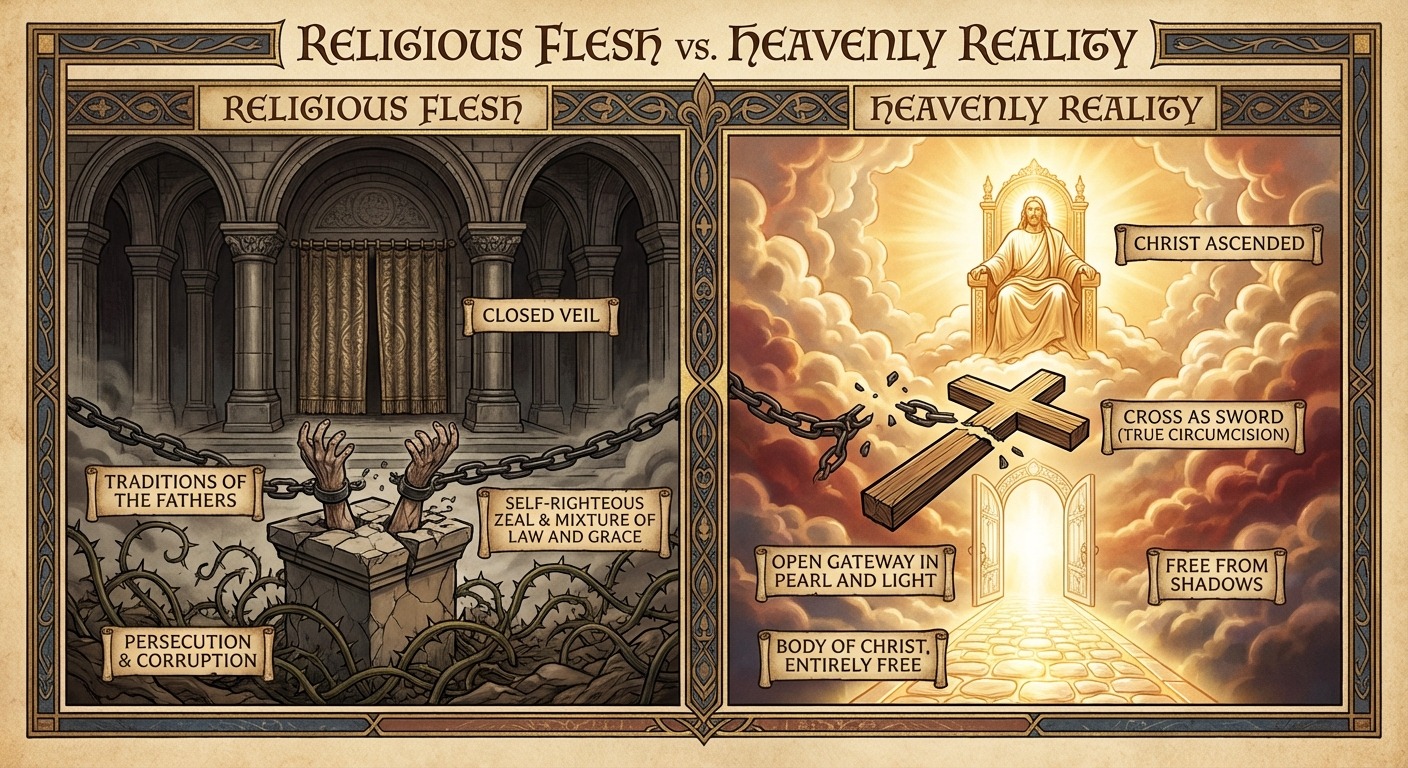
Religious Flesh vs. Heavenly Reality
Galatians 1:13-14 -- Religious Flesh vs. Heavenly Reality
This chart shows the structure. What follows explains each part.
Having established the historical conflict between Paul's gospel and the Judaizers' system, we now examine the fundamental nature of that divide. This article moves beyond the historical players to reveal the two opposing realities they represent: the earthly religion of flesh versus the heavenly reality of Christ. Here, Paul uses his own past as Exhibit A to show how even zealous, tradition-based religion stands in direct opposition to the revelation of grace.
The Judaizers were not preaching paganism. That is what makes the Galatian situation so urgent and so instructive -- they were preaching something that looked deeply Jewish, thoroughly scriptural, and respectably devout. Their system had centuries of tradition behind it, a physical center in Jerusalem, a coherent structure of practice and observance, and the endorsement of a community with genuine apostolic history. Against that, Paul is insisting that the ascended Christ has inaugurated something of a different order entirely -- not a reformed version of what they had, but a heavenly reality that the earthly system could only shadow. The pull of the old system on the Galatians makes complete sense. That is exactly what makes it dangerous.
Galatians 1:13-14
For ye have heard of my conversation in time past in the Jews' religion, how that beyond measure I persecuted the church of God, and wasted it. And profited in the Jews' religion above many my equals in mine own nation, being more exceedingly zealous of the traditions of my fathers.
The Old Earthly System: Religion of the Flesh
Throughout the letter to the Galatians, Paul exposes the stark divide between the old earthly system—the Jerusalem-centered religion of the flesh—and the heavenly reality inaugurated by Christ. The old system is marked by an imposing, shadowy temple, heavy with the weight of tradition and veiled from the true presence of God. This temple, with its closed veil, stands as a symbol of the distance between man and God under the law, where access is restricted and the way into the holiest is not yet made manifest (Hebrews 10:1-9). The heavy stone pillars and the closed veil are not merely architectural features; they represent the unyielding structure of religious flesh, a system built on the traditions of the fathers and maintained by self-righteous zeal.
Under this old order, the hands of men are bound with heavy iron chains—chains forged from the inherited customs and ordinances handed down through generations. As Paul testifies in Galatians 1:13-14, he himself was once exceedingly zealous of the traditions of his fathers, advancing in the Jews’ religion beyond many of his equals. Such zeal, however, is not the liberty of the Spirit but the bondage of fleshly religion. The altar to which these bound hands cling is already crumbling, for it is built on the mixture of law and grace, a foundation that cannot stand. This mixture is not a bridge to God but a source of confusion and spiritual decay, as Paul warns against rebuilding the things which Christ has already destroyed (Galatians 2:18-21).
The base of this system is tangled with thorns, the inevitable fruit of religious flesh. Persecution and corruption spring up where the law is mingled with grace, for the flesh strives to preserve its own righteousness and resists the freedom that comes from Christ. Those who walk according to the flesh persecute those who are born after the Spirit, as seen in the allegory of the two Jerusalems (Galatians 4:29). The old Jerusalem, which now is, is in bondage with her children, producing only servitude and strife.
The New Heavenly Reality: Liberty in Christ
In contrast, the new dispensation of Grace reveals a heavenly reality—the true, ascended Christ, who sits upon a radiant throne above. This is not an earthly sanctuary but the fulfillment of all that the shadows pointed toward. The cross stands at the center of this reality, not as an emblem of defeat but as the sharp sword of the true circumcision, cutting off the flesh and severing the iron chains of tradition and self-effort. “Stand fast therefore in the liberty wherewith Christ hath made us free, and be not entangled again with the yoke of bondage” (Galatians 5:1).
Beneath the cross, the gateway is open. There is no more veil, for Christ has entered in once for all, and the way into the holiest is now made clear (Hebrews 10:19-22). The pathway is no longer built of dead stones but of glowing, living stones—the Body of Christ, unified and free from the shadows of the old temple. Here, there is no mixture of law and grace, no striving in the flesh, but only the living reality of Christ in His people. “For in Christ Jesus neither circumcision availeth any thing, nor uncircumcision; but faith which worketh by love” (Galatians 5:6).
Thus, the Jerusalem-centered religion of the flesh is exposed as a system of bondage, perpetuated by tradition and self-righteous zeal, producing only corruption and persecution. The heavenly reality, by contrast, is the liberty of the new creation—Christ as the living Head, His Body free and open to God, walking in the light of grace without the shadows of the old earthly system.
What this article makes visible is the structural contrast between the earthly, Jerusalem-centered system -- with its fleshly throne and gravitational pull toward human tradition -- and the ascended Christ who has relocated everything above all heavens, into the believer as living stone. The distinction is not about one culture being superior to another; it is about two different ages and two different modes of God's dwelling. The old system had its place and served its purpose. But it is now past. What the Judaizers were doing was asking the Galatians to rebuild what Christ's ascension had left behind. The next article examines that contrast through one of Paul's most striking images: the slave versus the heir.
With the stark contrast between religious flesh and heavenly reality now established, Paul will apply this framework directly to the Galatians' current crisis. The next article confronts their specific error: having begun with the Spirit's work, they were now attempting to complete it through fleshly observance of the law—precisely the mixture that nullifies grace.
Every chart in this series is free to explore online.
 Get the full chart set (PDF – $8)
Members get all PDFs included → Why Membership
Log in with an active membership to download printable PDFs on this site. Purchased on the shop? Access downloads from your shop account.
If you would like to help fund this work:
These charts are based on the following book:

Galatians - Christ in Me As Life - the Spirit as the Blessing of the Gospel
A biblical commentary on Galatians, exploring how Christ is revealed throughout Scripture. Deep theological insights for serious students of the Word.
View Related Book