
Visual Theology – Galatians
The Visual Theology charts are designed to help you see the structure and movement of Scripture. They highlight patterns, contrasts, and developments that are often difficult to hold together when reading line by line.
These charts show the structure of the argument. The accompanying articles develop each part in full.
This approach follows a long tradition of visual teaching in the Church. The well-known charts of Clarence Larkin helped many grasp the broad outline of Scripture. In the same spirit, these charts aim to make visible what the Word of God is revealing.
Charts and teaching notes for the book of Galatians. Select a chart below to view the image and article.
Click chart to view larger
From the teaching in: Galatians - Christ in Me As Life - the Spirit as the Blessing of the Gospel
Galatians 1:6-9
Grace vs. The Perverted Gospel
Galatians 1:6-9 -- Grace vs. The Perverted Gospel
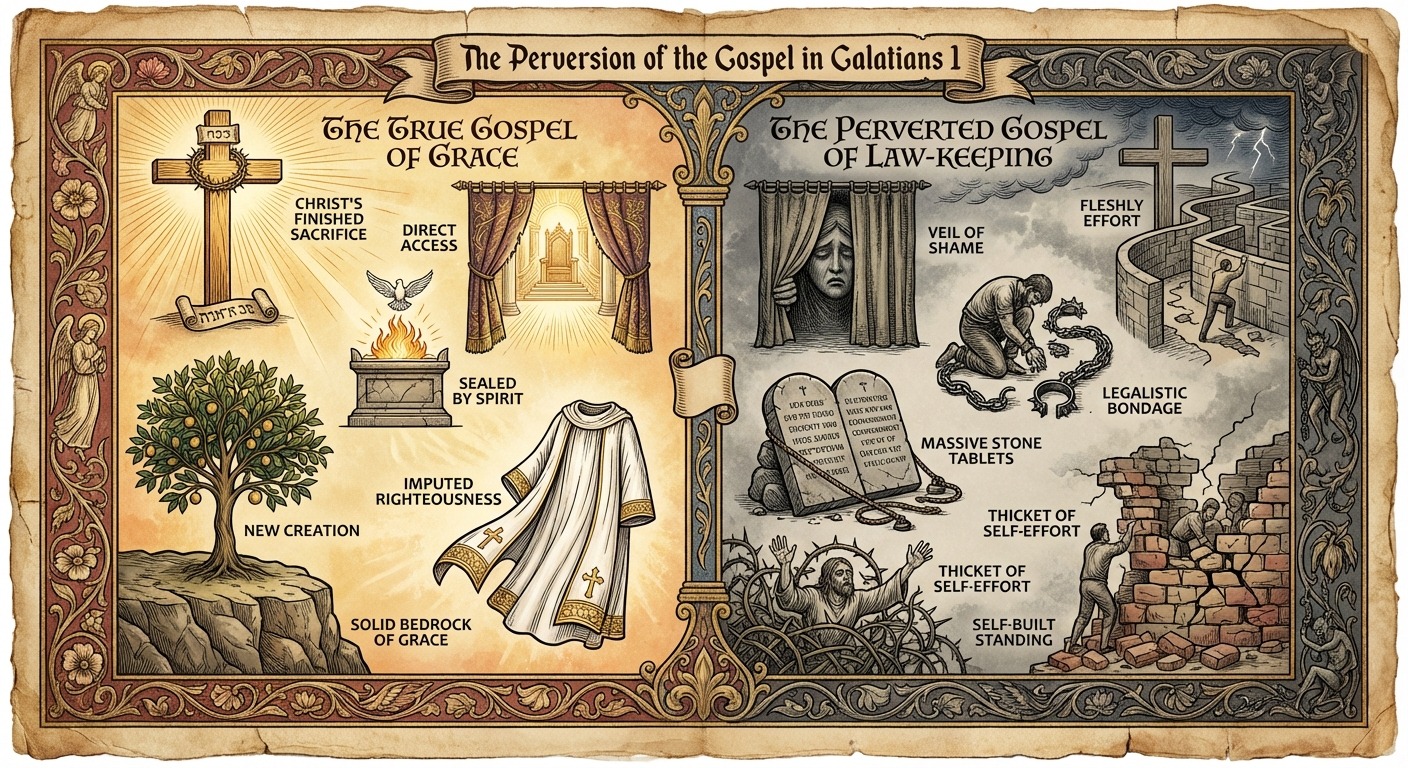
This chart shows the structure. What follows explains each part.
Having just examined the stark contrast between the spiritual economies of grace and dead works, we now turn to the specific moment where Paul confronts the Galatians' alarming departure. This article focuses on Galatians 1:6-9, where Paul expresses his stunned disbelief that they would so quickly abandon the true gospel of grace for a perverted version. Here, we will map the two distinct paths—one leading from Christ's finished work into freedom, the other diverting toward fleshly effort and bondage—to understand precisely what was at stake in their dangerous shift.
Paul says he marvels -- the word suggests stunned incredulity -- that the Galatians have been so quickly removed from the one who called them into the grace of Christ. The speed of the drift is part of what shocks him. These were people who had seen the Spirit poured out, who had experienced the liberty of the gospel firsthand, and within a remarkably short window they were being led down a path that Paul identifies as not another gospel but a perversion of the same one. Something has to explain how that happens so fast. The article does not begin by answering that question -- it begins by mapping the two roads, so you can see exactly what was on offer and what the switch entailed.
Galatians 1:6-9
I marvel that ye are so soon removed from him that called you into the grace of Christ unto another gospel which is not another but there be some that trouble you and would pervert the gospel of Christ but though we or an angel from heaven preach any other gospel unto you than that which we have preached unto you let him be accursed as we said before so say I now again if any man preach any other gospel unto you than that ye have received let him be accursed
The True Gospel vs. The Perverted Gospel
The epistle to the Galatians draws a decisive line between the true gospel of grace and the perverted gospel of law-keeping. Paul’s words in Galatians 1:6-9 warn of those who would trouble the believers by turning them from the gospel of Christ to another message, which is not another, but a perversion. At the heart of this distinction lies the believer’s position: under the true gospel, the starting point is the altar of Christ’s finished sacrifice. “I do not frustrate the grace of God: for if righteousness come by the law, then Christ is dead in vain” (Galatians 2:21). All standing before God begins with what Christ has accomplished, not with human effort or religious striving.
The Path of the True Gospel
From this altar, the believer enters through the open, torn veil, signifying direct access into the very presence of God. The barrier that once separated has been removed, and there is no longer a need for intermediaries or self-made coverings. The Holy Spirit seals the believer, marking them as God’s own, and the flame of His indwelling presence rests upon the altar of Christ’s work. This sealing is not the result of works but is received by faith: “Received ye the Spirit by the works of the law, or by the hearing of faith?” (Galatians 3:2).
Clothed in pristine white robes of imputed righteousness, the believer stands not by the merit of their own deeds, but by the righteousness freely accounted to them through Christ. There is no striving to establish a personal record; instead, the believer is established as a flourishing green tree of the new creation. “For in Christ Jesus neither circumcision availeth any thing, nor uncircumcision, but a new creature” (Galatians 6:15). The roots of this new life rest firmly on the solid bedrock of grace, unshaken by the shifting sands of human performance.
The Path of the Perverted Gospel
In stark contrast, the perverted gospel diverts the believer from the cross onto a path of fleshly effort. Though it begins at the same cross, it quickly leads to an attempt to build one’s own standing with crumbling bricks and heavy mortar—unstable and burdensome. Instead of an open veil, a thick, heavy veil of shame is drawn, closing off access and creating distance from the throne of grace. The believer finds themselves weighed down by massive stone tablets representing the law, burdened by the impossible demands of legalistic righteousness.
This path is marked by a thicket of sharp thorns, the ceaseless entanglement of self-effort and frustration. Far from liberty, the believer is bound by heavy iron chains of legalistic bondage, unable to walk in the freedom Christ has purchased. Paul exhorts, “Stand fast therefore in the liberty wherewith Christ hath made us free, and be not entangled again with the yoke of bondage” (Galatians 5:1).
The Decisive Call
Thus, the true gospel leads from the altar of Christ’s finished work, through direct access into God’s presence, to a life clothed in righteousness and rooted in grace. The perverted gospel, by contrast, traps the believer in a cycle of effort, shame, and bondage, far from the liberty and newness of life intended in Christ. The call of Galatians is to reject any message that adds to the finished sacrifice, and to rest wholly on the grace that makes the believer a new creation, sealed and accepted in the presence of God.
What is now visible is the full anatomy of the difference: the cross as starting point, the open veil, the Spirit received by faith, the white robe of imputed righteousness -- against the crumbling brickwork of self-effort, the veil of shame, the iron chains of legalistic bondage. Paul is not splitting a fine hair. He is describing two different destinations. But the Galatians' problem was not that they had chosen the wrong destination intentionally -- it was that someone had bewitched them into thinking the two roads were the same road with slightly different rest stops. The next article names the precise point of confusion: how law and grace come to be blended into something that looks like both but is actually neither.
Seeing the clear fork in the road between the true gospel and its perversion raises a critical question: how does such a departure happen so subtly and quickly? This leads us directly to our next article, which examines the insidious mechanism Paul describes as 'leaven'—the small, seemingly harmless additions that can completely corrupt the pure gospel of grace.
Every chart in this series is free to explore online.
 Get the full chart set (PDF – $8)
Members get all PDFs included → Why Membership
Log in with an active membership to download printable PDFs on this site. Purchased on the shop? Access downloads from your shop account.
If you would like to help fund this work:
These charts are based on the following book:

Galatians - Christ in Me As Life - the Spirit as the Blessing of the Gospel
A biblical commentary on Galatians, exploring how Christ is revealed throughout Scripture. Deep theological insights for serious students of the Word.
View Related Book