
Visual Theology – Galatians
The Visual Theology charts are designed to help you see the structure and movement of Scripture. They highlight patterns, contrasts, and developments that are often difficult to hold together when reading line by line.
These charts show the structure of the argument. The accompanying articles develop each part in full.
This approach follows a long tradition of visual teaching in the Church. The well-known charts of Clarence Larkin helped many grasp the broad outline of Scripture. In the same spirit, these charts aim to make visible what the Word of God is revealing.
Charts and teaching notes for the book of Galatians. Select a chart below to view the image and article.
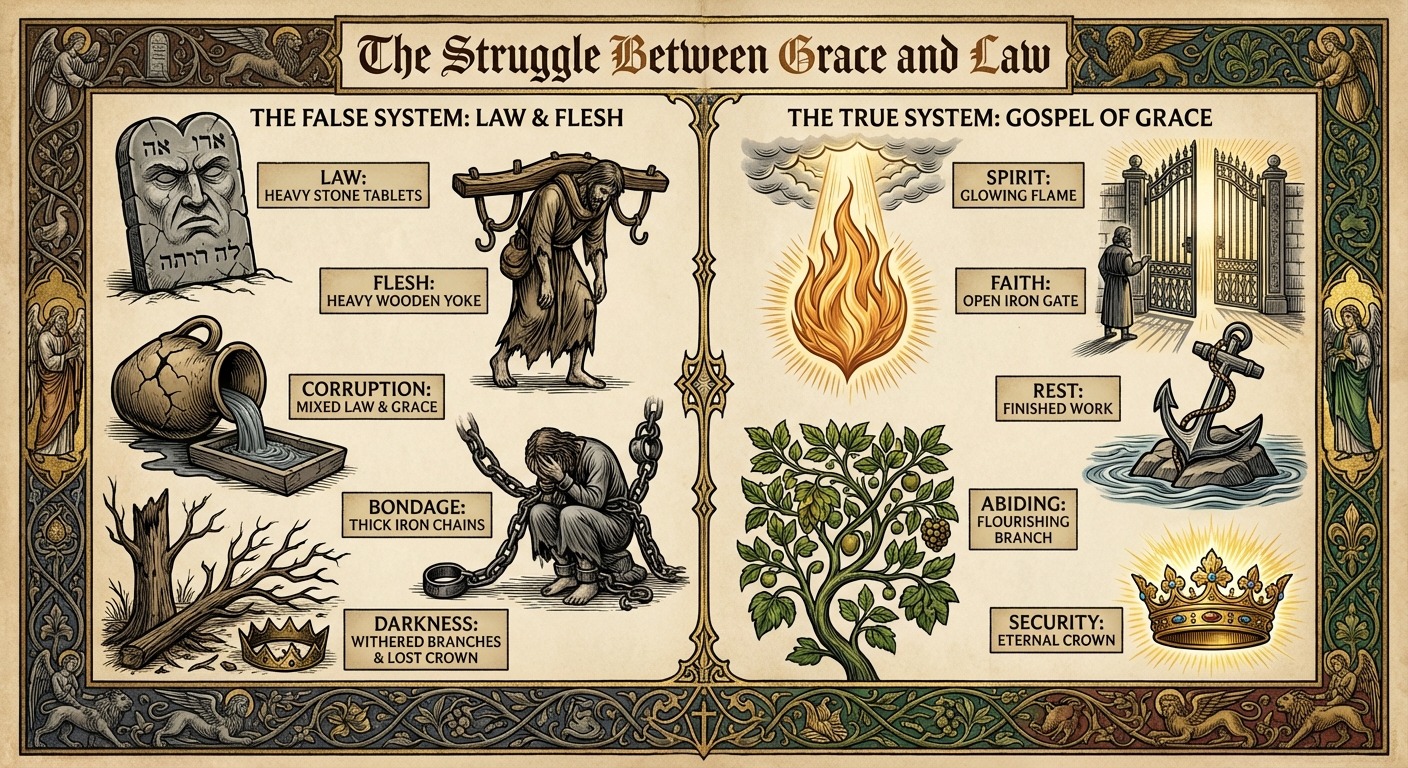
Click chart to view larger
From the teaching in: Galatians - Christ in Me As Life - the Spirit as the Blessing of the Gospel
Galatians 3:1-3
Grace vs. Law
Galatians 3:1-3 -- Grace vs. Law
This chart shows the structure. What follows explains each part.
Having seen how the old religious system of the flesh stands in opposition to the heavenly reality of Christ, we now turn to examine the precise mechanics of that conflict. This chart focuses on Galatians 3:1-3, where Paul exposes the fundamental, irreconcilable opposition between two operating principles: the Law, which demands performance from the flesh, and Grace, which supplies the Spirit through faith. Here, the abstract contrast becomes a practical diagnostic for the Galatians'—and our own—spiritual condition.
Paul's question to the Galatians -- 'having begun in the Spirit, are ye now made perfect by the flesh?' -- is one of the most diagnostic sentences in the New Testament, because it exposes the precise logic of the Galatian error: not that they abandoned the gospel entirely, but that they tried to complete it by a different mechanism than the one that started it. The Galatians had begun well. The Spirit had come, the gospel had landed, there was genuine life. What happened next was not apostasy but a kind of spiritual downgrade dressed in the language of maturity and completion. Paul will not allow the downgrade to pass as progress.
Galatians 3:1-3
O foolish Galatians, who hath bewitched you, that ye should not obey the truth, before whose eyes Jesus Christ hath been evidently set forth, crucified among you? This only would I learn of you, Received ye the Spirit by the works of the law, or by the hearing of faith? Are ye so foolish? having begun in the Spirit, are ye now made perfect by the flesh?
The Two Systems: Law vs. Grace
The seed of all our struggles in Christianity can be traced to the contrast between the true Gospel of Grace and the false system of Law and Flesh. In Galatians, Paul exposes the mechanics of these two systems, showing how the path one follows determines either bondage or liberty.
The False System: Law and Flesh
The false system begins with the heavy stone tablets of the Law, which serve as a strict schoolmaster. As Galatians 3:24 states, "Wherefore the law was our schoolmaster to bring us unto Christ, that we might be justified by faith." Yet, when the law is not left behind at the coming of faith, it becomes a burden. The attempt to achieve perfection through human flesh follows, represented by the heavy wooden yoke. Paul warns in Galatians 5:1, "Stand fast therefore in the liberty wherewith Christ hath made us free, and be not entangled again with the yoke of bondage." The striving of the flesh under the law’s demands leads only to frustration and defeat.
This downward spiral does not end there. When law and grace are mixed, the result is a corrupted gospel, like murky water in a cracked clay vessel. Galatians 2:21 makes it plain: "I do not frustrate the grace of God: for if righteousness come by the law, then Christ is dead in vain." The mingling of law and grace does not purify but pollutes, causing spiritual confusion and instability. The inevitable result is spiritual bondage, depicted as thick iron chains. Paul describes those who attempt to be justified by the law as being "fallen from grace" (Galatians 5:4), cut off from the vitality of Christ’s provision.
The final outcome of the false system is darkness and loss. Withered branches, severed from the tree, and a tarnished, lost crown signify the spiritual death and forfeiture that come from relying on the flesh and the law. The believer finds himself outside the sphere of life and fruitfulness, lacking the assurance and glory that come only by grace.
The True System: Spirit and Grace
In contrast, the true system begins with the descent of the Spirit, a living, glowing flame that brings life and power. The believer steps through the open iron gate of Faith, leaving the schoolmaster behind. Paul’s testimony in Galatians 2:20 expresses this reality: "I am crucified with Christ: nevertheless I live; yet not I, but Christ liveth in me: and the life which I now live in the flesh I live by the faith of the Son of God, who loved me, and gave himself for me." Here, faith opens the way to a new kind of life, one grounded not in self-effort but in Christ’s finished work.
Resting in Christ is depicted as a solid, grounded anchor. The believer ceases from striving, anchored securely in what Christ has accomplished. This rest leads to abiding in grace, pictured as a flourishing, green branch securely grafted into a vibrant vine. The life of Christ flows through the believer, producing fruit and vitality. The sequence culminates in eternal security, represented by a radiant, untouchable golden crown. The believer’s hope is no longer uncertain or tarnished, but secure and glorious, rooted in the unchanging grace of God.
The Root of the Struggle
Thus, the root of all struggle in Christianity lies in the choice between these two systems. The law and flesh bring only bondage, corruption, and loss, while the Spirit and faith in Christ’s finished work bring rest, fruitfulness, and eternal security. The call of Galatians is to leave behind the schoolmaster and its yoke, and to abide in the grace that alone brings life and liberty.
What is now on the table is the full diagram of the two systems and their irreconcilable ends: the law and flesh route terminating in bondage, darkness, and a tarnished crown; the Spirit and faith route producing rest, the life of an abiding branch, and the security of an untouchable inheritance. The argument is structural and sequential -- each step of the wrong path produces the next bad fruit, and each step of the right one produces the next good fruit. But the perversion of the gospel is rarely announced as perversion. It usually arrives quietly, through people who look trustworthy. The next article examines exactly how that subtlety operates -- how the leaven gets into the lump.
Understanding the stark, functional opposition between law and grace sets the stage for seeing how easily this truth can be compromised in practice. Next, we will examine Paul's dramatic confrontation with Peter in Antioch, where a behavioral shift—a withdrawal from Gentile believers—threatened to rebuild the very wall of separation that Christ's grace had destroyed, demonstrating that the gospel can be contradicted by actions even when the theology is verbally affirmed.
Every chart in this series is free to explore online.
 Get the full chart set (PDF – $8)
Members get all PDFs included → Why Membership
Log in with an active membership to download printable PDFs on this site. Purchased on the shop? Access downloads from your shop account.
If you would like to help fund this work:
These charts are based on the following book:

Galatians - Christ in Me As Life - the Spirit as the Blessing of the Gospel
A biblical commentary on Galatians, exploring how Christ is revealed throughout Scripture. Deep theological insights for serious students of the Word.
View Related Book