
Visual Theology – Galatians
The Visual Theology charts are designed to help you see the structure and movement of Scripture. They highlight patterns, contrasts, and developments that are often difficult to hold together when reading line by line.
These charts show the structure of the argument. The accompanying articles develop each part in full.
This approach follows a long tradition of visual teaching in the Church. The well-known charts of Clarence Larkin helped many grasp the broad outline of Scripture. In the same spirit, these charts aim to make visible what the Word of God is revealing.
Charts and teaching notes for the book of Galatians. Select a chart below to view the image and article.
Click chart to view larger
From the teaching in: Galatians - Christ in Me As Life - the Spirit as the Blessing of the Gospel
Galatians Romans 9:8
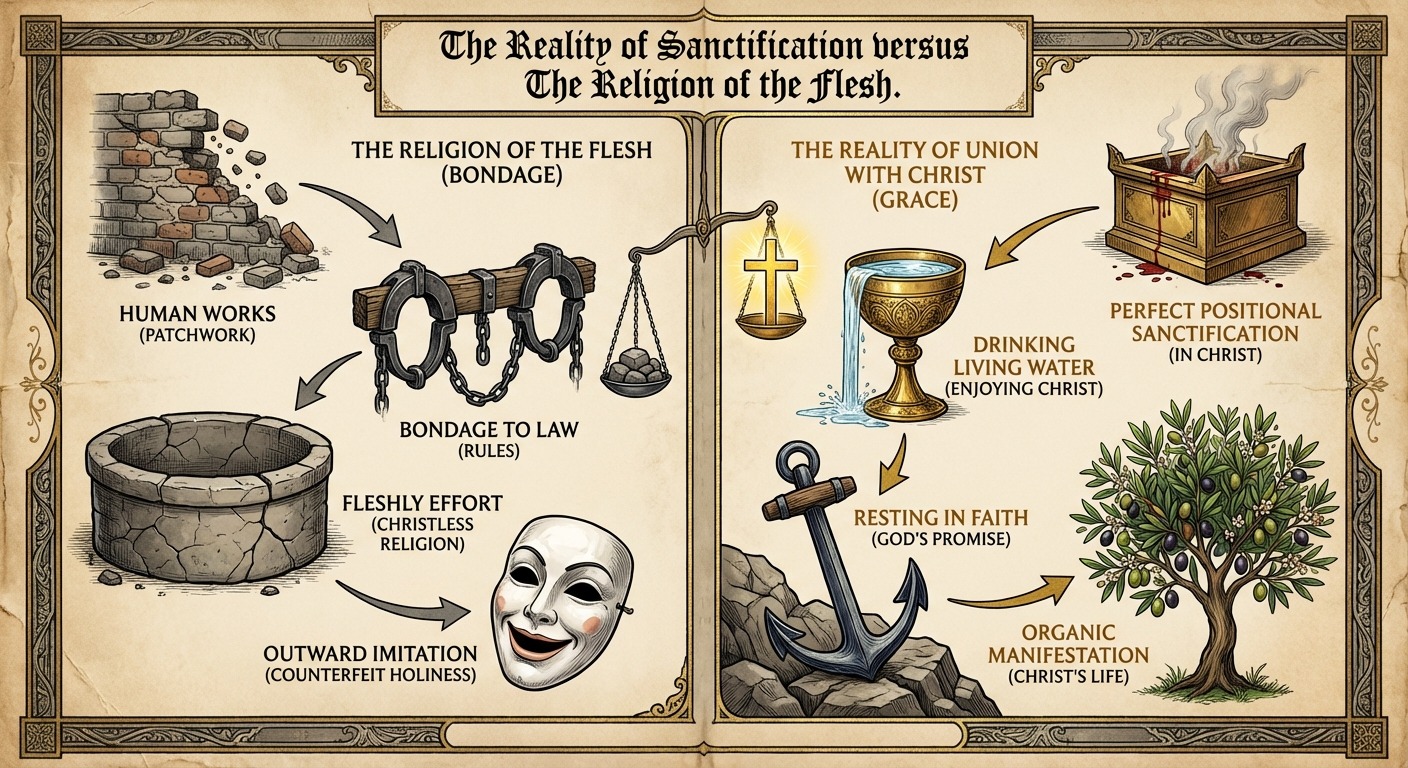
Sanctification by Faith vs. Religion of the Flesh
Galatians Romans 9:8 -- Sanctification by Faith vs. Religion of the Flesh
This chart shows the structure. What follows explains each part.
Having seen how Peter's behavior at Antioch contradicted the gospel of grace, we now turn to examine the two competing systems at work. This article moves from the specific confrontation to the underlying principles, contrasting the religion of human effort with sanctification that flows from faith in Christ alone.
Having watched the Antioch confrontation expose the gospel implications of table fellowship, the question naturally follows: what does living on the grace side of that confrontation actually look like? If sanctification is not a matter of observance and performance -- if the flesh's religion, however sincere, is the wrong instrument for the wrong job -- then what is the right instrument? Paul's answer is not 'try harder in the Spirit instead of in the flesh.' It is something more radical: the flesh's approach to holiness is not an inferior strategy; it is a contradiction of the gospel's terms. The article opens that contrast by mapping what each system produces.
Galatians Romans 9:8
They which are the children of the flesh, these are not the children of God: but the children of the promise are counted for the seed.
The Contrast in Galatians: Flesh vs. Spirit
The epistle to the Galatians presents a profound contrast between the religion of the flesh and the reality of sanctification by faith, or the manifestation of Christ as life. Paul exposes the mechanics of a Christless system, where the pursuit of holiness is built upon a patchwork of human works—a crumbling brick wall that cannot stand. This approach leads only to heavy iron yokes, symbolizing the bondage to law and outward rules, as he warns, “Stand fast therefore in the liberty wherewith Christ hath made us free, and be not entangled again with the yoke of bondage” (Galatians 5:1). The result of such striving is a dry, cracked stone cistern: fleshly effort that offers no living water, but only the barrenness of Christless religion.
This path of the flesh culminates in a hollow porcelain mask, a mere outward imitation or counterfeit holiness. Paul’s rebuke is pointed: “Are ye so foolish? having begun in the Spirit, are ye now made perfect by the flesh?” (Galatians 3:3). The religion of the flesh may produce an appearance of piety, but it is void of true life; it is an imitation, not a manifestation, of Christ.
The True System of the Spirit
In contrast, the true system of the Spirit begins not with human effort but with a blood-stained bronze altar—perfect positional sanctification in Christ, accomplished once for all. Here, the believer is crucified with Christ, and it is no longer the old self that lives, but Christ living in him: “I am crucified with Christ: nevertheless I live; yet not I, but Christ liveth in me” (Galatians 2:20). From this altar flows an overflowing golden chalice of water, signifying the continual drinking of the living water, the enjoyment of Christ Himself as the source of life.
This enjoyment leads to a deep ship’s anchor resting on bedrock, illustrating the believer’s rest in faith and in the unshakeable promise of God. The Christian life is not maintained by anxious striving, but by resting in what God has done. As Paul writes, “But now, after that ye have known God, or rather are known of God, how turn ye again to the weak and beggarly elements…?” (Galatians 4:9). To return to the old system is to abandon the anchor and drift into uncertainty.
The Organic Fruit of Union
The fruit of this union with Christ is not forced or artificial, but organic and effortless, like a vibrant, fruit-bearing olive tree. The manifestation of Christ’s life is the natural outflow of the Spirit’s work within: “But the fruit of the Spirit is love, joy, peace, longsuffering, gentleness, goodness, faith, meekness, temperance” (Galatians 5:22-23). This fruit is not the product of outward imitation, but the living reality of Christ formed in the believer.
Thus, Galatians draws the line between the patchwork and bondage of the flesh and the liberty and fruitfulness of life in Christ. Sanctification by faith is not a project of self-improvement or religious performance, but the outflow of union with the risen Lord. The believer’s calling is not to construct a mask, but to rest in Christ’s finished work and to enjoy His life, which alone produces true holiness.
The portrait is now complete: the patchwork approach to holiness -- patching the old garment with new material -- against the altar, the living water, the fruit that is the natural outflow of the Spirit's life rather than the hard-won achievement of the flesh. Sanctification by faith is not passive; it is simply sourced differently. But understanding the source requires going back one more time to the scene at Antioch, this time at greater depth, to understand exactly what the trouble from Jerusalem represented and why Paul's stand against it was a defense not of a theological position but of the truth of Christ itself.
With the stark contrast between fleshly religion and Spirit-led sanctification now established, we're prepared to see how these competing systems manifest in concrete community conflict. The next article returns to the historical narrative to examine how the 'trouble from Jerusalem' represents precisely this fleshly system in action.
Every chart in this series is free to explore online.
 Get the full chart set (PDF – $8)
Members get all PDFs included → Why Membership
Log in with an active membership to download printable PDFs on this site. Purchased on the shop? Access downloads from your shop account.
If you would like to help fund this work:
These charts are based on the following book:

Galatians - Christ in Me As Life - the Spirit as the Blessing of the Gospel
A biblical commentary on Galatians, exploring how Christ is revealed throughout Scripture. Deep theological insights for serious students of the Word.
View Related Book