
Visual Theology – Galatians
The Visual Theology charts are designed to help you see the structure and movement of Scripture. They highlight patterns, contrasts, and developments that are often difficult to hold together when reading line by line.
These charts show the structure of the argument. The accompanying articles develop each part in full.
This approach follows a long tradition of visual teaching in the Church. The well-known charts of Clarence Larkin helped many grasp the broad outline of Scripture. In the same spirit, these charts aim to make visible what the Word of God is revealing.
Charts and teaching notes for the book of Galatians. Select a chart below to view the image and article.
Click chart to view larger
From the teaching in: Galatians - Christ in Me As Life - the Spirit as the Blessing of the Gospel
Galatians Matthew 21:33-39
Seizing vs. Receiving the Inheritance
Galatians Matthew 21:33-39 -- Seizing vs. Receiving the Inheritance
This chart shows the structure. What follows explains each part.
Having established that our standing before God is an inheritance received, not a wage earned, we now confront a critical question: how do we actually approach this inheritance? The previous article contrasted the systems of Law and Grace, showing that we are children, not laborers. This article examines the two postures available to us: seizing versus receiving. Using the parable of the wicked tenants, we will see how religious effort represents an attempt to seize what can only be given, a rejection of the Heir Himself.
The inheritance promised to Abraham's Seed is real, substantial, and certain -- confirmed by God's own oath, ratified in Christ's blood, sealed in His resurrection. But there are two fundamentally different ways to approach an inheritance, and only one of them corresponds to what an inheritance actually is. The first is seizing: deciding that the promise is yours, identifying what it would look like, and going out to take it by your own effort and strategy. Abraham did this with Hagar. The result was Ishmael -- real, living, significant, but not the promised seed. The second is receiving: agreeing with God about what He has promised, confessing your own inability to produce it, and waiting in faith for Him to do what He said He would do.
Galatians Matthew 21:33-39
Hear another parable: There was a certain householder, which planted a vineyard, and hedged it round about, and digged a winepress in it, and built a tower, and let it out to husbandmen, and went into a far country. And when the time of the fruit drew near, he sent his servants to the husbandmen, that they might receive the fruits of it. And the husbandmen took his servants, and beat one, and killed another, and stoned another. Again, he sent other servants more than the first: and they did unto them likewise. But last of all he sent unto them his son, saying, They will reverence my son. But when the husbandmen saw the son, they said among themselves, This is the heir; come, let us kill him, and let us seize on his inheritance. And they caught him, and cast him out of the vineyard, and slew him. When the lord therefore of the vineyard cometh, what will he do unto those husbandmen? They say unto him, He will miserably destroy those wicked men, and will let out his vineyard unto other husbandmen, which shall render him the fruits in their seasons. Jesus saith unto them, Did ye never read in the scriptures, The stone which the builders rejected, the same is become the head of the corner: this is the Lord's doing, and it is marvellous in our eyes? Therefore say I unto you, The kingdom of God shall be taken from you, and given to a nation bringing forth the fruits thereof. And whosoever shall fall on this stone shall be broken: but on whomsoever it shall fall, it will grind him to powder. And when the chief priests and Pharisees had heard his parables, they perceived that he spake of them. But when they sought to lay hands on him, they feared the multitude, because they took him for a prophet. And Jesus entered into Jerusalem, and into the temple: and when he had looked round about upon all things, and now the eventide was come, he went out unto Bethany with the twelve. And in the morning, as they passed by, they saw the fig tree dried up from the roots. Peter calling to remembrance saith unto him, Master, behold, the fig tree which thou cursedst is withered away. And Jesus answering saith unto them, Have faith in God. For verily I say unto you, That whosoever shall say unto this mountain, Be thou removed, and be thou cast into the sea; and shall not doubt in his heart, but shall believe that those things which he saith shall come to pass; he shall have whatsoever he saith. Therefore I say unto you, What things soever ye desire, when ye pray, believe that ye receive them, and ye shall have them. And when ye stand praying, forgive, if ye have ought against any: that your Father also which is in heaven may forgive you your trespasses. But if ye do not forgive, neither will your Father which is in heaven forgive your trespasses. And they come again to Jerusalem: and as he was walking in the temple, there come to him the chief priests, and the elders of the people, and say unto him, By what authority doest thou these things? and who gave thee this authority? And Jesus answered and said unto them, I also will ask you one thing, which if ye tell me, I in like wise will tell you by what authority I do these things. The baptism of John, whence was it? from heaven, or of men? And they reasoned with themselves, saying, If we shall say, From heaven; he will say unto us, Why did ye not then believe him? But if we shall say, Of men; we fear the people; for all hold John as a prophet. And they answered Jesus, and said, We cannot tell. And he said unto them, Neither tell I you by what authority I do these things. But what think ye? A certain man had two sons; and he came to the first, and said, Son, go work to day in my vineyard. He answered and said, I will not: but afterward he repented, and went. And he came to the second, and said likewise. And he answered and said, I go, sir: and went not. Whether of them twain did the will of his father? They say unto him, The first. Jesus saith unto them, Verily I say unto you, That the publicans and the harlots go into the kingdom of God before you. For John came unto you in the way of righteousness, and ye believed him not: but the publicans and the harlots believed him: and ye, when ye had seen it, repented not afterward, that ye might believe him. Hear another parable: There was a certain householder, which planted a vineyard, and hedged it round about, and digged a
The Two Paths of Inheritance
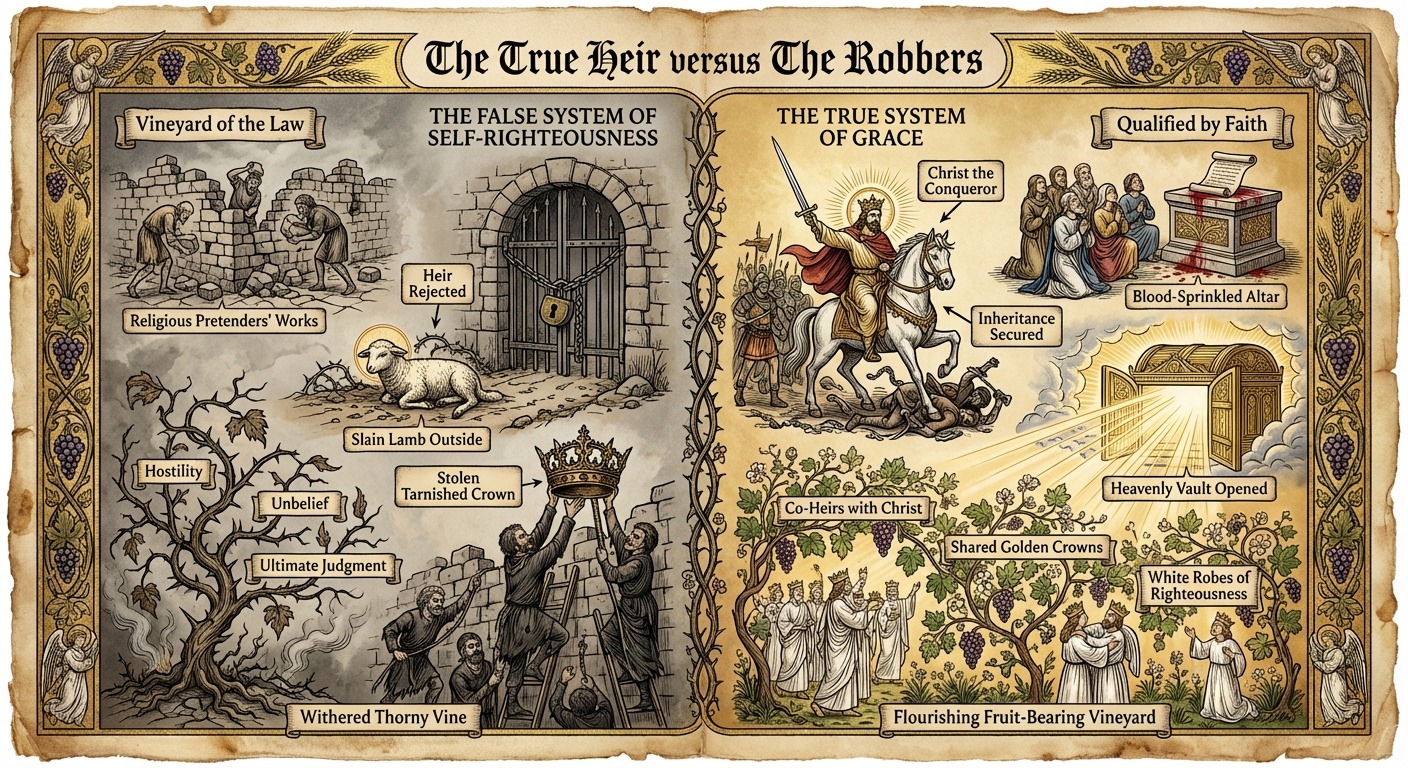
The epistle to the Galatians presents a stark contrast between two ways of seeking the inheritance promised by God: one rooted in the futility of self-righteousness, the other in the sufficiency of Christ as the true Heir. Paul confronts the error of those who, desiring the kingdom, attempt to occupy the Vineyard of the Law by constructing crumbling stone walls of their own works. These religious pretenders labor under the illusion that human effort and fleshly zeal can secure a place in the inheritance. Yet, in this system, the true Heir is rejected and cast out—a slain lamb outside a locked iron gate—mirroring the tragic pattern of those who, in seeking the promise, refuse the One to whom it rightfully belongs.
Such striving produces only a tarnished, heavy crown, the burden of law-keeping that cannot be borne. The rebellious husbandmen, seeking to seize what is not theirs, reap instead a withered, thorny vine of hostility and unbelief, culminating in judgment. As Paul writes, "For if the inheritance be of the law, it is no more of promise: but God gave it to Abraham by promise" (Galatians 3:18). The inheritance cannot be stolen by human effort; it is not the wage of the laborer, but the gift of the promise.
The System of Grace and Rest
In contrast, the true system of Grace is marked by rest and qualification through faith. Believers are found at a blood-sprinkled altar of promise, not striving but resting, their acceptance secured by the finished work of the slain Lamb. Christ Himself, the true Joshua and sole Heir, advances with a drawn sword to conquer the enemies of the land. The inheritance is not won by the strength or zeal of men, but by the victory of the Heir. "And if ye be Christ's, then are ye Abraham's seed, and heirs according to the promise" (Galatians 3:29).
The vault of heaven is opened by the true Heir, overflowing with light, and believers are brought in as co-heirs. They receive not a tarnished crown of their own making, but shared golden crowns and white robes of Christ's own righteousness. Inside the flourishing, fruit-bearing vineyard, the children of promise partake of the abundance secured by Another. "Wherefore thou art no more a servant, but a son; and if a son, then an heir of God through Christ" (Galatians 4:7).
The True Ground of Inheritance
Thus, the mechanics of inheritance are not grounded in the flesh, but in the blood and righteousness of the rejected yet triumphant Heir. Those who seek to seize the kingdom by works find only exclusion and judgment, while those who receive it in Christ are welcomed as co-heirs into the abundance of the promise. The epistle to the Galatians calls all who would inherit to lay aside the crumbling stones of self-righteousness and rest at the altar where the true Heir has already secured every blessing.
Seizing versus receiving -- the flesh's approach and faith's approach to the same inheritance -- is not a minor distinction in application. It determines what you end up with. The seized inheritance is always Ishmael: produced by natural effort, carrying the family resemblance, but not the promised seed. The received inheritance is always Isaac: born of promise, impossible by natural calculation, the one through whom the blessing flows to all nations. Having distinguished these two approaches to the inheritance, Paul now turns to the act that places the believer inside the covenant in the first place: baptism into Christ, and what that baptism means in terms of which covenant -- the everlasting or the new -- the believer actually inhabits.
Understanding that the inheritance is received, not seized, clarifies the posture of faith. But this raises a further question: into what exactly are we baptized when we receive it? The act of receiving places us into a specific covenant relationship with Christ. The next article will explore this precise location, distinguishing between the everlasting covenant of our heavenly inheritance and the new covenant of Israel's earthly promises.
Every chart in this series is free to explore online.
 Get the full chart set (PDF – $8)
Members get all PDFs included → Why Membership
Log in with an active membership to download printable PDFs on this site. Purchased on the shop? Access downloads from your shop account.
If you would like to help fund this work:
These charts are based on the following book:

Galatians - Christ in Me As Life - the Spirit as the Blessing of the Gospel
A biblical commentary on Galatians, exploring how Christ is revealed throughout Scripture. Deep theological insights for serious students of the Word.
View Related Book