
Visual Theology – Galatians
The Visual Theology charts are designed to help you see the structure and movement of Scripture. They highlight patterns, contrasts, and developments that are often difficult to hold together when reading line by line.
These charts show the structure of the argument. The accompanying articles develop each part in full.
This approach follows a long tradition of visual teaching in the Church. The well-known charts of Clarence Larkin helped many grasp the broad outline of Scripture. In the same spirit, these charts aim to make visible what the Word of God is revealing.
Charts and teaching notes for the book of Galatians. Select a chart below to view the image and article.
Click chart to view larger
From the teaching in: Galatians - Christ in Me As Life - the Spirit as the Blessing of the Gospel
Galatians 3:17-29
The Everlasting Covenant Confirmed in Christ
Galatians 3:17-29 -- The Everlasting Covenant Confirmed in Christ
This chart shows the structure. What follows explains each part.
Having established that God's covenant with Abraham was a unilateral oath secured entirely within the Godhead, we now confront the critical question this raises: what, then, was the purpose of the Law that came centuries later? This article directly addresses that tension, drawing a decisive line between the everlasting covenant of promise confirmed in Christ and the temporary, mediated system of the Mosaic Law.
The Everlasting Covenant is a category that sits above the Mosaic covenant and the New Covenant of Jeremiah -- it is the covenant of the oath, the promise made to the Seed, confirmed in Christ's blood and sealed in His resurrection. Paul's argument in Galatians is pressing toward a distinction that the Judaizers had collapsed: they treated all of God's covenantal dealings as one continuous tradition, with Christ as its climax and the church as the new Israel continuing Israel's obligations. Paul insists on a sharper line. The promise made before Sinai is not the same thing as the covenant given at Sinai, and the fulfillment of the promise in Christ is not the inauguration of a new Sinai. It is something of an entirely different order.
Galatians 3:17-29
And this I say, that the covenant, that was confirmed before of God in Christ, the law, which was four hundred and thirty years after, cannot disannul, that it should make the promise of none effect. For if the inheritance be of the law, it is no more of promise: but God gave it to Abraham by promise. Wherefore then serveth the law? It was added because of transgressions, till the seed should come to whom the promise was made; and it was ordained by angels in the hand of a mediator. Now a mediator is not a mediator of one, but God is one. Is the law then against the promises of God? God forbid: for if there had been a law given which could have given life, verily righteousness should have been by the law. But the scripture hath concluded all under sin, that the promise by faith of Jesus Christ might be given to them that believe. But before faith came, we were kept under the law, shut up unto the faith which should afterwards be revealed. Wherefore the law was our schoolmaster to bring us unto Christ, that we might be justified by faith. But after that faith is come, we are no longer under a schoolmaster. For ye are all the children of God by faith in Christ Jesus. For as many of you as have been baptized into Christ have put on Christ. There is neither Jew nor Greek, there is neither bond nor free, there is neither male nor female: for ye are all one in Christ Jesus. And if ye be Christ's, then are ye Abraham's seed, and heirs according to the promise.
The Law and the Everlasting Covenant of Promise
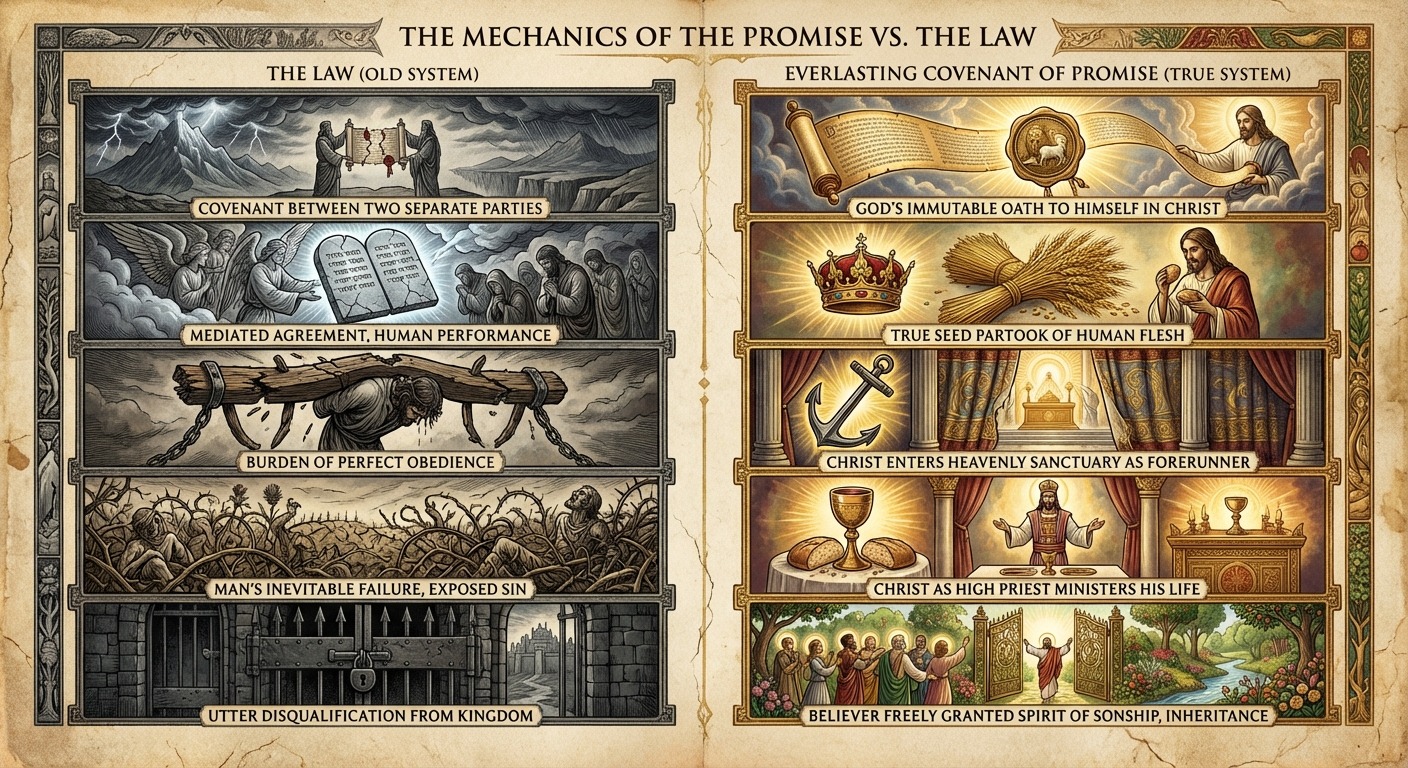
The epistle to the Galatians draws a decisive line between the Law and the Everlasting Covenant of Promise, revealing the true basis of the believer’s inheritance. Paul sets forth that the Law is a system characterized by a covenant between two separate parties, standing at a distance, as at a stormy mountain. This arrangement is mediated, requiring human performance and obedience to commandments delivered by angels, written upon heavy, cracking stone tablets. The Law thus imposes the burden of perfect obedience—a yoke too heavy and splintering for man to bear. Inevitably, this system exposes man’s failure and sin, leaving him in a barren field choked with thorns, unable to produce fruit for God. The end result is utter disqualification from the kingdom, as if a heavy iron gate were barred shut against all who would seek to enter by their own merit (cf. Galatians 3:10, “Cursed is every one that continueth not in all things which are written in the book of the law to do them”).
The Covenant of Promise in Christ
In stark contrast, the Everlasting Covenant of Promise is rooted not in human performance but in God’s own immutable oath to Himself in Christ. As Paul explains, “Now to Abraham and his seed were the promises made. He saith not, And to seeds, as of many; but as of one, And to thy seed, which is Christ” (Galatians 3:16, KJV). Here, God Himself is both the promiser and the fulfiller, binding the covenant with an unbreakable royal seal. The true Seed—Christ—partakes of human flesh to secure the inheritance, not by the striving of man, but by His own person and work.
Christ, as the forerunner, enters the heavenly sanctuary on behalf of those who are His. The anchor of hope is cast behind the veil, firmly secured, as Hebrews declares: “Which hope we have as an anchor of the soul, both sure and stedfast, and which entereth into that within the veil; Whither the forerunner is for us entered, even Jesus…” (Hebrews 6:19-20, KJV). In this capacity, Christ acts as our High Priest, ministering His own life to us—not demanding our performance, but offering Himself as the bread and wine, the substance of the New Covenant.
The Fruit of the Covenant
The fruit of this Everlasting Covenant is that the believer is freely granted the Spirit of Sonship and the inheritance itself. “Wherefore thou art no more a servant, but a son; and if a son, then an heir of God through Christ” (Galatians 4:7, KJV). The gate is now open into a flourishing, fruitful garden, where the life of Christ is ministered to the saints apart from works of the Law.
The Absolute Distinction
Thus, the inheritance is not attained by the Law’s demands or by man’s effort, but by the promise confirmed in Christ, the Seed. The Law, with its mediated agreement and heavy yoke, could only expose sin and bar the way to life. But the Everlasting Covenant, established by God’s own oath and fulfilled in Christ, secures the inheritance for all who are in Him, granting access and fruitfulness by the Spirit. The distinction is absolute: “For if the inheritance be of the law, it is no more of promise: but God gave it to Abraham by promise” (Galatians 3:18, KJV).
The Everlasting Covenant confirmed in Christ produces the Spirit of sonship -- not the spirit of servants governed by a mediated code, but sons who cry 'Abba, Father' because the Seed's own life is now theirs. That is the inheritance side of the covenant. But there is another side: the approach to that inheritance. The next article examines the two fundamentally different ways that the inheritance can be pursued -- seizing it by the flesh's effort, or receiving it through faith -- and why only one of those approaches corresponds to the covenant's own terms.
With the stark contrast between the Law's condemnation and the Promise's freedom now clearly drawn, a vital question emerges: what does it mean to live as a beneficiary of this everlasting covenant? The next article will explore the practical reality of receiving our standing before God not as a wage earned, but as an inheritance secured by Christ the Heir.
Every chart in this series is free to explore online.
 Get the full chart set (PDF – $8)
Members get all PDFs included → Why Membership
Log in with an active membership to download printable PDFs on this site. Purchased on the shop? Access downloads from your shop account.
If you would like to help fund this work:
These charts are based on the following book:

Galatians - Christ in Me As Life - the Spirit as the Blessing of the Gospel
A biblical commentary on Galatians, exploring how Christ is revealed throughout Scripture. Deep theological insights for serious students of the Word.
View Related Book