
Visual Theology – Galatians
The Visual Theology charts are designed to help you see the structure and movement of Scripture. They highlight patterns, contrasts, and developments that are often difficult to hold together when reading line by line.
These charts show the structure of the argument. The accompanying articles develop each part in full.
This approach follows a long tradition of visual teaching in the Church. The well-known charts of Clarence Larkin helped many grasp the broad outline of Scripture. In the same spirit, these charts aim to make visible what the Word of God is revealing.
Charts and teaching notes for the book of Galatians. Select a chart below to view the image and article.
Click chart to view larger
From the teaching in: Galatians - Christ in Me As Life - the Spirit as the Blessing of the Gospel
Galatians 2:11-14
Paul's Rebuke of Peter
Galatians 2:11-14 -- Paul's Rebuke of Peter
This chart shows the structure. What follows explains each part.
Having examined the confrontation at Antioch from the outside—seeing how Peter's withdrawal enacted a false gospel—we now turn to Paul's actual words in that moment. This article focuses on the precise theological mechanics Paul exposes in his rebuke: how fear-driven conformity creates a chain of hypocrisy that rebuilds walls Christ tore down. Here, Paul's argument becomes our text, showing that table fellowship is never neutral—it either embodies or denies the gospel of justification by faith alone.
The Antioch confrontation has been described from the outside and from the inside. Now Paul's words at that confrontation become the text -- because what he says to Peter's face is the precise argument that anchors the entire letter. The masks, the fear of the circumcision, the wall rebuilt between Jew and Gentile at a common table: these are not just sociological failures. They are theological statements. Every act of withdrawal implies a gospel, and the gospel Peter's behavior implied was one where a Gentile believer needed to become more like a Jewish one to be fully received. Paul will not let that implication stand, because it renders the cross unnecessary.
Galatians 2:11-14
But when Peter was come to Antioch, I withstood him to the face, because he was to be blamed. For before that certain came from James, he did eat with the Gentiles: but when they were come, he withdrew and separated himself, fearing them which were of the circumcision. And the other Jews dissembled likewise with him; insomuch that Barnabas also was carried away with their dissimulation. But when I saw that they walked not uprightly according to the truth of the gospel, I said unto Peter before them all, If thou, being a Jew, livest after the manner of Gentiles, and not as do the Jews, why compelest thou the Gentiles to live as do the Jews?
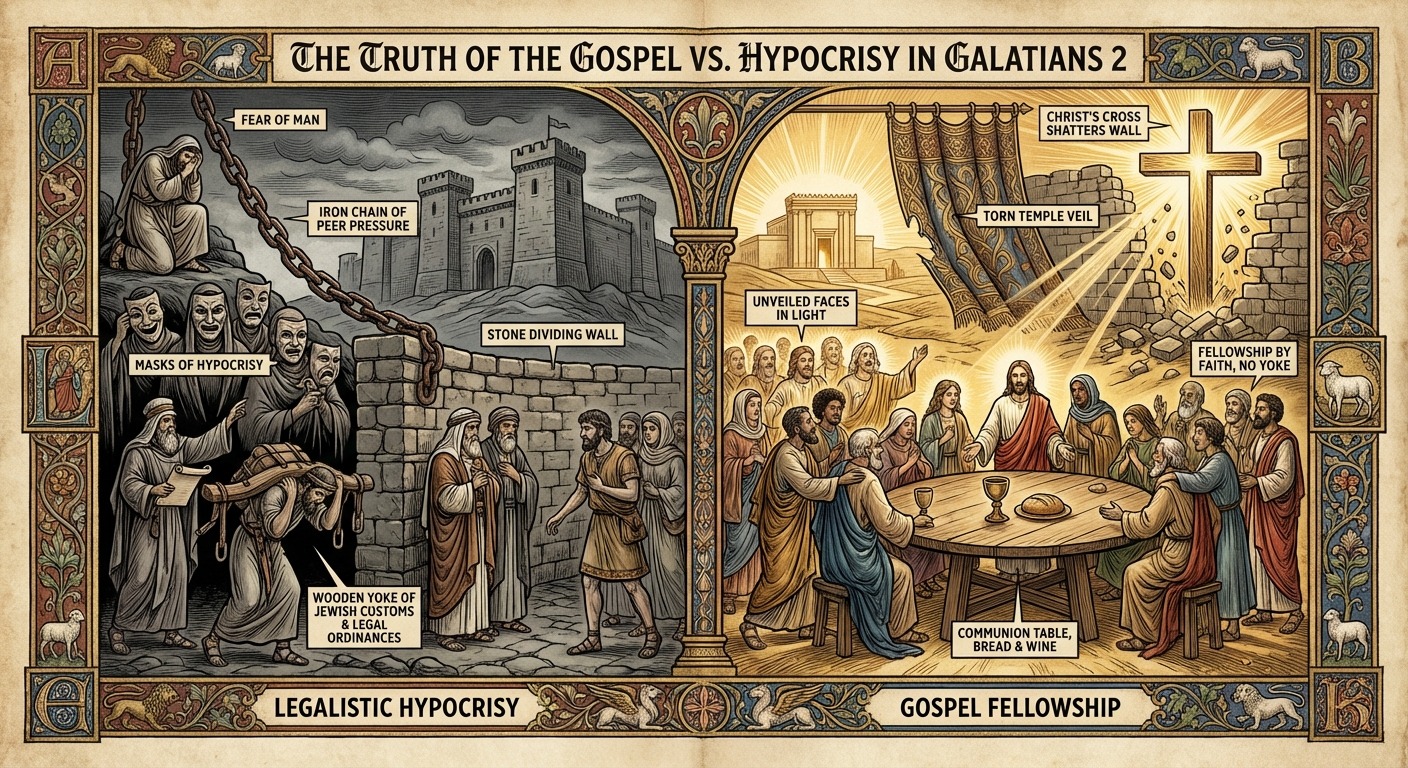
The Mechanics of Legalistic Hypocrisy vs. Gospel Fellowship
Paul’s rebuke of Peter in Galatians 2:11-14 exposes the underlying mechanics of Legalistic Hypocrisy and contrasts them with the reality of Gospel Fellowship.
The false system begins with the fear of man, which forges an iron chain of peer pressure. Under its weight, believers adopt theatrical masks of hypocrisy, hiding their true state and conforming outwardly to the expectations of others. This hypocrisy does not remain a private matter; it builds a thick stone dividing wall between groups, separating those who are deemed worthy from those who are not. The process culminates in laying a heavy wooden yoke of Jewish customs and legal ordinances on the shoulders of others, demanding conformity to external rules as the price of belonging and acceptance at the table of fellowship.
A Denial of the Gospel
Paul’s confrontation with Peter reveals that this system is not merely a matter of personal inconsistency, but a denial of the very heart of the gospel. When Peter withdrew from eating with Gentile believers out of fear for those “which were of the circumcision,” he participated in this chain of hypocrisy and division. The iron chain of peer pressure bound even Barnabas, leading him away from “the truth of the gospel” (Galatians 2:13). The stone wall erected between Jewish and Gentile believers contradicted the unity secured by Christ.
The True System of Gospel Fellowship
By contrast, the true system of Gospel Fellowship is established on the free gift of Christ’s cross. Through his sacrifice, the thick stone wall of division is shattered. The torn temple veil stands as a sign in the background, declaring the abolition of external ordinances that once separated people from God and from each other. As Paul declares, “Knowing that a man is not justified by the works of the law, but by the faith of Jesus Christ” (Galatians 2:16), believers are invited to stand equally with unveiled faces in the light, no longer hiding behind masks or compelled by fear.
In this fellowship, the gathering is around an open, shared wooden communion table, with bread and wine symbolizing the unity and acceptance that flow from Christ’s finished work. There is no longer a yoke of the law to bear; participation is not earned by conformity to customs or ordinances, but is secured entirely by faith. The gospel proclaims that “if righteousness come by the law, then Christ is dead in vain” (Galatians 2:21). Therefore, the community of believers is marked not by division and burden, but by freedom and equality, with all standing together as recipients of grace.
The Call to the Church
Paul’s rebuke thus calls the church to reject the iron chains, masks, walls, and yokes of Legalistic Hypocrisy, and instead to embrace the open fellowship of the gospel, where Christ’s cross has made all one and removed every barrier.
What Paul has now established through the Antioch narrative is the ground-level consequence of mixing law and grace: hypocrisy, fear, and a broken table. The argument has been biographical and historical up to this point -- Paul's own call, his independence from Jerusalem, the conflict with the Judaizers, the confrontation with Peter. Now the letter pivots decisively into doctrine. The next article takes up the formal question that all of this has been circling: how is a person actually justified before God? Not by the works of the law. But then how? The mechanics of justification by faith are the territory of Part Three.
Paul's rebuke has exposed the fatal contradiction between legalistic conformity and gospel fellowship. But what exactly is the alternative system? Having shown what the gospel destroys—walls, masks, and yorks—Paul must now define what it establishes. This leads directly into his foundational declaration of how a person is made right with God, which we examine next: the antithesis between justification by works of the law and justification by faith in Christ.
Every chart in this series is free to explore online.
 Get the full chart set (PDF – $8)
Members get all PDFs included → Why Membership
Log in with an active membership to download printable PDFs on this site. Purchased on the shop? Access downloads from your shop account.
If you would like to help fund this work:
These charts are based on the following book:

Galatians - Christ in Me As Life - the Spirit as the Blessing of the Gospel
A biblical commentary on Galatians, exploring how Christ is revealed throughout Scripture. Deep theological insights for serious students of the Word.
View Related Book