
Visual Theology – Galatians
The Visual Theology charts are designed to help you see the structure and movement of Scripture. They highlight patterns, contrasts, and developments that are often difficult to hold together when reading line by line.
These charts show the structure of the argument. The accompanying articles develop each part in full.
This approach follows a long tradition of visual teaching in the Church. The well-known charts of Clarence Larkin helped many grasp the broad outline of Scripture. In the same spirit, these charts aim to make visible what the Word of God is revealing.
Charts and teaching notes for the book of Galatians. Select a chart below to view the image and article.
Click chart to view larger
From the teaching in: Galatians - Christ in Me As Life - the Spirit as the Blessing of the Gospel
Galatians 1 Timothy 1:6-11
The Law Lawfully Exposing the Flesh
Galatians 1 Timothy 1:6-11 -- The Law Lawfully Exposing the Flesh
This chart shows the structure. What follows explains each part.
Having established that 'faith working by love' is the organizing principle of the Christian life, Paul now addresses a crucial follow-up question: What, then, is the purpose of the Law? This article examines the lawful use of the Law—not as a tool for righteousness, but as a mirror that exposes the flesh. We will see how the Law, when used correctly, does not produce life but reveals our need for the Spirit's supply, driving us back to the cross.
Paul's argument throughout Galatians is not that the law is sinful -- it is holy, just, and good. The problem is not the law but the use of the law: specifically, the attempt to use it as a mechanism for producing righteousness. There is, however, a lawful use of the law, and Paul names it: the law functions as a mirror that exposes the flesh -- its rebellion, its inadequacy, its inability to produce the life of God. When the law is used this way, it is not a path to righteousness but an exposure of the flesh that drives the believer back to the cross and to the supply of the Spirit. The article examines both uses and what each produces.
Galatians 1 Timothy 1:6-11
From which some having swerved have turned aside unto vain jangling desiring to be teachers of the law understanding neither what they say nor whereof they affirm but we know that the law is good if a man use it lawfully knowing this that the law is not made for a righteous man but for the lawless and disobedient for the ungodly and for sinners for unholy and profane for murderers of fathers and murderers of mothers for manslayers for whoremongers for them that defile themselves with mankind for menstealers for liars for perjured persons and if there be any other thing that is contrary to sound doctrine according to the glorious gospel of the blessed God which was committed to my trust.
The Law’s Burden and the Flesh’s Rebellion
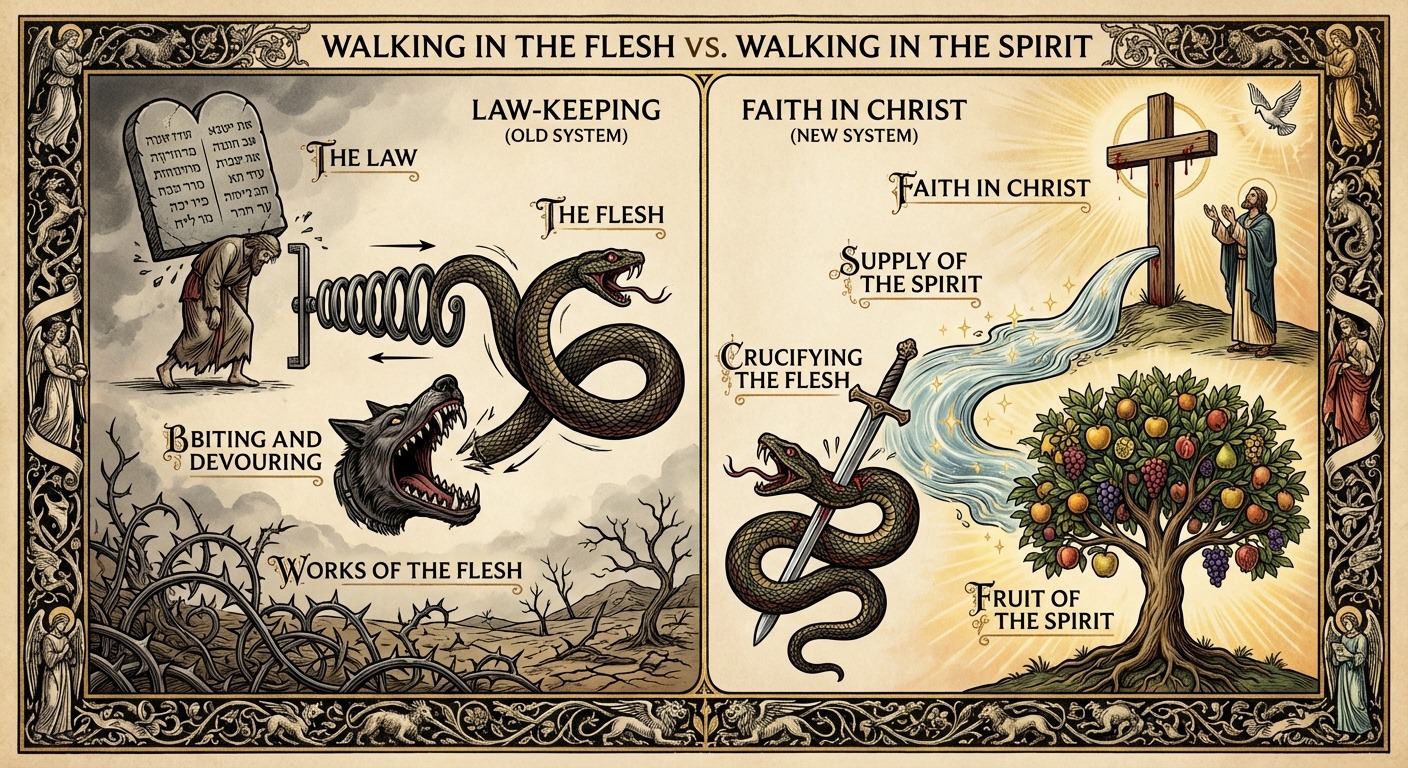
The Apostle Paul’s letter to the Galatians lays bare the true workings of the Law and the Gospel, revealing why sin is fundamentally at odds with the message of Christ. Paul shows that seeking righteousness by the Law places the believer under a heavy, crushing burden, likened to a stone tablet. This burden does not subdue sin; rather, it acts as a mechanism that arouses the flesh—a coiled, hissing serpent within. The Law, instead of producing life, exposes the restless activity of the flesh, stirring up its desires. As Paul writes, “For as many as are of the works of the law are under the curse” (Galatians 3:10), and again, “Are ye so foolish? having begun in the Spirit, are ye now made perfect by the flesh?” (Galatians 3:3).
The result of this dynamic is not righteousness but an eruption of envy, strife, and contention—depicted as snapping wolf jaws, biting and devouring one another. Paul warns, “But if ye bite and devour one another, take heed that ye be not consumed one of another” (Galatians 5:15). The landscape that emerges from this striving is barren, overrun with iron briars and thorns, the works of the flesh. These works are catalogued in Galatians 5:19-21: “Now the works of the flesh are manifest, which are these; Adultery, fornication, uncleanness, lasciviousness, Idolatry, witchcraft, hatred, variance, emulations, wrath, strife, seditions, heresies, Envyings, murders, drunkenness, revellings, and such like.”
The Gospel’s Power and the Spirit’s Supply
In stark contrast, the Gospel presents a new way: the believer’s sight is anchored not on the Law but on the blood-stained wooden cross of Christ. Faith in Him opens a channel for the supply of the Spirit, pictured as a river of clear water. This supply is not passive; it is the living power that enables the believer to crucify the flesh—here, a heavy iron sword pierces the serpent. This is not a mere suppression or self-effort, but the actual putting to death of the flesh’s power through the Spirit. Paul declares, “And they that are Christ’s have crucified the flesh with the affections and lusts” (Galatians 5:24).
The outcome of this new system is a flourishing, vibrant tree laden with ripe fruit—the fruit of the Spirit. Paul describes this in Galatians 5:22-23: “But the fruit of the Spirit is love, joy, peace, longsuffering, gentleness, goodness, faith, Meekness, temperance: against such there is no law.” The Gospel does not merely promise change; it actually works, producing what the Law could never accomplish. The believer is not left in a barren wilderness, but is made fruitful by the Spirit’s supply.
Sin Contrary to the Gospel
Thus, sin stands contrary to the Gospel, not only because it is forbidden, but because the Gospel is the only system that actually deals with sin—crucifying the flesh and producing true righteousness. The Law, for all its demands, only exposes and provokes the workings of the flesh. The Gospel, by faith in Christ and the supply of the Spirit, brings forth a new creation, abundant in the fruit that pleases God.
The law lawfully used exposes what the flesh is and what it cannot do -- and in doing so, it clears the ground for the Spirit to supply what the law could only demand. The flesh exposed, the cross applied, the Spirit flowing: this is the rhythm of the life Paul describes. But what does this look like in community? What does it mean for believers to relate to one another not as taskmasters wielding the law but as burden-bearers carrying one another in love? That is the final application Paul makes before his closing -- and it is the subject of the next article.
Understanding the Law's true function—to expose the flesh rather than justify it—sets the stage for a critical application. If the flesh is exposed and crucified by the Spirit, how does this transformation manifest in our relationships within the community of faith? The next article will contrast the harsh taskmasters produced by religious flesh with the gentle burden-bearers formed by the Spirit.
Every chart in this series is free to explore online.
 Get the full chart set (PDF – $8)
Members get all PDFs included → Why Membership
Log in with an active membership to download printable PDFs on this site. Purchased on the shop? Access downloads from your shop account.
If you would like to help fund this work:
These charts are based on the following book:

Galatians - Christ in Me As Life - the Spirit as the Blessing of the Gospel
A biblical commentary on Galatians, exploring how Christ is revealed throughout Scripture. Deep theological insights for serious students of the Word.
View Related Book