
Visual Theology – Galatians
The Visual Theology charts are designed to help you see the structure and movement of Scripture. They highlight patterns, contrasts, and developments that are often difficult to hold together when reading line by line.
These charts show the structure of the argument. The accompanying articles develop each part in full.
This approach follows a long tradition of visual teaching in the Church. The well-known charts of Clarence Larkin helped many grasp the broad outline of Scripture. In the same spirit, these charts aim to make visible what the Word of God is revealing.
Charts and teaching notes for the book of Galatians. Select a chart below to view the image and article.
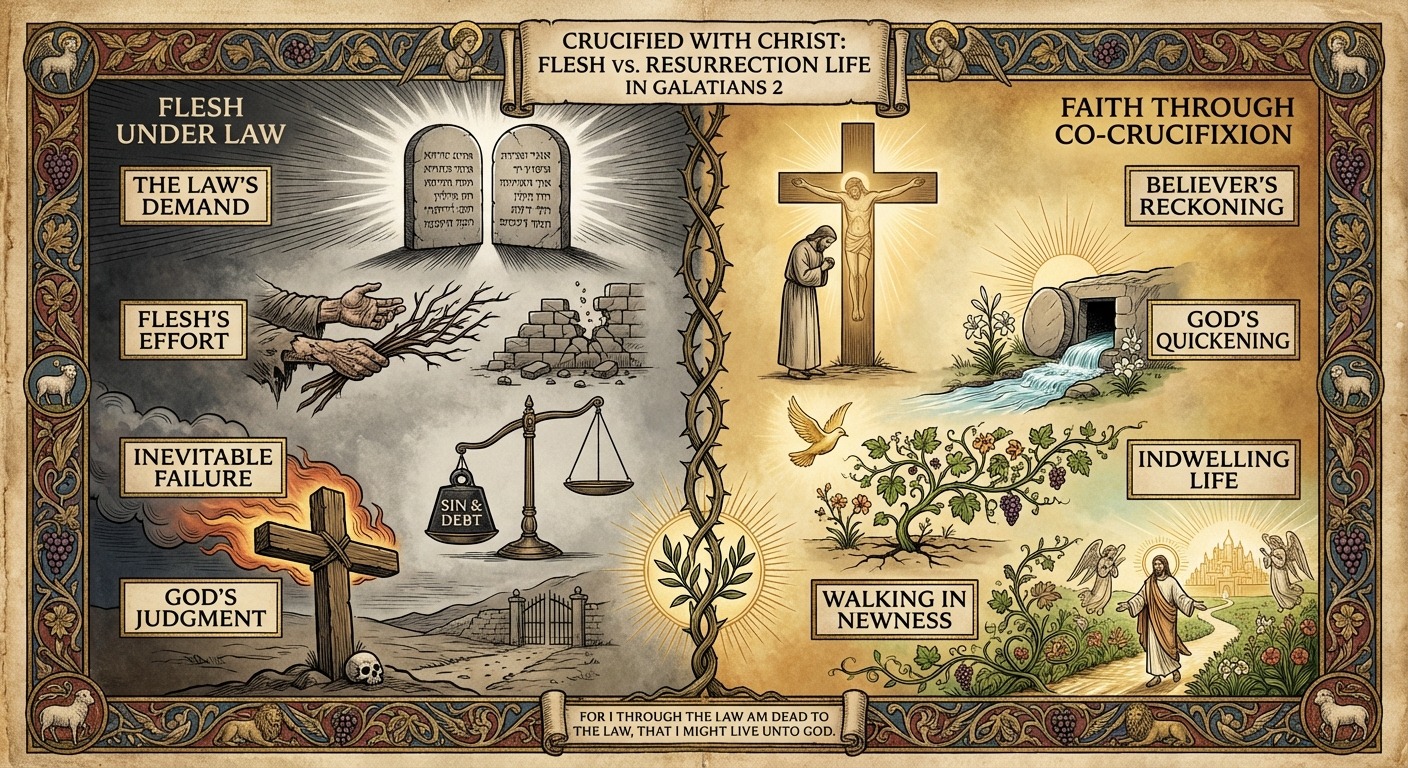
Click chart to view larger
From the teaching in: Galatians - Christ in Me As Life - the Spirit as the Blessing of the Gospel
Galatians 2:19-22
Galatians 2: Crucified with Christ
Galatians 2:19-22 -- Galatians 2: Crucified with Christ
This chart shows the structure. What follows explains each part.
Having established that our heavenly inheritance flows from being baptized into Christ under the everlasting covenant, we must now examine the foundational event that makes this union possible. This article focuses on the decisive moment of co-crucifixion described in Galatians 2:19-22, where the old self governed by law is executed, making way for Christ to live in us. Here, Paul reveals the interior mechanism of the shift from striving under law to living by faith.
Paul has pressed the Galatians' experience and Abraham's example. Now he returns to the decisive moment -- Galatians 2:20 again, but this time approached from the angle of the law's role and the cross's finality. The shift from law to life in Christ is not a gradual movement; it is a reckoning -- a decision to agree with what God has declared about who you are in Christ, and to treat the old self that the law was governing as something that has already been executed. The article is examining the interior mechanism of that shift: what it means to reckon yourself dead to sin and alive to God.
Galatians 2:19-22
For I through the law am dead to the law, that I might live unto God. I am crucified with Christ: nevertheless I live; yet not I, but Christ liveth in me: and the life which I now live in the flesh I live by the faith of the Son of God, who loved me, and gave himself for me. I do not frustrate the grace of God: for if righteousness come by the law, then Christ is dead in vain.
The Decisive Shift: From Law to Life in Christ
The epistle to the Galatians, particularly Galatians 2:19-20, sets forth a decisive contrast between the old system of the flesh under the law and the new way of living by faith through co-crucifixion with Christ. Paul declares, "For I through the law am dead to the law, that I might live unto God. I am crucified with Christ: nevertheless I live; yet not I, but Christ liveth in me: and the life which I now live in the flesh I live by the faith of the Son of God, who loved me, and gave himself for me" (Galatians 2:19-20, KJV). This statement encapsulates the radical shift from striving in the flesh to resting in the life of Christ.
The Old System: The Flesh Under Law
Under the old system of the flesh, the Law stands as heavy, unbroken stone tablets radiating a harsh light of demand. The Law is not merely a guide, but a relentless standard that exposes every failure. The flesh's effort to keep the law amounts to offering withered branches or constructing a crumbling stone wall—attempts that cannot bear fruit or endure the weight of divine requirement. The result of this striving is inevitable failure, as symbolized by an unbalanced scale of justice tipping downward, signifying the impossibility of attaining righteousness by human effort. The final mechanism in this system is God's judgment on the flesh, where the execution cross serves as a terminal roadblock—death is the only end for the flesh under the law's curse.
Paul's argument in Galatians 3:10-12 reinforces this: "For as many as are of the works of the law are under the curse: for it is written, Cursed is every one that continueth not in all things which are written in the book of the law to do them" (Galatians 3:10, KJV). The law demands perfect obedience, and the flesh is powerless to supply it, leading only to condemnation.
The New System: Faith and Co-Crucifixion
In contrast, the new system of faith is grounded in co-crucifixion with Christ. The believer's part is not striving, but reckoning—bowing passively in surrender at the base of the cross, acknowledging that the old man has been crucified with Christ. This reckoning is not an act of the will to improve the flesh, but a recognition of its death. Romans 6:6 affirms, "Knowing this, that our old man is crucified with him, that the body of sin might be destroyed, that henceforth we should not serve sin" (KJV).
The believer's surrender is met by God's part: the quickening. From the place of death, God causes a vibrant stream of living water to flow from the empty tomb, signifying resurrection life.
The Indwelling Life of Christ
This newness of life is not the product of human effort, but the indwelling life of Christ Himself. As a flourishing green vine springs up from barren ground, so the believer walks in newness of life, animated by the risen Christ. Paul writes in Romans 6:4, "Therefore we are buried with him by baptism into death: that like as Christ was raised up from the dead by the glory of the Father, even so we also should walk in newness of life" (KJV). The believer is no longer under the harsh light of demand, but under the gentle power of indwelling life.
The Governing Reality
Thus, the believer's experience is not a mixture of law and grace, flesh and Spirit, but a decisive break: dead to the law, living to God. The law's demands and the flesh's efforts end at the cross. What remains is the reckoning of our co-crucifixion and the daily experience of Christ living in us. "Not I, but Christ" becomes the governing reality, as the believer walks in the power of the quickened, indwelling life, free from the bondage of the old system and alive unto God.
The reckoning of faith -- agreeing with the verdict of the cross about the old self, and agreeing with the verdict of resurrection about the new one -- is the operative move that makes the rest of Galatians livable rather than merely arguable. Once the cross has been properly reckoned, the next question is practical: what is the supply that sustains this new life? Not the law's demands, which only expose what the flesh cannot do. Something else. Something that comes as a gift received rather than a wage earned. That is the subject of the next article: the supply of the Spirit.
Understanding that we have been crucified with Christ establishes the death of the old self, but it raises a vital practical question: what now supplies the power for this new life? If it is no longer our effort, what is the continuous source? This leads us directly to examine the role of the Holy Spirit as the dynamic supply that makes 'not I, but Christ' an experiential reality.
Every chart in this series is free to explore online.
 Get the full chart set (PDF – $8)
Members get all PDFs included → Why Membership
Log in with an active membership to download printable PDFs on this site. Purchased on the shop? Access downloads from your shop account.
If you would like to help fund this work:
These charts are based on the following book:

Galatians - Christ in Me As Life - the Spirit as the Blessing of the Gospel
A biblical commentary on Galatians, exploring how Christ is revealed throughout Scripture. Deep theological insights for serious students of the Word.
View Related Book