
Visual Theology – Galatians
The Visual Theology charts are designed to help you see the structure and movement of Scripture. They highlight patterns, contrasts, and developments that are often difficult to hold together when reading line by line.
These charts show the structure of the argument. The accompanying articles develop each part in full.
This approach follows a long tradition of visual teaching in the Church. The well-known charts of Clarence Larkin helped many grasp the broad outline of Scripture. In the same spirit, these charts aim to make visible what the Word of God is revealing.
Charts and teaching notes for the book of Galatians. Select a chart below to view the image and article.
Click chart to view larger
From the teaching in: Galatians - Christ in Me As Life - the Spirit as the Blessing of the Gospel
Galatians 3:1-5
Hearing of Faith vs. Works of the Law
Galatians 3:1-5 -- Hearing of Faith vs. Works of the Law
This chart shows the structure. What follows explains each part.
Having established that Abraham was justified by faith long before the law was given—and that seeking justification through law-keeping places one under its curse—Paul now turns the spotlight directly onto the Galatians' own experience. In this article, he confronts them with a piercing, personal question: How did you receive the Spirit? This moves the argument from biblical precedent to present reality, exposing the fundamental contrast between a system of human effort and the divine economy of faith.
The two systems Paul has been describing throughout Galatians -- law and Spirit, works and faith, flesh and promise -- do not only operate at the level of initial salvation or doctrinal stance. They operate in the daily experience of the Christian life, including and especially the experience of waiting. When God has made a promise and the promise has not yet been fulfilled, what do you do? The Galatians were in a version of this situation: the promise of the Spirit had come, but the Judaizers were now telling them that something more was required to secure it. Paul's response is to locate the Galatians' experience in the larger story of the two systems, and to show that the supply line of the Spirit runs through faith, not through law.
Galatians 3:1-5
O foolish Galatians, who hath bewitched you, that ye should not obey the truth, before whose eyes Jesus Christ hath been evidently set forth, crucified among you? This only would I learn of you, Received ye the Spirit by the works of the law, or by the hearing of faith? Are ye so foolish? Having begun in the Spirit, are ye now made perfect by the flesh? Have ye suffered so many things in vain? if it be yet in vain. He therefore that ministereth to you the Spirit, and worketh miracles among you, doeth he it by the works of the law, or by the hearing of faith?
The Two Systems: Law and Spirit
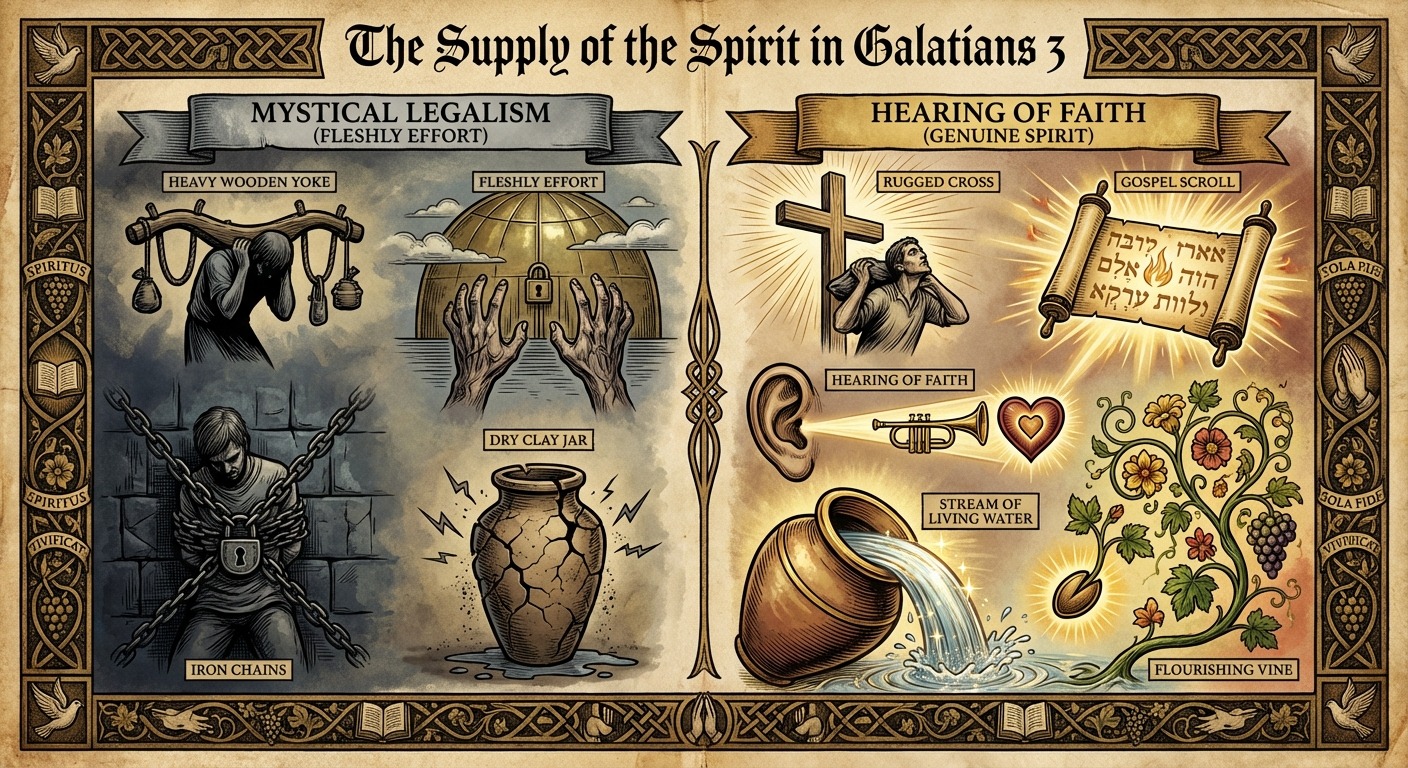
The epistle to the Galatians lays bare the profound distinction between two contrasting systems: the fleshly mechanics of mystical legalism and the genuine, spontaneous supply of the Spirit through the hearing of faith. Paul addresses the Galatians with the piercing question, “Received ye the Spirit by the works of the law, or by the hearing of faith?” (Galatians 3:2, KJV). This inquiry exposes the futility of attempting to perfect spiritual life through human effort and external observance.
The Burden of Mystical Legalism
Under the false system of mystical legalism, the believer is pictured as bearing a heavy wooden yoke of law-keeping and asceticism. This yoke represents the burden of striving to achieve righteousness and spiritual vitality by human performance. The soul, under this system, is driven to manufacture a spiritual encounter by fleshly effort, reaching upward with desperate hands toward a closed, brass sky—signifying the impenetrable barrier of self-imposed religious striving. Even as outward behavior is chained and restrained by sheer willpower, the core of the person remains untouched; the inner life is left as a dry, cracked clay jar, suffering from an unquenched, agonizing thirst. This inward barrenness is the inevitable result of relying upon the works of the law, which can only bind the exterior without imparting true life.
The Vitality of the Hearing of Faith
In contrast, the true mechanism of spiritual vitality is found in the hearing of faith. Here, the believer’s flesh is reckoned dead—a reality signified by the cross, which removes the oppressive burden of human performance. The Gospel is not a distant message but is actively proclaimed and preached to oneself, an unfurled, glowing scroll of truth that enters the heart. The word is not merely heard with the ears but is received by faith, as an open ear or golden trumpet brings the living voice directly to the inner man. In this posture of receptive faith, the Spirit is supplied spontaneously, not as a result of striving but as a rushing stream of living water pouring effortlessly into the open vessel of the soul.
This supply of the Spirit is not mere external restraint; it is a seed of glory that blossoms from within, growing into a flourishing vine. The transformation is organic and inward, not mechanical or imposed from without. As Paul declares elsewhere, “I am crucified with Christ: nevertheless I live; yet not I, but Christ liveth in me: and the life which I now live in the flesh I live by the faith of the Son of God, who loved me, and gave himself for me” (Galatians 2:20, KJV). The hearing of faith thus moves the believer out from under the yoke of law and into the liberty of the Spirit, where the inner thirst is quenched and the life of Christ is manifest.
The Ultimate Contrast
The contrast is therefore not merely between two methods, but between two realms: the dry futility of fleshly effort and the overflowing supply of the Spirit. The former binds and exhausts, leaving the soul barren; the latter liberates and fills, producing true, organic transformation from within. In Galatians, Paul calls the believer to forsake the heavy yoke of mystical legalism and to embrace the hearing of faith, where the Spirit is supplied and the seed of glory is given space to blossom.
The mystical legalism Paul describes here -- the attempt to leverage spiritual disciplines and observances as mechanisms for securing the Spirit's supply -- is a very precise form of the Galatian error, because it does not deny the Spirit; it simply reroutes the channel by which the Spirit is received. The believer who falls into this pattern is not apostate; they are just confused about the supply chain. The next article turns to the specific experience of waiting on God's promise in a season of apparent delay -- and the two very different approaches to that waiting that produce either the bondage of Ishmael or the freedom of Isaac.
By grounding the Christian life in the 'hearing of faith' rather than the 'works of the law,' Paul has established the ongoing, vital channel of the Spirit's supply. This sets the stage to examine what this faith looks like in practice, especially during seasons of waiting. Next, we will see how Paul uses the story of Abraham to illustrate the stark difference between waiting on God's promise by faith and striving to manufacture the promise through fleshly effort.
Every chart in this series is free to explore online.
 Get the full chart set (PDF – $8)
Members get all PDFs included → Why Membership
Log in with an active membership to download printable PDFs on this site. Purchased on the shop? Access downloads from your shop account.
If you would like to help fund this work:
These charts are based on the following book:

Galatians - Christ in Me As Life - the Spirit as the Blessing of the Gospel
A biblical commentary on Galatians, exploring how Christ is revealed throughout Scripture. Deep theological insights for serious students of the Word.
View Related Book