
Visual Theology – Galatians
The Visual Theology charts are designed to help you see the structure and movement of Scripture. They highlight patterns, contrasts, and developments that are often difficult to hold together when reading line by line.
These charts show the structure of the argument. The accompanying articles develop each part in full.
This approach follows a long tradition of visual teaching in the Church. The well-known charts of Clarence Larkin helped many grasp the broad outline of Scripture. In the same spirit, these charts aim to make visible what the Word of God is revealing.
Charts and teaching notes for the book of Galatians. Select a chart below to view the image and article.
Click chart to view larger
From the teaching in: Galatians - Christ in Me As Life - the Spirit as the Blessing of the Gospel
Galatians Romans 6:4-13
The Supply of the Spirit
Galatians Romans 6:4-13 -- The Supply of the Spirit
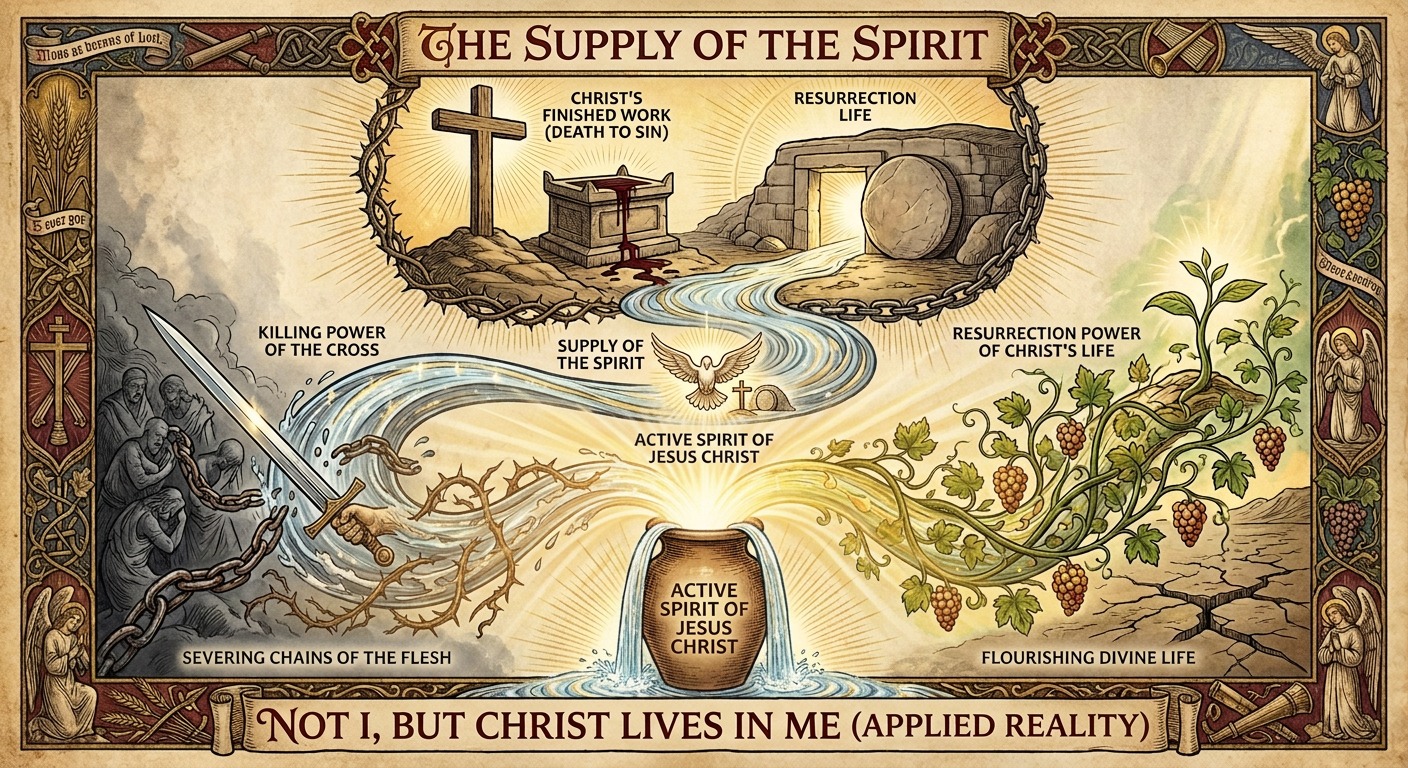
This chart shows the structure. What follows explains each part.
Having established the decisive reckoning of being co-crucified with Christ, we now turn to the practical question: what sustains this new life? If the old "I" is dead and Christ lives in me, what is the actual, daily supply that makes this truth an experiential reality? This article examines the Spirit as the singular, dynamic supply that applies the finished work of Christ—both its killing power and its enlivening power—directly to the believer.
Having established that the believer is co-crucified with Christ and that the life now lived is Christ's life received by faith, Paul asks a practical question: what actually sustains that? What is the supply line? The Galatians were being told, in effect, that the supply came through observance -- that keeping the law more carefully, returning to the calendar, submitting to circumcision, these were the mechanisms of spiritual health. Paul's counter-question is the one from chapter three: did you receive the Spirit by the works of the law, or by the hearing of faith? The article turns that question into a full examination of the Spirit as the life of Christ, supplied continuously through faith rather than earned through performance.
Galatians Romans 6:4-13
Therefore we are buried with him by baptism into death that like as Christ was raised up from the dead by the glory of the Father, even so we also should walk in newness of life. For if we have been planted together in the likeness of his death, we shall be also in the likeness of his resurrection: knowing this, that our old man is crucified with him, that the body of sin might be destroyed, that henceforth we should not serve sin. For he that is dead is freed from sin. Now if we be dead with Christ, we believe that we shall also live with him: knowing that Christ being raised from the dead dieth no more; death hath no more dominion over him. For in that he died, he died unto sin once: but in that he liveth, he liveth unto God. Likewise reckon ye also yourselves to be dead indeed unto sin, but alive unto God through Jesus Christ our Lord. Let not sin therefore reign in your mortal body, that ye should obey it in the lusts thereof. Neither yield ye your members as instruments of unrighteousness unto sin: but yield yourselves unto God, as those that are alive from the dead, and your members as instruments of righteousness unto God. For sin shall not have dominion over you: for ye are not under the law, but under grace.
The Spirit as the Life of Christ
The Spirit is the Life of Christ for the believer, not as a distant doctrine, but as an immediate and active supply. In Galatians, Paul grounds the believer’s daily walk not in self-effort, but in the living application of Christ’s finished work. The historical realities of Christ—His death upon a wooden cross and the open, empty tomb—are not merely events of the past, but the very foundation of the believer’s present experience. The cross stands for His death to sin and the purging of all that is contrary to God, while the empty tomb proclaims the power of His resurrection life.
The Supply of the Spirit
This finished work is not left as a static accomplishment. Rather, it is brought into the believer’s life by the Supply of the Spirit. Paul describes this supply as the active, personal Spirit of Jesus Christ, who brings the realities of the cross and the resurrection directly into the experience of those who believe. In Galatians 3:2-5, Paul asks, “Received ye the Spirit by the works of the law, or by the hearing of faith?... He therefore that ministereth to you the Spirit, and worketh miracles among you, doeth he it by the works of the law, or by the hearing of faith?” The answer is clear: the Spirit is supplied not by human effort, but by faith in what Christ has accomplished.
This supply is not passive. The Spirit applies two distinct aspects of Christ’s work.
1. The Killing Power of the Cross
First, there is the killing power of the cross. Through the Spirit, the reality of the cross becomes effective in the believer, severing the chains and thorns of the flesh. The “old man” is put to death, not by striving, but by the power of Christ’s death applied by the Spirit. As Paul testifies in Galatians 2:20, “I am crucified with Christ: nevertheless I live; yet not I, but Christ liveth in me.” The believer’s union with Christ in His death is made real by the Spirit, who executes the judgment of the cross upon the flesh.
2. The Impartation of Resurrection Life
Second, the Spirit imparts the resurrection power of Christ’s life. The same Spirit who brings the cross to bear upon the flesh also supplies the living, flourishing power of Christ’s resurrection. The believer is not left empty, but filled with new life. This is not a mere improvement of the old, but the impartation of Christ’s own risen life, active and fruitful. As Paul writes in Romans 6:4, “even so we also should walk in newness of life.” The Spirit is the channel through which this newness flows.
The Culmination: Christ Lived in Us
The culmination of this supply is that the believer, though an earthen vessel, is entirely filled with the living water of the Spirit. This is not theoretical, but practical and positional: “yet not I, but Christ liveth in me” (Galatians 2:20). The Spirit makes this a lived reality, so that the Christian life is not a matter of imitation, but of participation—Christ’s own life supplied and lived out within the believer.
Thus, the single flow of the Supply of the Spirit takes all that Christ has accomplished—His death to sin and His resurrection life—and applies it directly and continually to the believer. The Spirit is not an addendum to the gospel, but the very means by which Christ lives in His people, making the finished work of the cross and the empty tomb the daily experience of all who trust in Him.
The supply of the Spirit is continuous, abundant, and received by the same mechanism that received the Spirit in the first place: faith -- specifically the hearing of faith, which is not a passive reception but an active agreement with what God has said about His Son and about those who are in Him. The cross and the tomb applied moment by moment, the killing power of the cross at work on the flesh and the resurrection life flowing in through faith. But the same contrast that frames the supply of the Spirit -- hearing of faith versus works of the law -- is also the frame that Paul will apply to the entire season of waiting for God's promises. What does it look like to wait by faith rather than by seizing? That is the next stop.
Understanding the Spirit as the continuous supply for life in Christ raises a crucial question about how we receive and walk in that supply. If it comes not by works but by faith, what does that faith look like in practice, especially in seasons of waiting? This leads us directly to the next article, which explores the posture of waiting on God's promise versus the flesh's strategy of impatient striving.
Every chart in this series is free to explore online.
 Get the full chart set (PDF – $8)
Members get all PDFs included → Why Membership
Log in with an active membership to download printable PDFs on this site. Purchased on the shop? Access downloads from your shop account.
If you would like to help fund this work:
These charts are based on the following book:

Galatians - Christ in Me As Life - the Spirit as the Blessing of the Gospel
A biblical commentary on Galatians, exploring how Christ is revealed throughout Scripture. Deep theological insights for serious students of the Word.
View Related Book