
Visual Theology – Galatians
The Visual Theology charts are designed to help you see the structure and movement of Scripture. They highlight patterns, contrasts, and developments that are often difficult to hold together when reading line by line.
These charts show the structure of the argument. The accompanying articles develop each part in full.
This approach follows a long tradition of visual teaching in the Church. The well-known charts of Clarence Larkin helped many grasp the broad outline of Scripture. In the same spirit, these charts aim to make visible what the Word of God is revealing.
Charts and teaching notes for the book of Galatians. Select a chart below to view the image and article.
Click chart to view larger
From the teaching in: Galatians - Christ in Me As Life - the Spirit as the Blessing of the Gospel
Galatians 2:18-21
Destroying and Rebuilding the Law
Galatians 2:18-21 -- Destroying and Rebuilding the Law
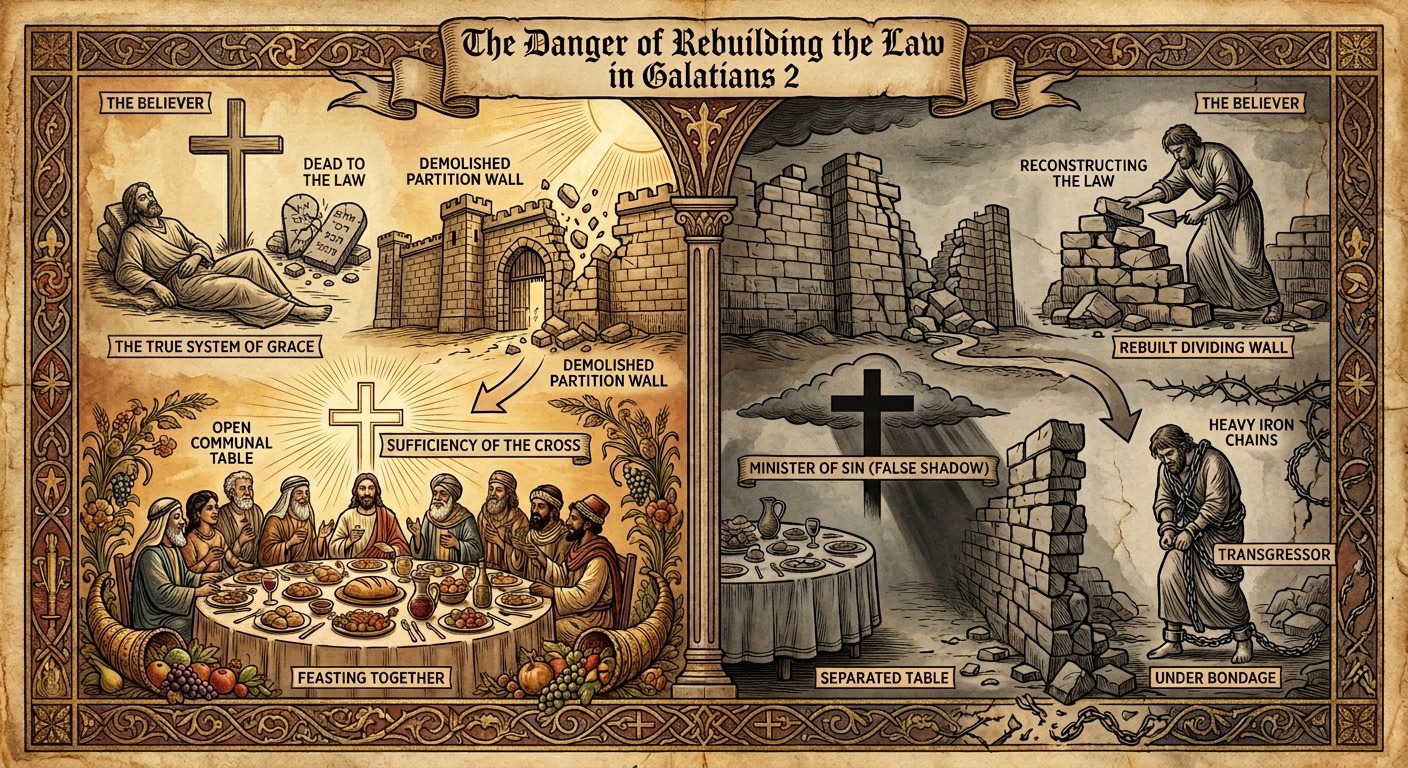
This chart shows the structure. What follows explains each part.
Having established that justification by faith does not make Christ a minister of sin, Paul now sharpens his argument to its logical conclusion. In this article, we examine the stark choice presented in Galatians 2:18-21: either we accept that our death to the law through Christ destroyed its condemning and dividing power, or we attempt to rebuild that very structure, making ourselves transgressors and nullifying grace.
Paul's argument has arrived at its sharpest edge: if justification is by faith in Christ, and if the law is what was left behind at the cross, then going back to the law is not merely a step backward -- it is a contradiction. It is the rebuilding of what was specifically destroyed so that something better could take its place. The rubble of the partition wall is not reconstruction material. To pick it up and start laying it again is to say, in effect, that what Christ did was insufficient -- that the old structure needed to come back up, that the death to the law was a mistake. Paul calls this 'frustrating the grace of God,' and the phrase is carefully chosen.
Galatians 2:18-21
For if I build again the things which I destroyed, I make myself a transgressor. For I through the law am dead to the law, that I might live unto God. I am crucified with Christ: nevertheless I live; yet not I, but Christ liveth in me: and the life which I now live in the flesh I live by the faith of the Son of God, who loved me, and gave himself for me. I do not frustrate the grace of God: for if righteousness come by the law, then Christ is dead in vain.
The Danger of Rebuilding What Was Destroyed
In Galatians 2:18-21, Paul confronts the critical distinction between what was destroyed through death to the law and the grave error of rebuilding it. The true system of grace, as Paul teaches, is grounded in the believer's death with Christ. Through that death, the law's authority over the believer ended — not because the believer broke the law or overpowered it, but because a dead person is no longer under its jurisdiction. In that death, the law's function as a dividing barrier — separating Jew from Gentile and all from the fullness of fellowship in Christ — was decisively ended. What remains is an open, communal table, where both Jews and Gentiles feast together, no longer separated by legal ordinances, but united under the sufficiency of the cross.
A Practical Denial: Peter's Example
Paul's confrontation with Peter in Galatians 2:11-14 illustrates the practical outworking of this doctrine. When Peter withdrew from eating with the Gentiles, he was, in effect, rebuilding the old dividing wall — reintroducing the separation that the cross had abolished. Such rebuilding is not a harmless return to tradition; it is a denial of the sufficiency of Christ's work. The cross is not to be shadowed by the law, for, as Paul declares, "I do not frustrate the grace of God: for if righteousness come by the law, then Christ is dead in vain" (Galatians 2:21, KJV).
The Transgressor and the Rebuilt Wall
To rebuild the law is to stack the broken stones back into a dividing wall — a reversal of the gospel's liberating work. The one who does so places himself back under heavy iron chains, becoming a transgressor. Paul's words are pointed: "For if I build again the things which I destroyed, I make myself a transgressor" (Galatians 2:18, KJV). The attempt to reconstruct the law does not restore righteousness; it exposes the builder as one who has abandoned the freedom and unity purchased by Christ.
The Sufficiency of the Cross
Under the true system of grace, the cross stands in full sufficiency. The destroyed partition wall means that all who believe, regardless of background, are welcomed to the same table. The law, as a barrier, was not merely set aside but ended through death, so that nothing remains to separate the people of God. Any return to the law as a means of righteousness is not only futile but casts a shadow over the cross — making Christ a minister of sin, as Paul warns against in Galatians 2:17.
Living in Gospel Freedom
Thus, the mechanics of dying to the law are not abstract. They result in a real, lived unity — a feast at the open table, where the only sufficiency is the cross of Christ. To rebuild the law is to reject this unity and to reimpose chains that Christ has already broken. The believer is called, therefore, not to reconstruct what was destroyed through death with Christ, but to live in the freedom and fellowship secured by the cross, where the dividing wall has been forever ended.
Death to the law through the law is the theological bedrock that Paul will not allow anyone to pour over with a new foundation. The cross is not the beginning of a new law-keeping project -- it is the end of the project of the self that needs a law to govern it. But what is the positive content on the other side of that death? What does the life look like that emerges from co-crucifixion with Christ? That is the territory the next article enters -- Galatians 2:20, the verse that may be the most concentrated statement of the entire Pauline gospel.
This destruction of the law's power is not an abstract theological point—it is the foundation for a new, shared life. Having seen the futility of rebuilding what Christ destroyed, we are now prepared to explore the positive reality that replaces it: the crucified and resurrected life described in the very next verses.
Every chart in this series is free to explore online.
 Get the full chart set (PDF – $8)
Members get all PDFs included → Why Membership
Log in with an active membership to download printable PDFs on this site. Purchased on the shop? Access downloads from your shop account.
If you would like to help fund this work:
These charts are based on the following book:

Galatians - Christ in Me As Life - the Spirit as the Blessing of the Gospel
A biblical commentary on Galatians, exploring how Christ is revealed throughout Scripture. Deep theological insights for serious students of the Word.
View Related Book